


If I Were Starting My Portfolio From Scratch Today, This Is the First ETF I'd Buy
Key Points
Dividend growth stocks have delivered the highest returns over the long term.
The Schwab U.S. Dividend Equity ETF focuses on high-yielding dividend-growth stocks.
The ETF has an exceptional performance track record.
- These 10 stocks could mint the next wave of millionaires ›
I've been investing for more than two decades. I've made a lot of mistakes along the way. Some of my biggest miscues have been chasing high-yield or high-growth stocks. One thing I've learned over the years is that the best investment strategy is to strike a balance between growth and yield.
Given those learnings, if I were starting my portfolio over from scratch today, the first thing I'd buy to anchor it would be the Schwab U.S. Dividend Equity ETF (NYSEMKT: SCHD). Here's why it's such a great foundational fund.
Missed Nvidia in 2009? This Rare Signal Is Flashing Again. In 2009, a "Double Down" signal flashed for a little-known chipmaker called Nvidia. For the first time in years, that same "Total Conviction" signal is flashing for a company 1/100th the size of Nvidia. Continue »

Image source: Getty Images.
Dividend growth trumps everything
One data set that has altered my investment mindset is the returns of stocks by their dividend policy. Hartford Funds publishes an annual report entitled: The Power of Dividends: Past, Present, and Future. One of the most impactful data sets is the average annual total returns and volatility of S&P 500 stocks by dividend policy:
|
Returns |
Beta |
Standard Deviation |
|
|---|---|---|---|
|
Dividend Growers & Initiators |
10.22% |
0.89 |
15.97% |
|
Dividend Payers |
9.20% |
0.94 |
16.71% |
|
No Change in Dividend Policy |
6.87% |
1.02 |
18.45% |
|
Dividend Cutters & Eliminators |
-0.96% |
1.22 |
24.80% |
|
Dividend Non-Payers |
4.21% |
1.18 |
21.91% |
|
Equal-Weighted S&P 500 Index |
7.74% |
1.00 |
17.55% |
Data source: Hartford Funds and Ned Davis Research.
As that data clearly shows, dividend growers and initiators have delivered far higher returns with less volatility than higher-yielding stocks (typically those with no change in their dividend policy or cutters and eliminators) and pure growth stocks (dividend non-payers). This data has led me to steadily shift my portfolio toward dividend growers.
The best dividend growers in a single fund
The Schwab U.S. Dividend Equity ETF provides targeted exposure to the highest-quality, high-yielding dividend growth stocks. The ETF tracks the Dow Jones U.S. Dividend 100 Index, which aims to measure the performance of 100 high-yielding dividend stocks with a history of consistent dividend payments. The index screens companies based on several dividend quality characteristics, including yield, five-year dividend growth rate, and financial strength.
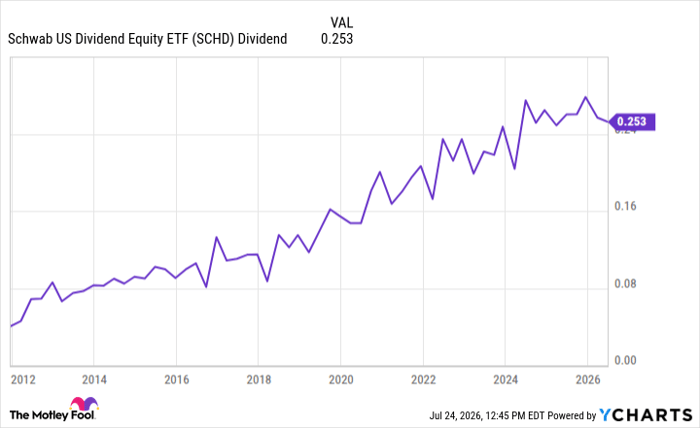
That growth screen is worth highlighting. The ETF has paid a steadily rising cash distribution since its inception in 2011:
SCHD Dividend data by YCharts
The fund has grown its payout at an 11.2% compound annual rate since 2017. Its current holdings have increased their payouts by a 9.4% compound annual rate over the past five years. That's an improvement from the 8.6% five-year dividend growth rate the fund's holdings had delivered before its last annual reconstitution in March.
The Schwab U.S. Dividend Equity ETF's focus on dividend growth has really paid off for investors over the years. It has delivered an average annualized total return of more than 12% over the past one-, three-, and 10-year periods, as well as since its inception in 2011 (13.1%).
Building a portfolio on the power of dividend growth
The Schwab U.S. Dividend Growth ETF is an ideal foundational holding for a new portfolio. It should deliver strong total returns with lower volatility over the long term. That's why it would be the first ETF I'd buy if I were building my portfolio from scratch today.
Where to invest $1,000 right now
When our analyst team has a stock tip, it can pay to listen. After all, Stock Advisor’s total average return is 896%* — a market-crushing outperformance compared to 206% for the S&P 500.
They just revealed what they believe are the 10 best stocks for investors to buy right now, available when you join Stock Advisor.
See the stocks »
*Stock Advisor returns as of July 26, 2026.
Matt DiLallo has positions in Schwab U.S. Dividend Equity ETF. The Motley Fool has no position in any of the stocks mentioned. The Motley Fool has a disclosure policy.
Recommended Articles


