


Every Time President Trump Talks About Iran, Oil Prices Move. Here's the Pattern Investors Should Watch.
Key Points
With the mid-term elections on the horizon, there are material political implications to a re-escalation of the Middle East conflict.
U.S. President Donald Trump has de-escalated tensions before as oil has risen above $100 per barrel.
Investors looking at the energy sector should consider taking a longer-term view when buying stocks.
- 10 stocks we like better than Chevron ›
Oil is on the rise again amid flaring tensions in the Middle East. That's not remotely shocking, given the Strait of Hormuz's importance. The Strait is effectively closed right now. Roughly 20% of the world's oil moves through that single sea passage, so the raging geopolitical conflict has upended the energy market.
While the conflict has been active for only a relatively short time, a trend appears to be emerging. When oil prices rise sharply, U.S. President Donald Trump de-escalates the conflict. There's no way to know if that will happen again, however, which is why long-term investors need to take a big-picture view of the energy sector with stocks like Chevron (NYSE: CVX) and ExxonMobil (NYSE: XOM).
Missed Nvidia in 2009? This Rare Signal Is Flashing Again. In 2009, a "Double Down" signal flashed for a little-known chipmaker called Nvidia. For the first time in years, that same "Total Conviction" signal is flashing for a company 1/100th the size of Nvidia. Continue »

Image source: The White House.
Predicting a geopolitical conflict is a risky investment approach
Donald Trump is well aware that mid-term elections are coming up later in 2026. He is also aware that the geopolitical conflict in the Middle East is affecting U.S. citizens economically and emotionally. The hotter the conflict rages, the worse the mood is likely to get in the United States. The worse the mood, the more likely that elections don't go well for the President.
With oil spiking again, recently breaking over $100 per barrel, consumers start to worry about rising costs. That feeds into fears around inflation, which is running hotter than the Federal Reserve would like right now. That could lead to a rate hike, which would fuel concerns about a recession. And all of that comes as voters will be heading to the polls in a few months, with control of the Senate and the House up for grabs.
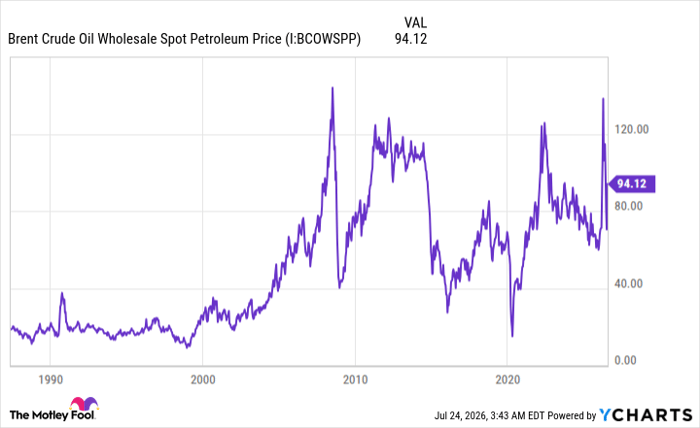
Brent Crude Oil Wholesale Spot Petroleum Price data by YCharts
It makes sense that Donald Trump would consider de-escalating the conflict to lower oil prices. Which appears to be something he's done before. However, as an investor, you should probably look at the bigger picture when considering investing in the energy sector. Historically, geopolitical events have gotten out of control before. There's no way to know what will actually happen this time around.
The energy sector is volatile
The unfortunate truth is that Wall Street is so focused on the short-term impact of the current geopolitical conflict that investors have lost sight of the long term. Wall Street tends to be myopic, so this isn't surprising, but the long-term truth is that the energy sector is inherently volatile. This is just another episode of volatility. It is headline-grabbing, but it isn't really unusual.
You could try to play the news-driven ups and downs in oil prices by buying and selling an upstream oil company like Devon Energy (NYSE: DVN). It operates in the U.S. market, so its production isn't impacted by the conflict. And its revenues and earnings will still benefit materially from higher energy prices. But it will also see revenues and earnings fall when energy prices fall. The stock is likely to trend along with energy prices if you believe you can predict the future of energy prices.
Most investors will be better off with a larger, more diversified energy investment, such as the integrated giants Exxon and Chevron. These companies are two of the world's largest energy businesses. While some of their production is directly impacted by the Middle East conflict, they have assets in other regions that are not. And they will benefit from rising oil prices, just as an upstream energy producer would. However, they also have midstream (pipeline) and downstream (chemical and refining) assets to help soften the blow when oil prices fall.
In addition, Exxon and Chevron have two of the strongest balance sheets in the integrated energy peer group. Exxon's debt-to-equity ratio is roughly 0.2x, while Chevron's is 0.25x. That gives each of these energy giants the wherewithal to take on debt during downturns to support their businesses and dividends.
Bet on reliable dividends, not energy prices
Chevron's dividend has been increased annually for 38 years. Exxon's dividend has been increased annually for 43 years. Those are incredible dividend records given the inherent volatility of the energy sector. It is a testament to the resilience of the two businesses across the entire energy cycle, not just the upside. That is a pattern worth following.
Most long-term investors should have some energy exposure given the important of oil and natural gas to the global economy. However, trying to time the political and geopolitical decisions of President Trump probably isn't the best investment approach when deciding on an energy stock. Most investors will be better off sticking with industry giants like Exxon and Chevron, focusing on their reliable dividend checks instead of oil prices. Right now, Chevron offers a 3.6% yield, with Exxon's 2.6% still well above the S&P 500 index's (SNPINDEX: ^GSPC) roughly 1% yield.
Should you buy stock in Chevron right now?
Before you buy stock in Chevron, consider this:
The Motley Fool Stock Advisor analyst team just identified what they believe are the 10 best stocks for investors to buy now… and Chevron wasn’t one of them. The 10 stocks that made the cut could produce monster returns in the coming years.
Consider when Netflix made this list on December 17, 2004... if you invested $1,000 at the time of our recommendation, you’d have $377,990!* Or when Nvidia made this list on April 15, 2005... if you invested $1,000 at the time of our recommendation, you’d have $1,269,518!*
Now, it’s worth noting Stock Advisor’s total average return is 896% — a market-crushing outperformance compared to 206% for the S&P 500. Don't miss the latest top 10 list, available with Stock Advisor, and join an investing community built by individual investors for individual investors.
See the 10 stocks »
*Stock Advisor returns as of July 25, 2026.
Reuben Gregg Brewer has no position in any of the stocks mentioned. The Motley Fool has positions in and recommends Chevron. The Motley Fool has a disclosure policy.
Recommended Articles


