


Want Exposure to the Fast-Growing Drone Market? Buy These 2 Stocks.
Key Points
Geopolitical conflicts are accelerating the need for cheap combat drones.
Experts estimate that the global drone market will more than double over the next decade.
The U.S. government is investing heavily in domestic drone production, including a $1 billion program aimed at reducing reliance on foreign suppliers and scaling low-cost military drones.
- 10 stocks we like better than Red Cat ›
The global drone market is soaring to new heights and is projected to more than double from $69 billion to $148 billion by 2036, according to business research firm IDTechEx. This explosive growth is being driven by geopolitical conflicts around the world, which have showcased the undeniable impact of low-cost drones.
The ongoing war between Ukraine and Russia has served as a demonstration of how drones have evolved from niche tools into dominant forces. With combat drones costing a few thousand dollars, Ukraine has proved that these aerial machines can neutralize multimillion-dollar tanks and armored vehicles.
Where to invest $1,000 right now? Our analyst team just revealed what they believe are the 10 best stocks to buy right now, when you join Stock Advisor. See the stocks »
For investors seeking exposure to the growing drone industry, Red Cat Holdings (NASDAQ: RCAT) and Kratos Defense & Security Solutions (NASDAQ: KTOS) are two drone stocks that stand out. Here's why.
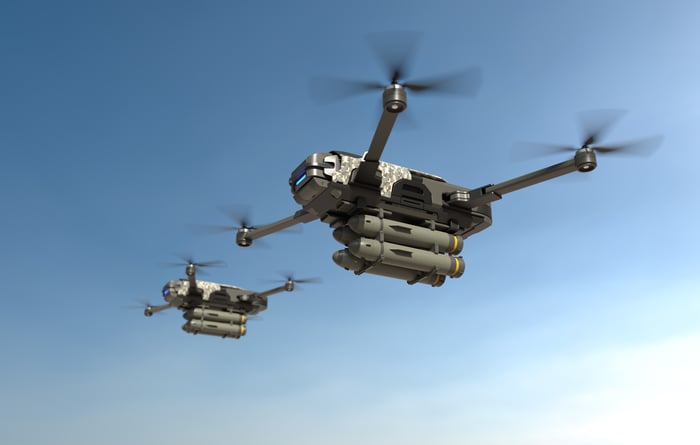
Image source: Getty Images.
The U.S. is aggressively expanding its drone program
As part of the U.S.'s efforts to "Unleash American Drone Dominance," the Pentagon has initiated a $1.1 billion program to mass-produce and field thousands of cheap drone systems costing between $3,000 and $5,000 to eliminate reliance on foreign sources and effectively counter adversaries.
As part of the program, the U.S. government is taking a new approach to how the military buys technology, shifting away from a slow bureaucratic contracting process toward merit-based field trials. The goal is to create a high-stakes testing ground where commercial manufacturers must prove the effectiveness of their drones in combat and their ability to scale to survive.
The program features "gauntlets" spread across four phases, which put manufacturers' equipment to the test in real-world battle scenarios. Here, drones are put into the hands of active-duty military pilots and front-line operators, who are given two hours to learn the systems and master controls before putting them into live simulated combat scenarios.
The first gauntlet was run in February this year and featured 25 companies. In addition, the phase two qualifier was held in Camp Grayling, Michigan, where 49 companies were tested for day and night navigation under complex radio-jamming and electronic warfare conditions.
Red Cat is moving forward in the drone dominance gauntlets
Red Cat's subsidiary, Teal Drones, was one of the companies selected to move on to the next phase of the gauntlet challenges. With its advancement, the company is the only publicly traded, pure-play drone stock that remains standing as part of the challenge.
Up next for Red Cat is proving it can manufacture and deliver 120 combat-ready kamikaze drones in a tight five-week window before the next gauntlet challenge at Fort Carson, Colorado, in August.
Kratos specializes in high-tech AI-powered drones
Kratos Defense was another company participating in the gauntlet challenges. However, the challenge's design favored agile companies with optimized supply chains built to deliver low-cost tactical drones quickly, and the company was eliminated after the phase two qualification stage.
But it's not over for Kratos by any means. The company specializes in high-end collaborative combat aircraft. Its XQ-58A Valkyrie is an AI-controlled autonomous aircraft that flies alongside manned fighter jets like the F-35. These units cost millions of dollars each and have large profit margins that smaller drone start-ups cannot compete with.
In January, the U.S. Marine Corps selected Kratos and partner Northrop Grumman to develop this wingman drone, which serves several roles, including conducting scout missions, absorbing enemy fire, jamming radar systems, and engaging enemy targets. And at a cost of $3 million to $4 million, it's drastically cheaper than an $80 million to $100 million F-35 fighter jet.
These two stocks provide investors with exposure to the growing drone industry
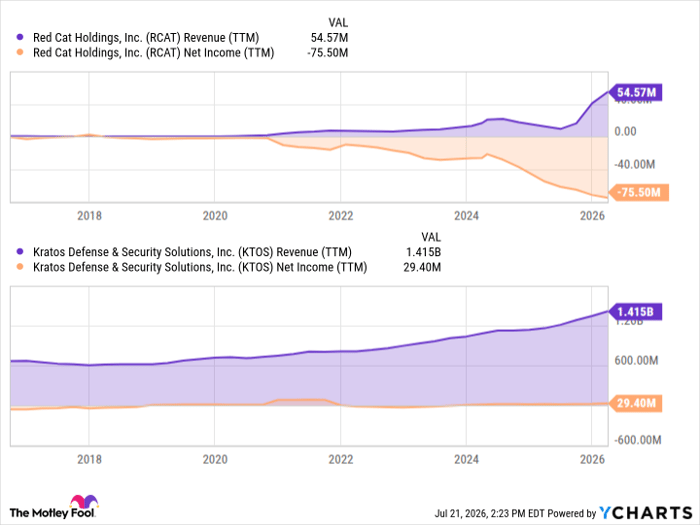
For investors seeking exposure to a pure-play drone start-up, Red Cat is emerging as an appealing option. But bear in mind that the stock carries significant risk, as it still has to navigate through the gauntlet of challenges ahead while spending big to scale up its manufacturing capabilities.
RCAT Revenue (TTM) data by YCharts
Kratos is a more established player with exposure to drones and other defense technologies, including infrastructure, software, electronic warfare, and propulsion systems across defense sectors. The company also faces high cash spend as it expands its facilities, but it has promising upside with its multibillion-dollar backlog.
As geopolitical tensions remain high and new technologies emerge, warfare is evolving, and the drone market is one area of rapid growth. For aggressive investors looking to capitalize on that long-term growth, Red Cat and Kratos are two drone stocks to invest in today.
Should you buy stock in Red Cat right now?
Before you buy stock in Red Cat, consider this:
The Motley Fool Stock Advisor analyst team just identified what they believe are the 10 best stocks for investors to buy now… and Red Cat wasn’t one of them. The 10 stocks that made the cut could produce monster returns in the coming years.
Consider when Netflix made this list on December 17, 2004... if you invested $1,000 at the time of our recommendation, you’d have $369,577!* Or when Nvidia made this list on April 15, 2005... if you invested $1,000 at the time of our recommendation, you’d have $1,301,557!*
Now, it’s worth noting Stock Advisor’s total average return is 908% — a market-crushing outperformance compared to 208% for the S&P 500. Don't miss the latest top 10 list, available with Stock Advisor, and join an investing community built by individual investors for individual investors.
See the 10 stocks »
*Stock Advisor returns as of July 23, 2026.
Courtney Carlsen has no position in any of the stocks mentioned. The Motley Fool has positions in and recommends Kratos Defense & Security Solutions. The Motley Fool has a disclosure policy.
Recommended Articles


