


Prediction: Micron Will Hit $1,400 in 2027. Here's the Math.
Key Points
Micron has seen demand for its memory chips skyrocket amid the AI boom.
Revenue is on track to continue climbing.
- 10 stocks we like better than Micron Technology ›
Micron Technology (NASDAQ: MU) has been one of the biggest artificial intelligence (AI) winners in recent times -- from an earnings and stock performance perspective. The company has seen revenue skyrocket amid demand for its memory solutions, and the stock has advanced 1,300% over the past three years. In the first half of this year, it climbed 300% and now trades at more than $900.
My prediction is Micron will reach $1,400 as early as next year -- here's the math.
Missed Nvidia in 2009? This Rare Signal Is Flashing Again. In 2009, a "Double Down" signal flashed for a little-known chipmaker called Nvidia. For the first time in years, that same "Total Conviction" signal is flashing for a company 1/100th the size of Nvidia. Continue »

Image source: Micron Technology.
A double-digit gain
If Micron climbs to $1,400, from today's level, that represents a gain of 44%, which isn't unusual for this stock. That also would put Micron at $1.5 trillion in market value. Using analysts' average revenue estimate for the current year of $129 billion, Micron would trade at a price-to-sales ratio of about 12. This is completely in line with the company's current P/S ratio.
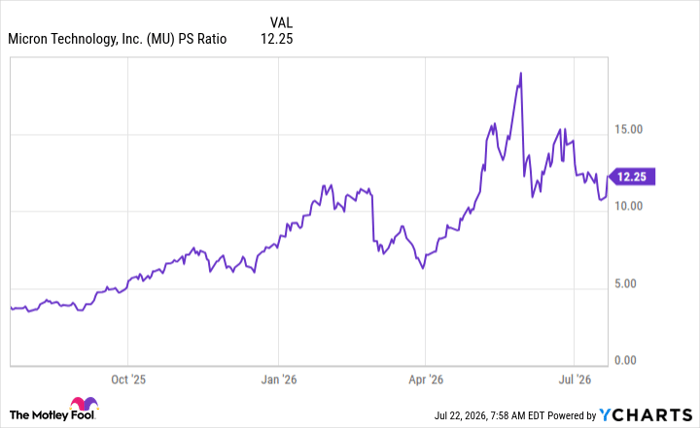
MU PS Ratio data by YCharts
So, the math works out, supporting the idea that Micron could reach this level. Importantly, the company's product offerings, earnings performance so far, and prospects are also pushing the stock in this direction. Micron is a leader in the memory and storage space, and these are key needs of AI customers. AI requires compute for calculations, but this goes hand in hand with memory and storage -- and as agentic AI is increasingly put to use, demand for Micron's products could see further growth. Agentic AI involves applying AI to real-world problems, with the AI taking a series of actions. This is seen as the next growth area in the AI market.
High levels of profitability
All of this has helped revenue take off in recent quarters, and the latest period offers us a great example. Revenue soared 345% to more than $41 billion, and this was accomplished at a high level of profitability on sales. Micron reported gross margin that exceeded 84% -- even topping chip giant Nvidia, which has steadily generated gross margins of more than 70%.
The current memory chip shortage, which Micron expects to continue past 2027, has pushed customers to rush to memory providers such as Micron to get their orders in -- and Micron has even established strategic customer agreements (SCAs) that offer great visibility on revenue to come. The company has completed 16 SCAs, with firm commitments for purchases over a period of years. Current SCAs will bring in $22 billion in financial commitments, according to Micron, and this may be just the beginning as the company aims to make these deals a central part of its business.
All of this supports my prediction that Micron stock will maintain its momentum and reach $1,400 by next year.
Should you buy stock in Micron Technology right now?
Before you buy stock in Micron Technology, consider this:
The Motley Fool Stock Advisor analyst team just identified what they believe are the 10 best stocks for investors to buy now… and Micron Technology wasn’t one of them. The 10 stocks that made the cut could produce monster returns in the coming years.
Consider when Netflix made this list on December 17, 2004... if you invested $1,000 at the time of our recommendation, you’d have $370,332!* Or when Nvidia made this list on April 15, 2005... if you invested $1,000 at the time of our recommendation, you’d have $1,272,280!*
Now, it’s worth noting Stock Advisor’s total average return is 904% — a market-crushing outperformance compared to 208% for the S&P 500. Don't miss the latest top 10 list, available with Stock Advisor, and join an investing community built by individual investors for individual investors.
See the 10 stocks »
*Stock Advisor returns as of July 23, 2026.
Adria Cimino has no position in any of the stocks mentioned. The Motley Fool has positions in and recommends Micron Technology and Nvidia. The Motley Fool has a disclosure policy.
Recommended Articles


