


Figma (FIG) Down 80% From Peak — 46% Revenue Growth, $30 Target
TradingKey - Figma (NYSE: FIG) ended Tuesday's trading at $21.95, a decline of 8.6%. The pullback came after the price sliced under the ascending trend line on the four-hour chart. Shares are off 80% from their high of $142.92 on the 52-week chart and down 37% YTD, after bottoming around $16.60 and rallying back. But the story is very different looking at the business fundamentals. In Q1 2026, revenues were $333.44 million, up 46% YoY vs $316 million estimated, 5.5% upside beat. The net dollar retention was 139%.
Management raised FY guidance to $1.422-$1.428 billion. The analyst average price target is $30.56 with Citi and BofA keeping Buy ratings. Q2 2026 earnings are scheduled to come out in August 5. RSI is near 40. The first technical support comes at $21.46 on the 100 EMA, and the second at $21.03.
The Disconnect: 80% Below Peak, 46% Revenue Growth
Figma's share price has tumbled to $21.95 from $142.92, meaning it now trades at about 8x forward revenues. That slide was partly driven by broader tech sector drag from rising rate fears, 9% operating margin guidance (which was reduced due to AI compute spend), and heavy insider selling. But business performance has been impressive.
Q1 2026 revenues of $333.44 million were 46% above the prior-year number and beating estimates of $316 million by 5.5%. Figma's net dollar retention rate hit 139%. The number of customers contributing $10,000 in annual recurring revenue increased 37% to 15,218.
Then, Figma lifted full-year guidance to $1.422 to $1.428 billion, fueled by enterprise expansion and a usage-based AI credits model. Q2 2026 earnings are expected to release on August 5. That's solid performance against the backdrop of a technical breakdown, which explains the average target of $30.56.
AI Credit Model and GPT-5.6 Integration — The New Revenue Layer
The most important strategic move for Figma this year was the introduction of a hybrid AI pricing model. Customers get a certain amount of AI credits included with their plans, but customers using a lot of it pay separately for additional credits if they run past those allowances. Management says more than 75% of enterprise customers who went over their included credits kept using AI.
That is early evidence of willingness for customers to pay for AI credits in addition to the baseline plan credits. That is important because AI can cut both ways for software companies: It can displace traditional design work that was generating new subscription growth for
companies, but it can also increase compute and infrastructure costs. By building AI credits on top of usage-based AI, Figma has created a potential revenue stream that could at least offset both potential negative sides.
On July 9, Figma added OpenAI's GPT-5.6 to Figma Make, which is Figma's prompt-to-prototype and application building product. That resulted in improved first-pass quality, faster iterations, more robust responsive layouts, and better error recovery. Figma Make now supports local codebases, reusable skills, Model Context Protocol connectors, design-system kits, annotations, and version history.
On July 16, Figma published a workflow that demonstrates how teams could connect Figma Make to production code, make design changes, then push those updates to GitHub. That shifts Figma's total addressable market from designers to developers and product managers, a significant expansion of the potential market if teams start using that workflow at scale in enterprise.
Analyst Targets and the August 5 Earnings Catalyst
Ten Wall Street analysts are tracking Figma: 5 with Buy ratings, 5 with Hold ratings, and none with Sell ratings. The average 12-month price target is $30.56, the high estimate is $38, and the lowest price target is $22. Citi initiated with a Buy rating. Bank of America has reinstated its rating with a Buy, stating that instead of rendering Figma less relevant with AI, AI is actually making Figma more useful.
RBC lowered Figma's price target to $22 from $28 and issued a Sector Perform rating on the stock after the company's Config 2026 conference. RBC sees near-term margin pressure on Figma because the company is spending so much on AI.
JPMorgan's analyst price target is $28. Piper Sandler's target has Figma turning profitable by the end of 2026. The key upcoming event for Figma will be the Q2 2026 earnings report, which is to come out August 5. Q2 guidance called for between $348 million and $350 million in revenue, above the $330 million Street consensus. If Q2 2026 revenues come within or above those targets and show consistent retention, the bull case for a run to $30 gets stronger.
FIG Technical Analysis: Trendline Break at $22.45, RSI 40, Key Levels
For the 4H chart with FIG having closed at $21.95, there is a break of the rising trendline. It is now below the 50 EMA at $22.45, obstructing the nearest support at the 100 EMA at $21.46. The following support would be at the key level of $21.03.
A confirmed close below $21.03 establishes $19.27 with a probable new support at $17.94. The bulls are required to break above $23.20 to start that process, with further resistance at $24.84. The 40 level RSI is on the edge of the oversold territory with no signals for a change.
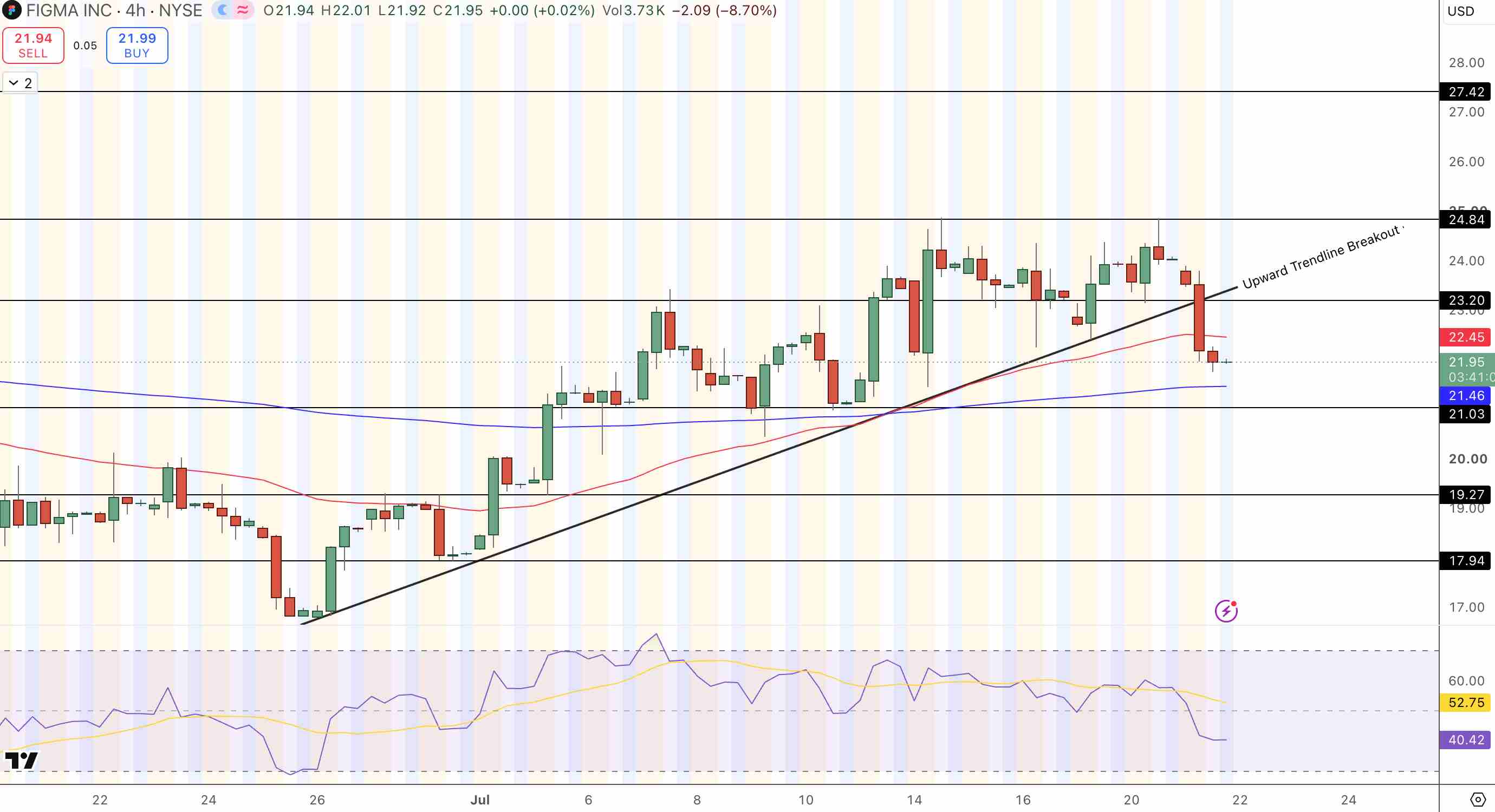
Figma (FIG) Price Chart - Source: Tradingview
Tuesday close was $21.95 with a decrease of 8.6%. The 52 week high was $142.92, with a low of $16.60, an 80% drop from its peak.
- For 2026 Q1, Revenue is pegged at $333.44M (+46% YoY, better than $316M est.). Expected Adj EPS is $0.10 (previously $0.06).
- Net retention is at 139% with the existing customers spending an average of 39% more than the last year. The $10K+ ARR customers are up by 37%.
- Expectations for Q2 earnings (August 5, 2026) revenue are at $348-$350M (lower than previously estimated $330M).
- Expected target is $30.56 with a high of $38 and a low of $22. Analysts rated 5 as Buy and 5 as Hold. No Sell ratings.
- Support is at $21.46 (100 EMA), $21.03, and below at $19.27. Resistance is at $23.20 and $24.84.
What is Figma Make and Its GitHub Value?
Figma Make is a new tool that allows design prototyping at a faster rate using AI and the GPT-5.6 model. The GitHub companion tool allows a team to link design changes directly to production code. This addition also allows Figma to expand into a developers workflow, and increase their Average Revenue Per User (ARPU) through more expensive subscriptions.
What to Watch at Q2 Earnings on August 5?
Investors need to watch the revenue guidance for the range of $348 million to $350 million, and whether net dollar retention remains close to 139%. Investors will also be watching to see what revenue will be from AI-Credit, as this will give a good measure of whether the new pricing model based on consumption will positively impact revenue.
Bottom Line
Figma closed Tuesday at $21.95 after breaking his upward trend-line and his Relative Strength Index was close to 40. The stock is up 80% from $142.92 - 52 week high, while quarterly revenue was up 46% and net dollar retention also increased to 139%. The 100 EMA at $21.46 and $21.03 are also supports to watch.
The first bullish sign would be a recovery to $23.20. The average analyst price target is $30.56, with a buy rating from Citi and BofA. The next major fundamental test will be on August 5 for Figma's Q2 earnings where they will be predicting revenue of $348 to $350 million, compared to a previous revenue estimate of $330 million.
Recommended Articles


