


TSMC Loses $400 Level: Wall Street Bullish Up to $650 but Still Hits Two-Month Low
TradingKey - Although TSMC ( TSM) had its target price raised by several institutions after recently releasing strong second-quarter earnings. However, TSMC's stock price still lost the $400 mark today, falling to its lowest point in nearly two months. As of writing, it was down 2.43% to $399.80.
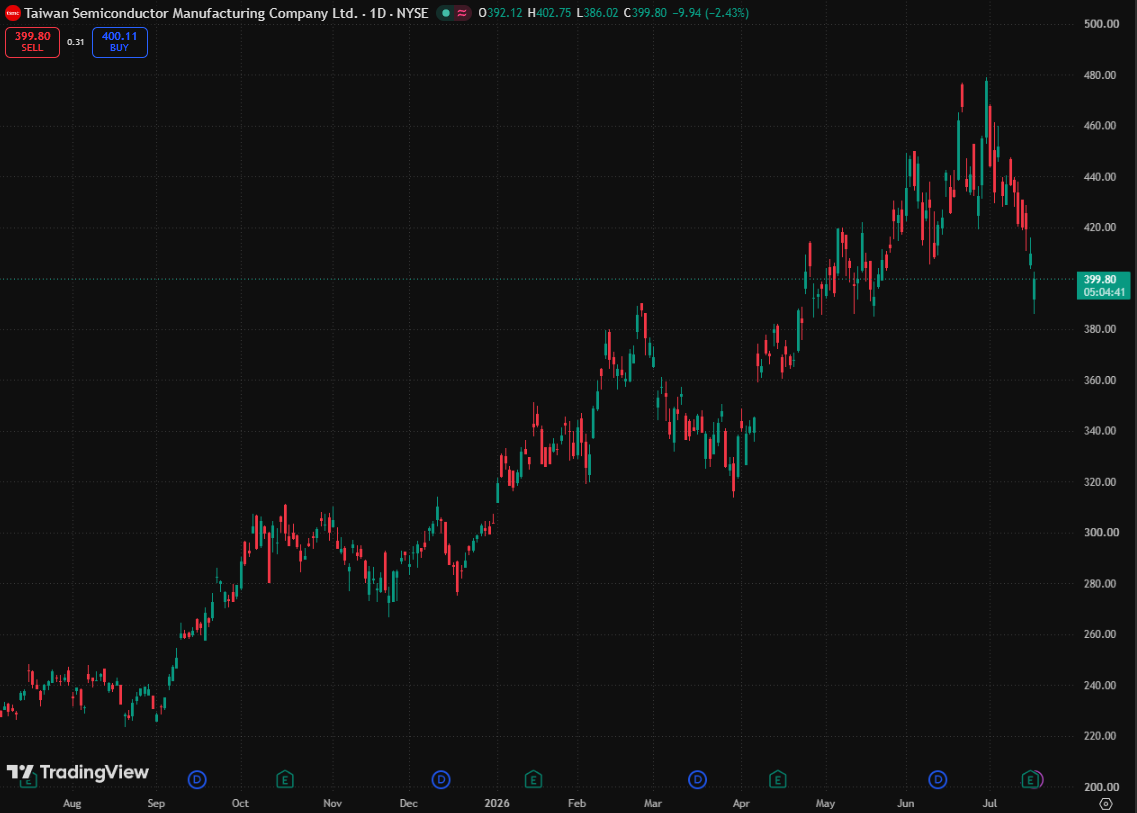
Source: TradingView
Data show that the company's second-quarter net profit increased by 77% year-on-year, while its revenue, gross margin, operating margin, and third-quarter revenue guidance all comprehensively exceeded market expectations. Meanwhile, the proportion of advanced processes continued to rise, and AI-related orders remained the largest growth driver.
As of July 17, 7 analysts have rated TSMC, with the highest target price at $650, representing approximately 62% upside from the current price; the lowest target price is $430, representing about 7% upside, with an average target price of $516.67.
Among them, D.A. Davidson raised its target price on TSMC from $450 to $500 and maintained a "Buy" rating. TD Cowen analyst Krish Sankar raised his target price on TSMC from $400 to $440 and maintained a "Hold" rating. Barclays raised its target price on TSM stock from $625 to $650 and maintained an "Overweight" rating, considering the earnings report positive overall.
All three institutions pointed out that due to the continuous growth in AI demand, TSMC's revenue expectations for 2026 are higher than anticipated. They also believe that the increase in TSMC's capital expenditures is higher than market expectations, reflecting strong demand in the AI market in 2027.
Meanwhile, chip stocks continued to fall today, with Intel ( INTC) falling 3.04%, AMD ( AMD) falling 2.08%; Nvidia ( NVDA ), Qualcomm ( QCOM ), Broadcom ( AVGO) and Marvell Technology ( MRVL) all falling more than 1%.
Multiple investment banks believe that TSMC's upward revision of its full-year outlook not only means its own growth momentum is further strengthening, but will also boost confidence across the entire AI semiconductor industry chain, with segments such as semiconductor equipment, advanced packaging, and memory expected to continue to benefit.
Although the gross margin guidance was slightly lower than some optimistic expectations, institutions generally believe that this primarily reflects temporary pressure from the mass production of new processes and does not alter the fundamental logic of long-term upward demand for AI.
Recommended Articles


