


Netflix (NFLX) Stock Plunges 8% After Q3 Guidance Disappoints — Is $65 the Next Stop?
TradingKey -Netflix (NASDAQ: NFLX) is changing hands at $67.63 as of Thursday, July 17, following an after-hours loss of over 8% on Wednesday, July 16. The drop came after Netflix released its Q2 report and issued Q3 guidance that failed to meet investor expectations. While second-quarter earnings of $0.80 exceeded the $0.79 forecast by 1.73%, quarterly revenue of $12.56 billion was slightly below the $12.58 billion consensus figure.
However, the most significant downside came from third-quarter guidance: Netflix provided revenue estimates of $12.86 billion and earnings of $0.82 per share, both of which are lower than Wall Street’s $13.0 billion and $0.84 predictions, respectively. Shares have now shed over 21% year-to-date. On the 2H timeframe, price has breached the bottom boundary of the symmetrical triangle and the EMAs. RSI is now hovering close to 21. Support at $66.50 is next, before it hits $65. For a recovery, shares must retest $72.60.
Netflix Q2 2026 Results Were Not Bad. Here's Why Investors Didn't Care
Netflix's Q2 2026 numbers were not bad. Revenue of $12.56 billion, which grew about 13% compared to the same period last year, was in line with management's guidance. Earnings of $0.80 beat the $0.79 consensus view. Operating margins came in at 33.4%, better than the company had forecasted. Free cash flow stood at $1.53 billion, although the figure suffered from greater than expected cash taxes, due to the breakup fees for Netflix's abandoned bid for Warner Bros.
Discovery. Management reiterated its forecast that advertising revenue will roughly double to about $3 billion in 2026, and that Netflix already has more than 4,000 advertisers on its platform. It added that more than 60% of sign-ups in countries where advertising is available are choosing the ad-supported subscription option. Mark Mahaney of Evercore ISI re-iterated a Buy rating after the conference call, saying that expanding margins, ad revenue growth, and relatively consistent subscriber engagement supported his valuation outlook.
But the market didn't care about any of this. It cared instead about Q3 guidance, which pegged $12.86 billion in revenues, compared to a Street projection of $13 billion. Earnings came in at $0.82 compared to expectations of $0.84. That guidance miss of $140 million, when the stock is already 21% down in 2026, was all investors needed.
Is Netflix able to continue to grow revenues in double digits once the tailwind of converting free-riding password-sharing accounts to paid subscriptions fades, once price hikes taper off, and once YouTube, TikTok and short-form video eat further into time-for-attention? The company said that in the first half of 2026, hours streamed increased about 2%, below expectations given Netflix's $20 billion in annual content spend.
The Three Growth Levers Netflix Still Has — and Where Each One Stands
- Ads are the most likely near-term growth driver. Netflix says that ad revenue will be $3 billion in 2026, and that its base of advertisers has increased by more than 70% year over year. The company also mentioned that cloud gaming is showing early signs of positive momentum, meaning more inventory for brand partners. But $3 billion in ad revenue on total 2026 revenues of between $51 billion and $51.4 billion is only about 6% of its business. Advertising alone, even at twice the rate of growth seen in 2025, cannot offset the slowdown in subscription growth that will occur if membership levels reach a plateau.
- Live programming. Sports (like NFL games), wrestling and live special events draw large audiences at times predictable to the advertiser. The financial risk is that rights to show sports can be expensive and returns are measured over a long time horizon. Netflix said at the Q2 conference call that the revenue mix in Q3 will be very similar to what we saw in Q2, meaning no single live event can move the needle enough to offset other areas in the business.
- International expansion. Netflix currently counts more than 325 million members globally. However, not all members generate equal revenue: those in high monetizing countries are fewer in number. And those in fast-growing countries have lower revenue potential. While Netflix says that it has explored the idea of creating a "free advertising" subscription for select countries, co-CEO Greg Peters said on the call there are no near-term plans to launch one.
NFLX Technical Setup: Triangle Breakdown, RSI 21, Key Levels
On the 2H chart, NFLX at $67.63 has breached the bottom boundary of the symmetrical triangle and fallen under the 50-day EMA (50 EMA) of $73.75 and 200-day EMA (200 EMA) of $76.40. RSI is near 21 and deeply oversold. That raises the possibility of some relief rally, but not a reversal. The bottom of the triangle, at $72.60, is now resistance.
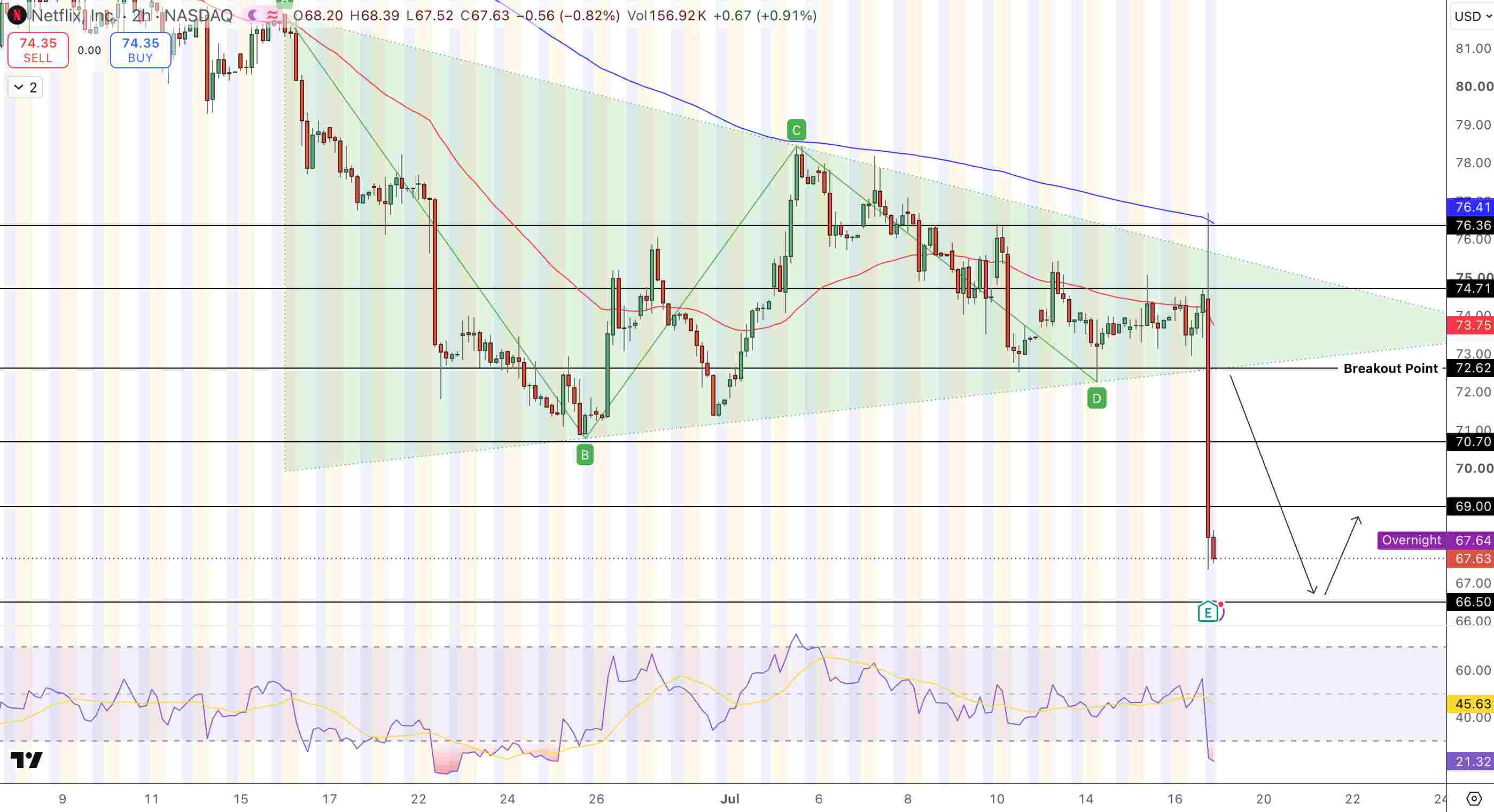
Netflix (NFLX) Price Chart - Source: Tradingview
A daily close back over $72.60 and subsequent recovery of $74.70 would invalidate the triangle breakdown. For a breakdown to occur, $66.50 is the key support. And a close below that level would open the door to $65.
- Q2 actuals: Revenue $12.56B (+13% YoY, slight miss). EPS $0.80 (beat $0.79 est). Op margin 33.4%
- Q3 guidance: $12.86B revenue vs $13.0B est. EPS $0.82 vs $0.84 est. Below on both
- FY2026: Revenue $51.0B to $51.4B. Ad revenue ~$3B (doubling from 2025). Margin 31.5%+
- Support: $66.50 then $65.00. 52-week low: $70.86 (now broken)
- Resistance: $72.60 (triangle support flipped). Then $74.70 and EMAs at $73.75 and $76.40
- Analyst view: Mahaney (Evercore) Buy reiterated. Average analyst target $112.17. P/E 23.8x
Why Did Netflix Stock Drop 8% on Q2 Earnings?
Netflix's shares fell over 8% following the release of Q2 earnings on July 16. The dip came in after-hours trading and occurred in response to lower guidance from the company for Q3 2026. Revenue guidance for the third quarter came in at $12.86 billion against Wall Street's consensus estimate of about $13 billion, while adjusted earnings-per-share guidance came in at $0.82 against the $0.84 forecast.
Q2 results were generally in line with expectations, with revenue coming in at $12.56 billion as guided and adjusted EPS at $0.80, which beat the $0.79 consensus estimate. The selloff reflected growing concerns that Netflix's growth rate is decelerating faster than Wall Street's model anticipated and adding to a more than 21% year-to-date decline leading up to the quarterly print.
Where Is Netflix's Ad Revenue Going in 2026?
During a July 16 earnings call, management confirmed ad revenue is on track to double to roughly $3 billion in 2026, up from about $1.5 billion in 2025. As of now, more than 4,000 advertisers are running campaigns, representing more than 70% year-over-year growth. Additionally, more than 60% of new sign-ups for Netflix in eligible markets during Q1 2026 opted for the ad tier.
Netflix also said it's seeing good signs for growth of the cloud gaming platform, which could unlock more advertising inventory. It noted that it's considering whether it can build a free ad-supported tier in select markets. However, co-CEO Greg Peters said that's not a near-term plan for the video streaming service.
What Would Take Netflix Stock Above $72?
For Netflix to rally higher above $72.60 it needs to gain investors' confidence that its growth is going to rebound. Possible scenarios that would spark that are: faster advertising revenues above the $3 billion 2026 target, evidence that viewing hours is growing much higher than the 2% in the first half of 2026, or an exciting new live announcement that creates a meaningful new subscriber-acquisition engine for Netflix. On the charts, closing back above $72.60 puts triangle support into neutral and a close above 50-period EMA at $73.75 would see the short-term trend turn constructive. RSI hovering near 21 implies deeply oversold levels, which sets up for a likely bounce.
Bottom Line
Netflix's stock fell 8% after Q3 guidance of $12.86 billion came in $140 million below Wall Street's expectation, which has put pressure on the shares' growth story. Q2 EPS came in above expectations, although revenue at $12.56 billion was just short. The stock is at $67.63, just below triangle support and below both the 50- and 200-day moving averages. RSI is hovering near 21, meaning the stock is heavily oversold. The immediate support is at $66.50 followed by $65.
A close above $72.60 would help the stock recover. It's important to note that the business case holds that ad revenue will double in 2026 to $3 billion. Netflix had 325 million total members as of mid-year and an operating margin of 33.4%. Management's comments about cloud gaming were positive. Investors now must decide if the Netflix growth outlook, after the tailwinds of the password crackdown and the price hikes, is robust enough to maintain the stock's 24x multiple given that shares are down more than 21% YTD.
Recommended Articles


