


Dow Jones Hangs On While Memory Chips Take Another Beating
Key Points
Taiwan Semiconductor fell 4.6% after raising its capital expenditure forecast to as much as $64 billion.
SK Hynix plunged 9.1%, extending its losses to roughly 30% from post-IPO highs set just days ago.
UnitedHealth rose 3.6% after beating estimates and raising guidance, steadying the Dow.
- 10 stocks we like better than Dow Jones Industrial Average ›
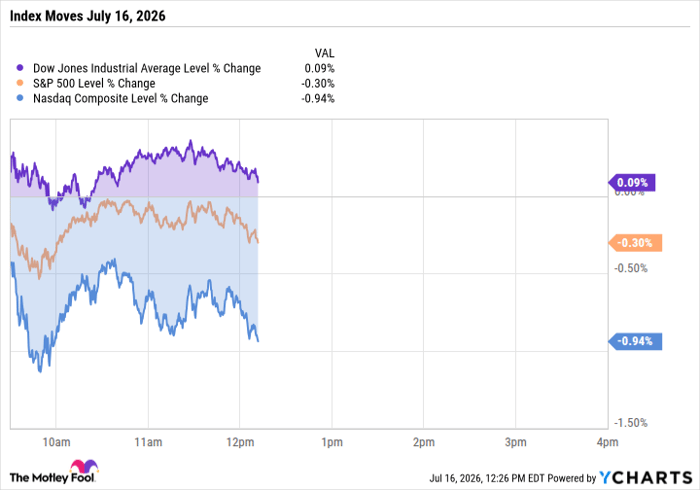
The semiconductor sell-off that began Monday in Seoul extended into a fourth consecutive session on Thursday. The tech-heavy indexes lagged while the Dow nearly held flat.
The Nasdaq Composite (NASDAQINDEX: ^IXIC) dropped 0.9% as of 12:26 p.m. ET, dragged lower by another wave of chip losses. The S&P 500 (SNPINDEX: ^GSPC) fell 0.3%. Meanwhile, the Dow Jones Industrial Average (DJINDICES: ^DJI) limited its decline to just 0.1%, thanks to healthcare stocks picking up the slack.
Where to invest $1,000 right now? Our analyst team just revealed what they believe are the 10 best stocks to buy right now, when you join Stock Advisor. See the stocks »
^DJI data by YCharts
Taiwan Semiconductor beats earnings, spooks investors anyway
The trouble started before the opening bell. Taiwan Semiconductor Manufacturing (NYSE: TSM) reported earnings that beat estimates, then promptly fell 4.6% after announcing it would spend between $60 billion and $64 billion in capital expenditures this year. That's up from a prior forecast of $52 billion to $56 billion. The company also committed another $100 billion to chipmaking facilities in Arizona. Investors didn't like the massive infrastructure spending.
Taiwan Semi didn't directly move any of the top indexes, since it doesn't trade on the Nasdaq exchange and isn't headquartered in America. But the index-moving ripple effects hit hard.
SK Hynix (NASDAQ: SKHY) cratered 9.1%, adding to Wednesday's 13.2% plunge. The stock is now down roughly 30% from its recent post-IPO highs. Micron Technology (NASDAQ: MU) dropped 6.3%, Nvidia (NASDAQ: NVDA) fell 2.7%, and Broadcom (NASDAQ: AVGO) slid 3.6%. That's bad news for both the Nasdaq Composite and S&P 500 indexes, and Nvidia weighed on the Dow as well.

Image source: Getty Images.
The volatility didn't stop there. Goldman Sachs (NYSE: GS) reversed course after Tuesday's 7.4% earnings-driven surge, falling 4.6% and dragging 316 points off the Dow. Caterpillar (NYSE: CAT) continued its slide, dropping 3.6% for a second consecutive day of losses tied to data center construction sentiment. That's another 194 Dow points erased.
Healthcare names kept the Dow from falling further. UnitedHealth Group (NYSE: UNH) bounced 3.6% after crushing earnings estimates and raising guidance. Abbott Laboratories (NYSE: ABT) soared 12.5% on another beat-and-raise performance (though its smaller market cap limited the index boost).
Space Exploration Technologies (NASDAQ: SPCX) slipped 1.4%, continuing its volatile post-IPO journey. Tech stocks fell hard in the Japanese and South Korean markets today, long before Wall Street's opening bell. SpaceX stock briefly dipped below its $135 IPO price this week, and a looming lockup expiration threatens to flood the market with up to 911.5 million additional shares once the company reports its first quarterly results.
On the economic front, the news was actually pretty good. Retail sales matched expectations, jobless claims came in lower than forecast, and the Philadelphia Fed's manufacturing index hit its highest level since November 2021. But solid macro data couldn't overcome the chip sector's gravitational pull.
Zooming out
Thursday's session marks the fourth day of chip-sector turbulence following Monday's Korean market crash.
The divergence between the Dow and the tech-heavy indexes reflects a market struggling to reconcile strong earnings with rising capital requirements. Chip companies are spending big to meet AI demand, and investors aren't sure the math works out. Strong earnings aren't enough when capital requirements keep climbing. Those capital expenses will trickle back into the income statement over time through amortization and depreciation charges.
For those with longer time horizons, the volatility is noise. But it's a deafening noise, and it might not quiet down until earnings season delivers some clarity on whether all that spending is actually paying off. Stay tuned, as the next couple of weeks will bring plenty of clues.
Should you buy stock in Dow Jones Industrial Average right now?
Before you buy stock in Dow Jones Industrial Average, consider this:
The Motley Fool Stock Advisor analyst team just identified what they believe are the 10 best stocks for investors to buy now… and Dow Jones Industrial Average wasn’t one of them. The 10 stocks that made the cut could produce monster returns in the coming years.
Consider when Netflix made this list on December 17, 2004... if you invested $1,000 at the time of our recommendation, you’d have $397,351!* Or when Nvidia made this list on April 15, 2005... if you invested $1,000 at the time of our recommendation, you’d have $1,304,257!*
Now, it’s worth noting Stock Advisor’s total average return is 937% — a market-crushing outperformance compared to 211% for the S&P 500. Don't miss the latest top 10 list, available with Stock Advisor, and join an investing community built by individual investors for individual investors.
See the 10 stocks »
*Stock Advisor returns as of July 16, 2026.
Anders Bylund has positions in Micron Technology, Nvidia, and UnitedHealth Group. The Motley Fool has positions in and recommends Abbott Laboratories, Broadcom, Caterpillar, Goldman Sachs Group, Micron Technology, Nvidia, and Taiwan Semiconductor Manufacturing. The Motley Fool recommends UnitedHealth Group. The Motley Fool has a disclosure policy.
Recommended Articles


