


PayPal at $55 on Day Two After the Stripe-Advent Bid; Polymarket Prices 82% Deal Odds
TradingKey - PayPal (NASDAQ: PYPL) is hovering near $55.41 on Thursday, July 16, holding firm beneath the $57.50 hurdle after a 17% rally on Wednesday triggered by Reuters’ announcement of an $60.50-per-share takeover proposal from Stripe and Advent International. There was no overnight movement; neither PayPal, Stripe, nor Advent has provided comment, and the board has yet to reply. Polymarket forecasters are currently assigning an 82% likelihood to PayPal being acquired by the end of 2027. The Relative Strength Index (RSI) has edged close to 80, signaling overbought conditions post-spike. The price void opening between $47.37 and $52.22 constitutes the crucial support tier. Earnings for Q2 are still slated for July 28.
Why the Stock Is at $55 and Not $60.50
When a buyout is leaked but hasn’t been confirmed, it is uncommon to see the stock change hands at that price. Instead, it trades at a discount reflecting two risks: that the transaction may not complete, and the length of time for completion. At $55.41, PYPL is pricing in a discount of some 8% to the $60.50 offer, implying the probability of the deal being struck is not a given by today’s price action despite the 82% probability cited by Polymarket.
Wall Street was largely taken by surprise with the $60.50 offer, with several analysts pointing to the ambiguity in whether or not the $60.50 price tag reflects a fair value for the company, or whether PayPal’s board may turn down the $60.50 to chase more. The 9-times-trailing multiple of PYPL, far below today’s broader stock market, is the basis for why the $60.50 price tag may undervalue PayPal’s long-term potential.
Consolidation below the $57.50 level is typical action for price over the day or so after a significant gap-up on deal-related news. Traders who piled in Wednesday on the momentum move are now gauging whether there are willing buyers at current levels to stand above $52.22. The gap created on the open Wednesday, the area between $47.37 and approx. $52.22 that was traded through quickly, represents where the stock leaped from.
If the deal theme loses traction or there is no formal answer from PayPal over the next week or so, the gap becomes the first place of pullback. If the board issues a positive response or a competing offer arises, the stock will fill the remaining price space and move to $60.50.
The Case for the Transaction: What Stripe Gets With PayPal
Specifically, Stripe’s case is this. PayPal sits on around 439 million active consumer accounts and facilitates hundreds of billions in annual payment transactions through Venmo, PayPal Checkout, and its Buy Now Pay Later program. While Stripe facilitates payments for businesses, it is focused on business-to-business payments rather than consumer-to-business or consumer-to-consumer. PayPal gives Stripe access to hundreds of millions of active consumers overnight, something Stripe could not have developed naturally without spending years and millions in consumer advertising. PayPal’s PYUSD stablecoin and crypto services fit seamlessly into Stripe’s own Tempo and Bridge stablecoin offerings, making a combined product with stablecoin and consumer distribution channels.
For Advent International, the investment would be in line with its history. Since 2008, the venture capital firm has put more than $7.8 billion into 18 payments and fintech companies worldwide, and recently wrapped up a $26 billion acquisition fund. At a multiple of 9-times trailing earnings, and with growing free cash flow under new CEO Enrique Lores, PayPal ticks every box of what Advent hunts for: a business with a depressed valuation, new leadership, and a turnaround on the business itself. The $50 billion in secured bank financing the two firms reportedly had before the Reuters story was published means the two sides viewed this deal seriously before the public announcement. The PayPal board is now assessing this offer against a plan to operate the company independently. Earnings on July 28 would feed heavily into that assessment.
PYPL Technical Setup: RSI 80, $52 Gap Support, Key Levels
In 4-hour, PYPL at $55.41 is coiling below $57.50 resistance since the gap-up. With the RSI close to 80, the oscillator is reading as overbought, although in deal-related moves, it can remain elevated as market makers bid the shares to a certain level rather than technical trading. At the far lower end are 50-EMA at $46.72, 100-EMA at $45.13. The $52.22 previous breakout support level is the primary support level. Below $52.22, the gap would be seen as filling and below $52, $49.31 comes into view. Above $57.50 is seen at $59.66, then $61.66, with the $60.50 bid price nestled between the two price targets.
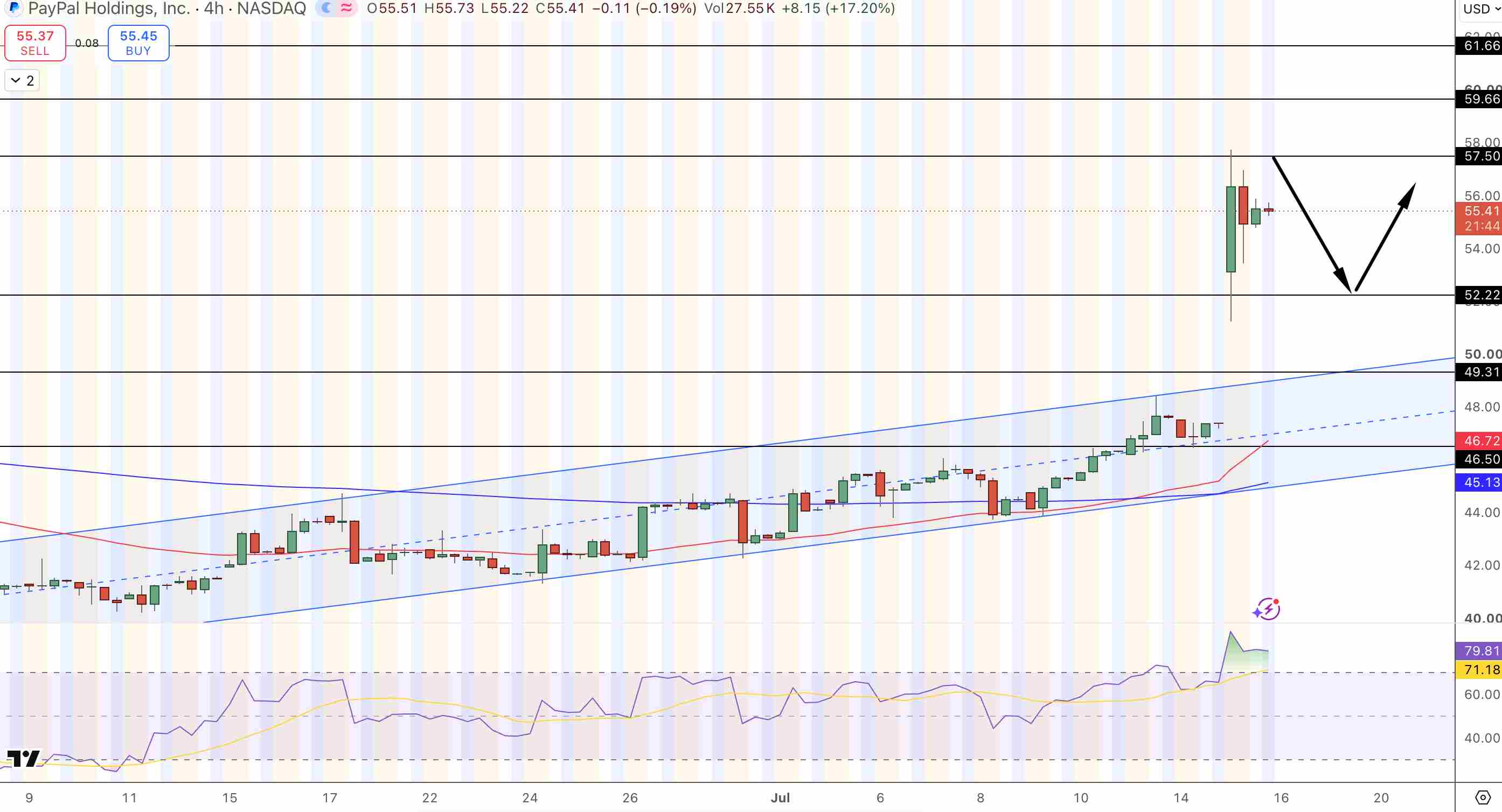
PayPal Price Chart - Source: Tradingview
- Bid price: $60.50 per share. 28% premium to pre-announcement $47.37 closing price.
- Deal probability: Polymarket: 82% chance of being acquired by 2027. 75% chance of specifically Stripe being in 2026
- Gap support: $52.22 level. Holds in a bull market, breaks to see the gap get filled
- Resistance: $57.50, then $59.66 and $61.66 ($60.50 bid sits between $59.66 and $61.66)
- Board status: No response yet from board at the moment. Reviewing options. July 28 earnings as a key factor
- Deal risk: No deal has been agreed to publicly. Analysts unsure of $60.50 fully valuing the company.
What Does Stripe Actually Gain by Buying PayPal?
In the context of the reported offer not yet being a closed deal, it is standard practice for a stock to discount to below the bid. The spread represents the probability the deal will not be consummated and the time value of waiting for closure, should it be months. The discount on PayPal to the bid price is currently around 8%. Polymarket currently prices an 82% deal probability prior to 2027, which should justify a market price around $55 to $57 for an investor prepared to wait. If PayPal’s board agrees to the deal or if there is a higher offer, the spread should narrow closer to $60.50.
How Does PayPal’s July 28 Earnings Affect the Deal?
Stripe currently only facilitates payment transactions with business clients, whereas PayPal has a much greater consumer network. For Stripe, the transaction would be an easy way to gain instant access to approximately 439 million active consumer accounts, Venmo’s peer-to-peer payment functionality, a Buy Now Pay Later service, and the PYUSD stablecoin. With respect to the terms described in the Stripe-Advent announcement, PayPal’s PYUSD and cryptocurrency-related business would be absorbed into Stripe’s Tempo and Bridge stablecoin programs. The resulting platform would be a unified payments entity capable of processing transactions for customers and merchants at home and abroad, and issuing a stablecoin, none of which are capabilities currently available in any payments firm today.
Bottom Line
The Q2 2026 earnings report issued on July 28 is the first full financial release from PayPal since the story broke. If PayPal’s Q2 figures beat conservative expectations, including single-digit growth on revenue and high-single-digit declines on non-GAAP EPS, then there would be room for PayPal’s board to push back on $60.50 by arguing that PayPal as a standalone business is worth more. That could lead to PayPal rejecting the current offer or offering a counter bid for a higher price.
Conversely, if PayPal’s Q2 comes in line or worse with expectations, it might be harder for the board to push back on the offer. During the earnings call, PayPal CEO Enrique Lores may also provide more details regarding a standalone plan that would give PayPal’s board another option.
Recommended Articles


