


Fed Governor Christopher Waller Just Drove a Dagger Through President Donald Trump's Demand for Lower Interest Rates
Key Points
Although the Dow Jones Industrial Average, S&P 500, and Nasdaq Composite recently hit all-time highs, interest-rate uncertainty threatens to upend Wall Street.
Despite fueling two concurrent price shocks, President Trump has been a vocal proponent for slashing interest rates.
While Fed Governor Waller plans to uphold the dual mandate, he's made clear that servicing America's national debt isn't the FOMC's problem.
- 10 stocks we like better than S&P 500 Index ›
Despite a brief period of heightened volatility in March, it's shaping up to be another stellar year for Wall Street and investors. The iconic Dow Jones Industrial Average (DJINDICES: ^DJI) blasted to an all-time high earlier this month, while the benchmark S&P 500 (SNPINDEX: ^GSPC) and growth-stock-propelled Nasdaq Composite (NASDAQINDEX: ^IXIC) accomplished similar feats in early June.
But things may not be as rosy as the stock market's major indexes imply. The U.S. economy is contending with two concurrent price shocks, both courtesy of decisions made by President Donald Trump, and investors are dealing with ongoing strife between the president and the Federal Reserve.
Where to invest $1,000 right now? Our analyst team just revealed what they believe are the 10 best stocks to buy right now, when you join Stock Advisor. See the stocks »
Although Trump has repeatedly pushed the Federal Open Market Committee (FOMC) -- the 12-person body, including Fed Chair Kevin Warsh, responsible for setting the nation's monetary policy -- to slash interest rates, a recent statement by Fed Governor Christopher Waller all but dashed the president's demands (with a catch).
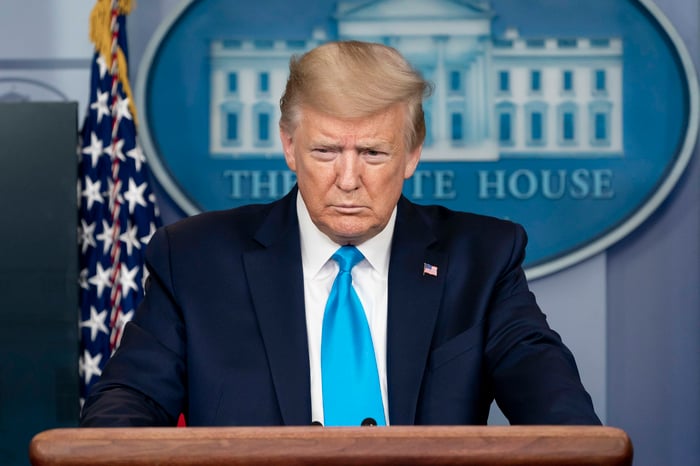
President Trump delivering remarks. Image source: Official White House Photo by Andrea Hanks, courtesy of the National Archives.
Donald Trump pushes for rate cuts amid two concurrent price shocks
Shortly after Trump's inauguration for his second non-consecutive term on Jan. 20, 2025, he and now-former Fed Chair Jerome Powell began publicly squabbling over interest rates.
Though Trump nominated Powell as Fed Chair during his first term, he was vocal about Powell's (and the FOMC's) unwillingness to rapidly bring down interest rates. Despite the FOMC voting to lower the federal funds target rate six times between September 2024 and December 2025, to a current range of 3.50% to 3.75%, President Trump opined that interest rates should be slashed to 1% or lower.
The president likely has three primary motivations behind his ongoing calls for lower interest rates:
- If borrowing costs decline, businesses are more likely to hire workers and spend on innovation. Although the unemployment rate remains historically low, we've watched it tick modestly higher since mid-2023.
- President Trump likely recognizes that the artificial intelligence (AI) infrastructure build-out is powering the stock market (and U.S. economy) higher. Lower interest rates would facilitate the expansion of AI data centers.
- Perhaps most importantly, lower interest rates would give the U.S. more flexibility when servicing its $39.4 trillion in outstanding national debt.
However, Trump's continual calls for lower interest rates come amid a surge in U.S. inflation, which hit a three-year high of 4.2% in May.
BREAKING: May CPI inflation rises to 4.2%, the highest level since April 2023.
-- The Kobeissi Letter (@KobeissiLetter) June 10, 2026
Core CPI inflation also rises to 2.9%, the highest since September 2025.
Inflation in the US is officially back above 4% and more than double the Fed's target.
Odds of Fed rate hikes are rising.
Part of the blame can be assigned to the president's tariff and trade policy. Even though the U.S. Supreme Court invalidated many of Trump's tariffs in February 2026, sweeping global tariffs continue to modestly lift prices in the goods sector.
The other and far more significant concurrent price shock has been the Iran war. Not long after the U.S. commenced military operations, Iran closed the Strait of Hormuz to virtually all commercial vessels. This action disrupted the transport of approximately a fifth of the world's crude oil supply and sent energy commodity prices skyrocketing.
Despite crude oil prices falling over the last two months, Trumpflation (i.e., Trump-driven inflation) has entered a new phase, with sectors and industries outside of energy being affected by Iran-war-driven price hikes.

Fed Governor Christopher Waller delivering remarks. Image source: Official Federal Reserve Photo.
Fed Governor Waller stamps out any hope of rate cuts, with a catch
Not only has the FOMC not lowered interest rates fast enough to appease President Trump, but several members of the FOMC are indirectly jabbing back at the president's calls for rate cuts.
For example, Fed Chair Kevin Warsh has stated several times, in one form or another, that the central bank will deliver price stability. Warsh's voting record as an FOMC member has historically been hawkish, suggesting he favors higher interest rates as a tool to suppress inflation. In other words, Warsh's statements speak to the growing prospect of higher, not lower, interest rates.
Fed Governor Christopher Waller also had some indirect but choice words on interest rates at a recent conference. Waller proclaimed,
We are not going to keep rates down just to help the government finance its deficits... Monetary policy must remain independent, focused on our economic objectives.
The silver lining here, from President Trump's perspective, is that Waller and his peers aim to uphold the dual mandate of maximum employment and price stability. If the economic data calls for rate cuts, Waller won't hesitate to push for a lower federal funds target rate. At the moment, rising Core Personal Consumption Expenditures point to the possibility of higher interest rates.
WALLER: FED WILL NOT KEEP RATES DOWN FOR THE PURPOSE OF HELPING THE U.S. GOVERNMENT FINANCE ITS DEFICITS
-- *Walter Bloomberg (@DeItaone) July 6, 2026
But there's a very high likelihood that Trump's push for lower interest rates stems from years of runaway federal deficits and the higher cost of servicing the nation's outstanding debt. While federal deficits have grown under both parties and virtually all presidents since 1970, the magnitude of federal deficits in the 2020s has become impossible to ignore.
Waller has made it clear that the FOMC isn't going to accommodate political persuasions aimed at helping the government service its debts.
For the stock market, concerns over national debt are nothing new. The Dow Jones Industrial Average, S&P 500, and Nasdaq Composite have been climbing this wall of worry for decades, with corporate earnings growth and innovation leading the charge.
But Waller's commentary that the Fed has no intention of adjusting its monetary policy to accommodate the U.S. Treasury, coupled with Kevin Warsh's insistence that the Fed "stay out of the fiscal business," sets the stock market up for a potentially bumpy ride in the coming years.
Should you buy stock in S&P 500 Index right now?
Before you buy stock in S&P 500 Index, consider this:
The Motley Fool Stock Advisor analyst team just identified what they believe are the 10 best stocks for investors to buy now… and S&P 500 Index wasn’t one of them. The 10 stocks that made the cut could produce monster returns in the coming years.
Consider when Netflix made this list on December 17, 2004... if you invested $1,000 at the time of our recommendation, you’d have $407,004!* Or when Nvidia made this list on April 15, 2005... if you invested $1,000 at the time of our recommendation, you’d have $1,244,599!*
Now, it’s worth noting Stock Advisor’s total average return is 924% — a market-crushing outperformance compared to 210% for the S&P 500. Don't miss the latest top 10 list, available with Stock Advisor, and join an investing community built by individual investors for individual investors.
See the 10 stocks »
*Stock Advisor returns as of July 11, 2026.
Sean Williams has no position in any of the stocks mentioned. The Motley Fool has no position in any of the stocks mentioned. The Motley Fool has a disclosure policy.
Recommended Articles


