


Record Numbers of Americans Are on GLP-1 Drugs. That's Great News for This Stock.
Key Points
More Americans than ever are using GLP-1 drugs.
Eli Lilly recently rolled out an oral weight loss drug.
- 10 stocks we like better than Eli Lilly ›
GLP-1 drugs are more popular than ever. This week, polling organization Gallup reported that 11% of U.S. adults are currently taking GLP-1 medications for weight loss, which is a huge jump from the 3% who said they were using the drugs in 2024. And 15% of those polled said they've used the drugs at some point, which is an increase of 9 percentage points over 2024.
Moreover, about 9 in 10 Americans are aware that the drugs are available for weight loss, up from 8 in 10 in 2024. That's good news for makers of the GLP-1 drugs, including Eli Lilly (NYSE: LLY) and Novo Nordisk (NYSE: NVO), which make the best-selling GLP-1 weight loss drugs.
Where to invest $1,000 right now? Our analyst team just revealed what they believe are the 10 best stocks to buy right now, when you join Stock Advisor. See the stocks »
But Lilly has to be considered the biggest beneficiary, as its drug tirzepatide, marketed as Mounjaro for type 2 diabetes and Zepbound for obesity, became the world's best-selling drug late last year, surpassing Keytruda, a cancer treatment manufactured by Merck. Lilly reported sales of $8.7 billion for Mounjaro in the first quarter and $4.2 billion for Zepbound, for a combined $12.9 billion.
Lilly's total revenue for the first quarter was $19.8 billion, up 56% from the same quarter a year ago. And due to better-than-expected growth in tirzepatide drugs, which blew past Wall Street's expectations, Lilly's management raised its full-year 2026 revenue guidance to between $82.2 billion and $85 billion, up $2 billion from previous expectations.
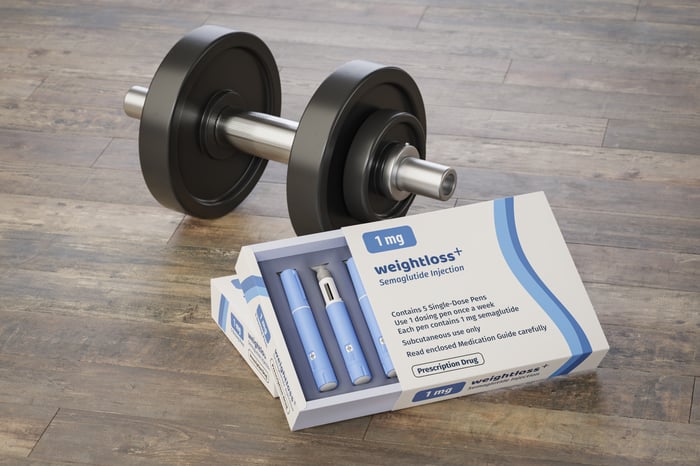
Image source: Getty Images.
A new oral weight loss drug could accelerate sales
Perhaps even more encouraging for the company and its shareholders, in the first quarter, Lilly's oral GLP-1 weight loss drug, called Foundayo, was approved and became available in pharmacies in early April. The rollout of Foundayo is likely to increase sales of Lilly's weight loss drugs, as consumers may be more comfortable with an oral option. Mounjaro is administered with a needle and a syringe or a single-dose pen needle (Novo Nordisk's Wegovy can be injected or taken as a pill).
Lilly's share price is up about 14% year to date and 6% over the past month, sending its market capitalization past $1 trillion.
Of course, the stock is expensive. Shares are trading at about $1,222, which is about 43 times trailing-12-month earnings and 33 times expected earnings. That's considerably higher than the price-to-earnings (PE) ratio of the S&P 500 as a whole, which has a trailing P/E of about 32 and a forward P/E of around 20.
So investors thinking about getting into the stock have to consider that hefty price tag. Yet, not too many companies are growing at Lilly's pace. And the rapidly rising popularity of GLP-1 drugs in general is a massive tailwind for the company.
Should you buy stock in Eli Lilly right now?
Before you buy stock in Eli Lilly, consider this:
The Motley Fool Stock Advisor analyst team just identified what they believe are the 10 best stocks for investors to buy now… and Eli Lilly wasn’t one of them. The 10 stocks that made the cut could produce monster returns in the coming years.
Consider when Netflix made this list on December 17, 2004... if you invested $1,000 at the time of our recommendation, you’d have $407,651!* Or when Nvidia made this list on April 15, 2005... if you invested $1,000 at the time of our recommendation, you’d have $1,252,823!*
Now, it’s worth noting Stock Advisor’s total average return is 922% — a market-crushing outperformance compared to 208% for the S&P 500. Don't miss the latest top 10 list, available with Stock Advisor, and join an investing community built by individual investors for individual investors.
See the 10 stocks »
*Stock Advisor returns as of July 9, 2026.
Matthew Benjamin has positions in Novo Nordisk. The Motley Fool has positions in and recommends Eli Lilly, Merck, and Novo Nordisk. The Motley Fool has a disclosure policy.
Recommended Articles


