


Biogen Is Paying $1 Billion for a Company That Won't Say What It Makes. Here's Why That's Actually Good News for BIIB Investors.
Key Points
Biogen struggled in recent years after a major blockbuster lost exclusivity.
The company’s new focus on growth is bearing fruit -- and the latest acquisition strengthens Biogen’s position in the key area of immunology.
- These 10 stocks could mint the next wave of millionaires ›
Biogen (NASDAQ: BIIB) built itself into a biotech giant thanks to its portfolio of multiple sclerosis (MS) drugs -- but in biotech and pharma, revenue growth depends on the life of a patent. Once a company loses exclusivity, generics or biosimilars enter the market, and the leader's drug sales decline. This is the challenge Biogen has faced in recent years, as MS blockbusters faced growing competition.
But the biotech giant put into place a recovery and growth plan, shifting many costs out of the MS franchise and into areas that represented growth potential. Biogen also made strategic acquisitions, announcing its intention to buy Apellis Pharmaceuticals, an immunology and rare diseases drug company, in March and closing the deal in May.
Where to invest $1,000 right now? Our analyst team just revealed what they believe are the 10 best stocks to buy right now, when you join Stock Advisor. See the stocks »
And just recently, Biogen announced another purchase. This time, the biotech is paying $1 billion for a company that won't say what it makes. Here's why this actually is good news for Biogen investors.

Image source: Getty Images.
Biogen's multiple sclerosis business
Let's start with a quick update on Biogen. As mentioned, the biotech company was once known as an MS giant, and it still sells a number of important MS drugs, such as Tecfidera and Tysabri. But loss of exclusivity made a significant dent in revenue, with Tecfidera's peak sales of $4.4 billion in 2019 dropping to $1.4 billion in 2022. In the latest fiscal year, all of Biogen's MS drugs, together, delivered $4 billion in revenue, further highlighting this decline.
In the recent quarter, chief executive officer Christopher Viehbacher said that after four years of declining earnings in 2023, the turnaround began -- and Biogen finally has been able to "stabilize the business." The shift of focus to growth products helped these drugs deliver a 12% increase in sales to $850 million in the first quarter. These are key neurology drugs such as Leqembi for Alzheimer's disease, Skyclarys for Friedreich ataxia, and postpartum depression drug Zurzuvae. They each brought in double- or triple-digit sales growth.
And though Biogen hasn't returned to its peak earnings levels, it looks like a rebound is taking shape, and this may lead to fresh growth.
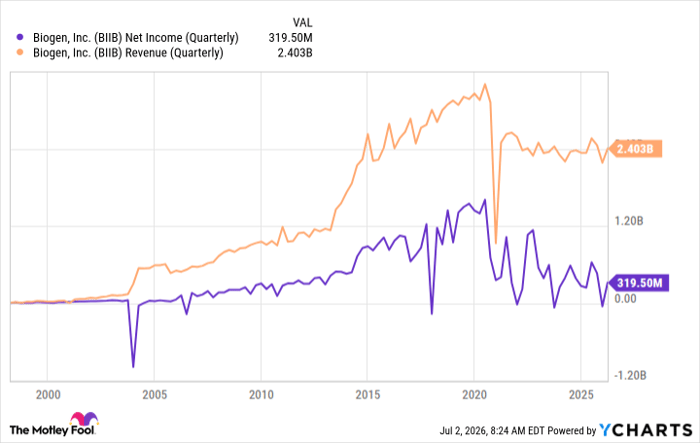
BIIB Net Income (Quarterly) data by YCharts
Acquisitions to support growth
Biogen, of course, has a solid internal pipeline, but the company, aiming to make immunology another key area, has used acquisitions to gain strength here. As mentioned, Biogen bought Apellis, gaining access to two commercialized drugs in this specialty area: Empaveli for three indications, including two rare kidney diseases, and Syfovre for an immune-mediated retinal disease. These drugs together delivered sales of $689 million last year.
Now, let's consider the company's very latest move, and that's to acquire RayThera for as much as $1 billion, including an upfront payment and potential milestone payments. RayThera's website doesn't offer much detail about its candidates -- we don't know the exact diseases they target. What we do know, from the acquisition press release, is that the portfolio "includes multiple anti-inflammatory assets that could potentially treat immune-mediated conditions across a range of indications." And the company's lead candidate is on track to enter a phase 1 trial in the third quarter.
Biogen's good news
Why is all of this good news for shareholders? The above statement suggests that RayThera's candidates aren't just targeting a disease or two. Instead, they might have the ability to treat a significant number of immune-mediated illnesses, and that could equal enormous revenue potential down the road. The global immunology market is massive, totaling more than $112 billion last year, according to Fortune Business Insights. Since Biogen is seeking to build out its immunology business, this addition could be a very wise move.
Of course, it's important to keep in mind that a lead candidate that's about to enter phase 1 doesn't result in revenue right away. The RayThera assets, even if successful through clinical trials, will take years to reach the commercialization stage. But that's OK. A biotech company must have a deep pipeline to generate the winning drugs of tomorrow. So acquiring Apellis to gain access to already commercialized drugs and buying RayThera for its pipeline were great strategic moves.
Biogen, after a few tough years, seems to be on the right track toward building out new growth businesses that may deliver over time -- and this is a solid reason to buy and hold the shares.
Where to invest $1,000 right now
When our analyst team has a stock tip, it can pay to listen. After all, Stock Advisor’s total average return is 918%* — a market-crushing outperformance compared to 208% for the S&P 500.
They just revealed what they believe are the 10 best stocks for investors to buy right now, available when you join Stock Advisor.
See the stocks »
*Stock Advisor returns as of July 4, 2026.
Adria Cimino has no position in any of the stocks mentioned. The Motley Fool recommends Biogen. The Motley Fool has a disclosure policy.
Recommended Articles


