


After Skyrocketing Nearly 200%, Is It Too Late to Buy Bloom Energy?
Key Points
Bloom Energy manufactures solid oxide fuel cell systems for on-site power generation.
An expected 19-gigawatt power gap supports a bullish thesis on Bloom.
The company carries a rich value, but future growth could justify its current price.
- 10 stocks we like better than Bloom Energy ›
Artificial intelligence (AI) has turned electricity into one of the hottest commodities on the market. And Bloom Energy (NYSE: BE), Wall Street's favorite fuel cell manufacturer, is right there capitalizing on the trend.
Bloom Energy's fuel cell systems -- big, box-shaped power generators -- convert fuel, like natural gas, straight into electricity without relying on combustion. Rather than delivering electricity through miles of transmission lines, as traditional utilities do, Bloom's energy servers can generate power on-site -- precisely what AI data centers need most.
Where to invest $1,000 right now? Our analyst team just revealed what they believe are the 10 best stocks to buy right now, when you join Stock Advisor. See the stocks »
Bloom's impressive revenue growth has shown up in its stock performance: At the time of writing (June 30), Bloom has grown about 194% since the start of the year, and over 1,100% from last year.
Of course, when a stock rises that much in such a short period, the question is inevitably raised: Has the opportunity been missed? Is it too late to buy Bloom?
AI's biggest bottleneck is Bloom's biggest boon
Artificial intelligence, though widely anticipated to become the most transformative technology of this century, is not a done deal yet. Indeed, its explosive pace of improvement -- just four years ago, ChatGPT hadn't even been released -- faces several concerning bottlenecks, not the least of which is the lifeblood that makes it "think" at all: energy.
By 2028, the U.S. could face a 19-gigawatt (GW) power shortfall, according to Antonio Neri, CEO of Hewlett Packard Enterprise. That's enough electricity, Neri points out, to power 60 million homes. Meanwhile, data centers are expected to make up nearly half of the growth of U.S. electricity demand through 2030.

Image source: Bloom Energy.
The mismatch between expected power demands and current generation capacity is one of the principal reasons behind Bloom's flourishing. It's simply much easier to build a power plant in a box than connect to the electric grid. It's also faster: It can take several years to build adequate generation and transmission lines to supply new power to data centers. Bloom can deploy its servers within three months.
Unsurprisingly, revenue for Bloom is coming in from sales of these Bloom boxes. Its first-quarter product revenue -- which consists primarily of selling its energy servers -- tripled year over year. Bloom has other businesses, too, like ongoing maintenance and electricity sales, which could become important down the road as recurring revenue. But its product sales are, right now, the cream of the crop.
Overall, Bloom's total revenue is expected to continue climbing at an impressive pace, as the chart below illustrates.
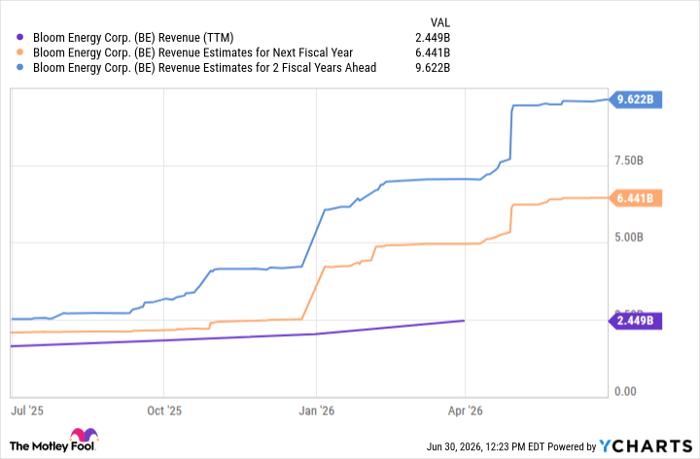
Data by YCharts
Bloom is not a stock for value investors, as it trades at a premium. And yet it's hard not to see something bright in this company's future: Bloom is in the right place, at the right time, with a scalable product that solves a serious problem for tech companies.
For long-term investors, then, the boat has left the dock, but there's still time to catch it before it's dipped below the horizon. Long-term investors who believe AI's power needs are only beginning will likely want to pick up shares of Bloom, as the stock is still capable of producing attractive returns over the long run.
Should you buy stock in Bloom Energy right now?
Before you buy stock in Bloom Energy, consider this:
The Motley Fool Stock Advisor analyst team just identified what they believe are the 10 best stocks for investors to buy now… and Bloom Energy wasn’t one of them. The 10 stocks that made the cut could produce monster returns in the coming years.
Consider when Netflix made this list on December 17, 2004... if you invested $1,000 at the time of our recommendation, you’d have $418,761!* Or when Nvidia made this list on April 15, 2005... if you invested $1,000 at the time of our recommendation, you’d have $1,195,804!*
Now, it’s worth noting Stock Advisor’s total average return is 918% — a market-crushing outperformance compared to 208% for the S&P 500. Don't miss the latest top 10 list, available with Stock Advisor, and join an investing community built by individual investors for individual investors.
See the 10 stocks »
*Stock Advisor returns as of July 3, 2026.
Steven Porrello has no position in any of the stocks mentioned. The Motley Fool has positions in and recommends Bloom Energy and Hewlett Packard Enterprise. The Motley Fool has a disclosure policy.
Recommended Articles


