


2 Stocks That Could Soar, Driven by Billions From Software Innovations. Hint: They Aren't Even Tech Stocks.
Key Points
Automakers' software business can generate margins far higher than their traditional wholesale business.
Rivian's partnership with Volkswagen is lucrative for multiple reasons, and it opens the door for more.
OnStar and Super Cruise are expected to generate big business and big margins for General Motors.
- 10 stocks we like better than General Motors ›
The automotive industry has long been plagued with negative narratives. A primary example is that operations are capital intensive and leave automakers with thin margins, which hurts earnings potential and valuations.
But the automotive industry is evolving rapidly to include more software and technology to power automated driving features, advanced infotainment solutions, and over-the-air updates that can lower costs due to no required service center visits -- all while improving the driving experience.
Missed Nvidia in 2009? This Rare Signal Is Flashing Again. In 2009, a "Double Down" signal flashed for a little-known chipmaker called Nvidia. For the first time in years, that same "Total Conviction" signal is flashing for a company 1/100th the size of Nvidia. Continue »
These factors can fundamentally change automakers as investments, and here are two examples of how Rivian Automotive (NASDAQ: RIVN) and General Motors (NYSE: GM) could generate billions through unique software innovations and strategies.
First up: Rivian
Toward the end of 2024, Rivian and Volkswagen partnered to develop a state-of-the-art, software-defined-vehicle (SDV) architecture that could be used across the duo's vehicle portfolios. The initial investment was significant, the potential is massive, and its financial implications are already powering Rivian. Let's dive deeper.
Volkswagen's initial investment into Rivian was for up to $5 billion, which was quickly bumped to $5.8 billion and would be delivered upon completion of certain objectives and milestones. Upon the late 2024 launch, a $1.3 billion lump-sum investment was sent Rivian's way, followed by an early 2025 $1 billion tranche, a mix of equity and debt, to complete operational milestones. After passing winter testing in the spring of 2026, it unlocked another $1 billion investment from Volkswagen and also established the latter as Rivian's largest shareholder, displacing Amazon.
Investors need only glance at first-quarter 2026 results to see the impact Rivian's software is having on its financials. Consolidated revenue checked in at $1.28 billion, which was largely driven by two segments: automotive and software and services. The former generated $908 million, or a 2% decrease compared to the prior year, while software and services generated $473 million, a 49% increase.
The revenue growth was positive, but the impact on gross profit is arguably more important. The automotive segment gross profit was $62 million during Q1, while the software and services segment gross profit totaled $181 million.
The profitability boost from the software business has already powered the young electric vehicle (EV) maker to a positive gross profit result during Q1 -- superior to rival Lucid Group, which is struggling to improve gross profitability -- and giving investors reason to believe it can one day generate bottom-line profits and become a viable long-term investment.
Keep in mind there's plenty of software business growth from Rivian's partnership with Volkswagen alone, and it opens the door for other traditional automakers to explore potentially lucrative software opportunities with Rivian.
Next up: General Motors
General Motors gives investors another angle in how to monetize software innovations. The Detroit automaker expects massive growth from OnStar and Super Cruise subscriptions, and it even has a long-term strategy to help drive this into reality.
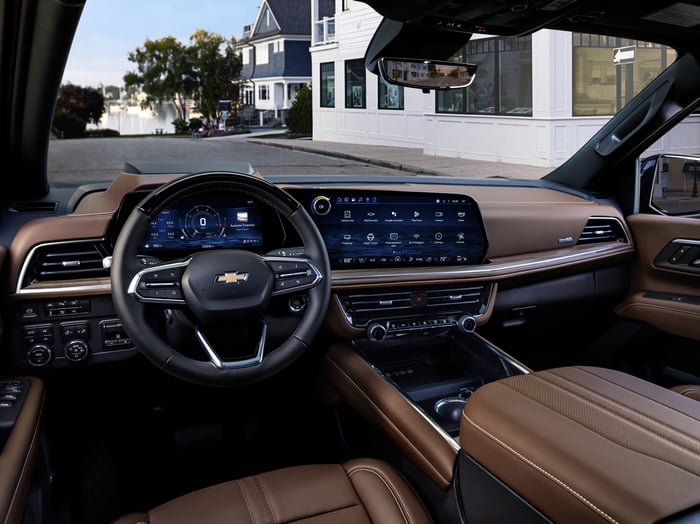
Image source: General Motors.
Let's take a look at some real-world data to emphasize the software potential. Last year, GM logged $2.7 billion in realized revenue and $5.4 billion in deferred revenue from OnStar and Super Cruise subscriptions -- healthy growth from $1.7 billion realized and only $200 million deferred as recently as 2020. This business is growing quickly with management expecting those software services to generate $3.1 billion in realized revenue and $7.5 billion in deferred revenue this year.
Investors would be wise not to underestimate how this business -- with margins that could approach 70% gross margin, according to GM -- stands to change GM as an investment in an industry known for low margins. "These software-like margins that are coming in the connected business can actually drive, and potentially over time, dwarf even the wholesale business, which is remarkably strong and remarkably large," CFO Paul Jacobson said, according to Automotive News.
GM is putting its money where its mouth is, too. Beginning with the 2025 model year, every new GM vehicle that rolls off the production line includes an eight-year basic OnStar subscription, and vehicles with Super Cruise will have a three-year subscription built into the price. This is essentially opening the widest funnel top to its software and services businesses, and banks on customers getting accustomed to these, and resubscribing and/or repurchasing them with their next vehicles.
Early evidence is fairly positive. At least 30% of the 35,000 GM drivers with an expiring three-year Super Cruise subscription renewed in 2025.
What it all means
Automakers are quickly evolving with the industry, and vehicles are becoming packed with more software technology and innovations. This is enabling new business models to generate incremental revenue streams, as well as higher margins. Furthermore, in the long term, it could help an industry plagued with paltry price-to-earnings (P/E) multiples to rise as Wall Street acknowledges the more profitable businesses in the years ahead.
Rivian and GM aren't tech stocks, but software could certainly power their stocks higher over the next decade.
Should you buy stock in General Motors right now?
Before you buy stock in General Motors, consider this:
The Motley Fool Stock Advisor analyst team just identified what they believe are the 10 best stocks for investors to buy now… and General Motors wasn’t one of them. The 10 stocks that made the cut could produce monster returns in the coming years.
Consider when Netflix made this list on December 17, 2004... if you invested $1,000 at the time of our recommendation, you’d have $418,761!* Or when Nvidia made this list on April 15, 2005... if you invested $1,000 at the time of our recommendation, you’d have $1,195,804!*
Now, it’s worth noting Stock Advisor’s total average return is 918% — a market-crushing outperformance compared to 208% for the S&P 500. Don't miss the latest top 10 list, available with Stock Advisor, and join an investing community built by individual investors for individual investors.
See the 10 stocks »
*Stock Advisor returns as of July 3, 2026.
Daniel Miller has positions in General Motors. The Motley Fool has positions in and recommends Amazon. The Motley Fool recommends General Motors. The Motley Fool has a disclosure policy.
Recommended Articles


