


US Stock Closing: Nasdaq Rises 1.5%, Dow Hits New Closing High, Philadelphia Semiconductor Index Continues to Rise About 4%; AMD Surges Over 7% and Is Close to Surpassing One Trillion Dollars in Market Value, Leading the Gains in Chip Stocks
TradingKey - As corporate earnings are validated and macro risks partially subside, US stocks have regained upward momentum. The three major US stock indexes extended yesterday's gains, with the Dow Jones Industrial Average continuing to set new closing highs, led by chip and memory stocks.
As of the close, the Dow Jones Industrial Average rose 0.26% to 52,319.2 points; the Nasdaq Composite Index gained 1.52% to 26,213.72 points; and the S&P 500 Index climbed 0.79% to 7,499.36 points.
Performance of technology stocks
AMD (AMD) rose 7.68% to close at $580.91, breaking through the $580 mark to hit a record high, bringing its latest market capitalization to $947.2 billion, on the verge of entering the trillion-dollar club.
Production ramp-up for AMD's sixth-generation 2nm server CPU, Venice, started at the end of May, with volume gradually scaling up in the second half of the year. The company stated that the number of customers participating in validation exceeds that of any previous generation. The successor product, Verano, is expected to launch in 2027, focusing on AI performance per dollar and per watt. Morgan Stanley pointed out in its latest report that shipments of AMD's next-generation EPYC CPU platform for servers, "Venice," are expected to reach 6.75 million units in 2027, surpassing the 5.75 million shipments of Nvidia's Vera CPU.
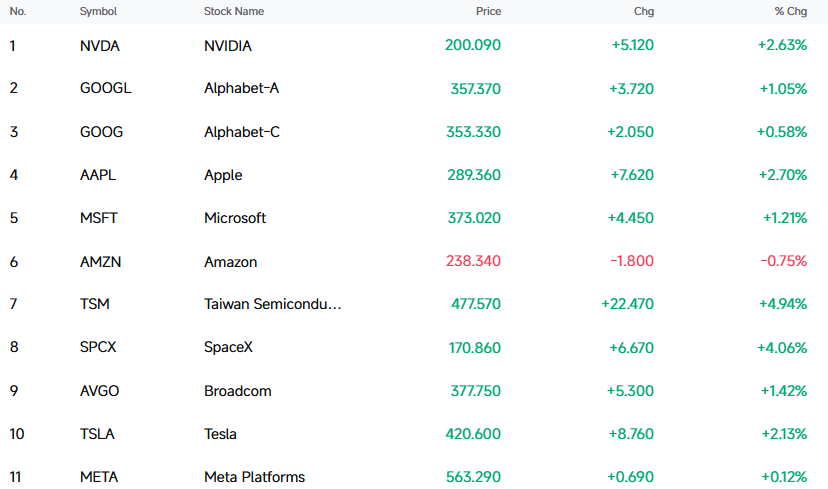
Mega-cap tech stocks all advanced: TSMC (TSM) rose 4.94%, SpaceX (SPCX) rose 4.06%, Apple (AAPL) rose 2.70%, Nvidia (NVDA) rose 2.63%, Tesla (TSLA) rose 2.13%, Broadcom (AVGO) rose 1.42%, Microsoft (MSFT) rose 1.21%, Alphabet (GOOGL) rose 1.05%, and Meta Platforms (META) rose 0.12%; only Amazon (AMZN) fell, dropping 0.75%.
[Source: FutuBull]
The Philadelphia Semiconductor Index climbed further by 3.92% to close at 14,246.96. Among its 30 constituents, 28 rose and 2 fell.
Chip stocks led the gains, with AMD (AMD) up 7.68%, Intel (INTC) up 6.01%, Arm Holdings (ARM) up 3.20%, and Nvidia (NVDA) up 2.63%.
Chinese ADRs mostly gained: Hesai (HSAI) surged 15.61%, XPeng (XPEV) rose 3.44%, Zai Lab (ZLAB) rose 3.20%, GDS Holdings (GDS) rose 2.39%, Vipshop (VIPS) rose 2.24%, and NIO (NIO) rose 2.22%.
Corporate News
Anthropic Releases Claude Science and Claude Sonnet 5 on Tuesday
On Tuesday, Anthropic concentrated the release of two core products: Claude Science, an automation tool geared toward scientific research scenarios, and Claude Sonnet 5, its next-generation flagship large language model.
Claude Science is an automation tool for scientific research that supports biochemical tasks such as protein structure prediction. Integrating more than 60 scientific databases, it enables natural language interaction and automates multi-step tasks; its beta version is open to paid users. Claude Sonnet 5 is the most powerful agentic model in the Sonnet series. Capable of autonomous planning and tool calling, its performance approaches that of Opus 4.8, with its core capabilities significantly improved over its predecessor and offering better security.
Amazon's AWS to Spend $1 Billion to Set Up Resident Engineer Division
Amazon’s AWS division announced the establishment of Frontier Deployment Engineers (FDE). Investing $1 billion of its own capital, AWS will deploy a team of thousands of AI experts to client sites to provide full-process construction support for agentic AI systems over 45-day cycles, with the core goal of shortening the business implementation cycle of AI technology. Unlike traditional outsourced technical services, this model is business-outcome-oriented and settled based on delivery results rather than the traditional hourly billing model. The end point of the service is not to deliver a system, but to help clients cultivate independent research and operation capabilities to avoid long-term vendor lock-in.
CME Group Plans to Launch Single-Stock Futures
CME Group announced that it will launch single-stock futures on July 27. The first batch of contracts will cover more than 50 U.S. individual stocks within the S&P 500, Nasdaq 100, and Russell 1000 indices, with companies such as Nvidia, Micron, Apple, Alphabet, Meta, and Tesla included.
OpenAI Finds Optimization Solution to Halve Inference Costs
According to The Information, a person familiar with the matter revealed that earlier this month, OpenAI engineers told some colleagues that by relying on several newly developed optimization technologies, they had found a solution that could cut model inference costs by more than half. After engineers applied this new set of technologies to scenarios where visitors without free or paid accounts used ChatGPT, they once reduced the number of required Nvidia graphics processing units (GPUs) to just a few hundred.
SK Hynix Submits Nasdaq Listing Application
SK Hynix has officially submitted its F-1 prospectus to the U.S. Securities and Exchange Commission (SEC), initiating the U.S. initial public offering (IPO) process, and plans to list on the Nasdaq Global Select Market under the ticker symbol "SKHY." According to the prospectus, SK Hynix will issue American Depositary Shares (ADSs), with each ADS representing a certain proportion of the company's common stock. Core terms such as the specific offering size, offering price, and the ratio of ADSs to shares will be determined based on the stock price in the South Korean KOSPI market and the overall market environment.
Blue Origin Confirms Exploded Launchpad Will Not Be Rebuilt as It Was, Adjusts Configuration to Strive for Launch Resumption Within the Year
Following the static-fire explosion of the New Glenn rocket, Blue Origin chose not to repair the launchpad to its original state, but instead switched to a "horizontal/vertical hybrid" launch solution, reusing the infrastructure originally matched for the heavy-lift 9x4 variant. This solution not only shortens the reconstruction cycle to secure the core goal of a return to flight by the end of the year, but also simultaneously increases long-term launch frequency, turning a passive accident recovery into an opportunity for capacity upgrades.
Currently, NASA still regards New Glenn as the preferred option for launching the cargo lander, believing that repair progress has exceeded expectations and that there is ample buffer time until 2027; at the same time, it has also prepared alternative launch options to handle extreme circumstances.
Industry & Macro News
BofA: Strong Nonfarm Payrolls Report Could Boost Rate Hike Expectations
Following three months of solid growth, BofA Securities expects nonfarm payrolls to increase by 110,000 in June, primarily driven by moderate initial jobless claims and strong ADP employment data. However, they also see downside risks. The surge in leisure and hospitality in May may have been influenced by the World Cup or Memorial Day. If it was the latter, June's employment figures could pull back. They added: "A strong jobs report could tilt the market further toward our previously forecast three rate hikes in 2026."
U.S. Job Openings Edge Up, Indicating Stable Labor Demand
U.S. JOLTs job openings for May came in at 7.594 million, against expectations of 7.3 million, while the previous figure was revised from 7.618 million to 7.585 million. According to data released Tuesday by the U.S. Bureau of Labor Statistics, the number of job openings rose to 7.59 million last month, slightly higher than the revised April figure. The median forecast of economists was 7.3 million. Employment increased in sectors such as construction, leisure, and hospitality. Job openings in professional and business services were nearly flat in May, a sector that had accounted for the vast majority of April's job growth. New positions in financial activities continued to shrink, with the sector emerging as the biggest drag on job growth this year. Overall, U.S. job openings changed little in May, indicating stable labor demand, while recent wage growth has picked up.
Citadel Securities Says Retail Investors Buy the Dip in U.S. Stocks at Record Pace, with June Set to Be the Most Active Trading Month
Scott Rubner, head of equity and equity derivatives strategy at Citadel Securities, pointed out that retail investors have been buying the dip in U.S. stocks at a record pace this year. In the first half of 2026, buying the dip has become the go-to strategy for retail investors.
Data compiled by Rubner show that on days when the S&P 500 fell, the average daily net buying by retail investors was nearly 3.5 times the historical average. This marks the strongest buy-the-dip behavior since the firm began tracking the data in 2020, surpassing the record set during the 2021 meme stock craze. Rubner stated that the participation of everyday investors has 'evolved from a cyclical phenomenon into a structural feature of modern markets, providing a steady source of demand for U.S. equities.'
Recommended Articles


