


SpaceX Stock Breaks Out 7% as Charter Mobile Talks and $4.3B Nasdaq-100 Buying Fuel Rally
TradingKey - On June 30, shares of SpaceX (NASDAQ: SPCX) reached $164.19, rising 7.15% and surpassing the horizontal blue channel established during its June 24 session. This rally comes amid two new developments: Bloomberg reports that SpaceX and Charter Communications are negotiating a partnership to offer satellite-connected mobile phones, the first confirmed partner for the previously rumored Starlink mobile service; and according to an analysis by TipRanks, the inclusion of SPCX in the Nasdaq-100 on July 7 could lead to $4.3 billion in index-tracking fund buying.
The addition will take effect after market close on July 6, with trading in the revised index commencing on July 7. RSI is currently 54.15, neither bullish nor bearish and with potential for further growth without becoming overbought or diverging.
The Charter Mobile Partnership — What a Cable Company Brings to a Satellite Phone Service
The Bloomberg reports of the SpaceX-Charter talks transform the nebulous notion of a “Starlink mobile phone service” into something tangible. Charter Communications is the second-largest cable company in the US; its Spectrum Mobile brand already serves 12.1 million wireless customers via its converged bundle service. As a wholesale mobile virtual network operator, Charter is already permitted by regulators to offer a mobile service and is already running a mobile wholesale network to deliver one.
For SpaceX, partnering with Charter would allow the company to quickly bring Starlink’s Direct-to-Cell satellite service, which is currently operational with T-Mobile in an emergency mode, to more of the Starlink broadband subscriber base via an integrated offering with existing billing, service, and distribution.
From the cable operator’s perspective, the service’s coverage of satellite dead zones offers a competitive edge over T-Mobile and Verizon wireless fixed internet: a Charter Mobile plan, with Starlink-backed mobile coverage in coverage-free regions, addresses a major pain point for fixed internet rivals that have recently used it to steal broadband customers from cable providers.
There is no news on the financial terms or timing for launch; talks are still in preliminary phases. However, the strategic rationale behind both parties’ interests is enough to make the market view the Bloomberg report as an incremental positive for SPCX in the current growth phase, beyond the Starlink broadband business.
The $4.3 Billion Nasdaq-100 Estimate and the Mechanics of July 7
TipRanks provides the first hard dollar number, $4.3 billion, of what was previously merely a “mechanical buying event.” The $4.3 billion is simply the modelled value of SPCX’s anticipated index weighting applied against AUM of existing Nasdaq-100 funds, which includes the Invesco QQQ Trust at over $300 billion alone, and the wider universe of passive index funds, ETFs, and structured products that are required to hold the constituents in a given proportion.
Nasdaq confirmed the technical timing on June 27 that the stock will enter the index following close on July 6, 2026, and begin trading within it on July 7. The stock is up 1.4% in pre-market after the news and trading higher across the board, with the effective date coming up in under a week.
That shift from a general mechanical-buying narrative to a specific $4.3 billion figure matters for what an investor should consider in terms of the size of the event against SPCX’s total market cap of approximately $2.02 trillion and public float in the 4 to 5% range. A flow of $4.3 billion into a stock that small is already large enough on its own to impact price, regardless of a change in fundamentals.
FounderETFs portfolio manager Michael Monaghan framed this stock’s recent volatility nicely: “the stock has a premium valuation and a very low float, so everything is going to be magnified in both directions,” which is exactly as true of the Nasdaq-100 flow as it was of the $225.64 to $147.11 selloff.
SPCX Technical Setup — Sideways Channel Breakout at $164, Targets $187.60 and $207.59
SPCX is above its sideways blue channel on the 4H timeframe that it has been trading in for a little over a week since June 24 with price moving from about $150 to $163, with green candles in the immediate breakout space displaying more solid bodies and thus greater buying pressure against what was resistance on the downside.
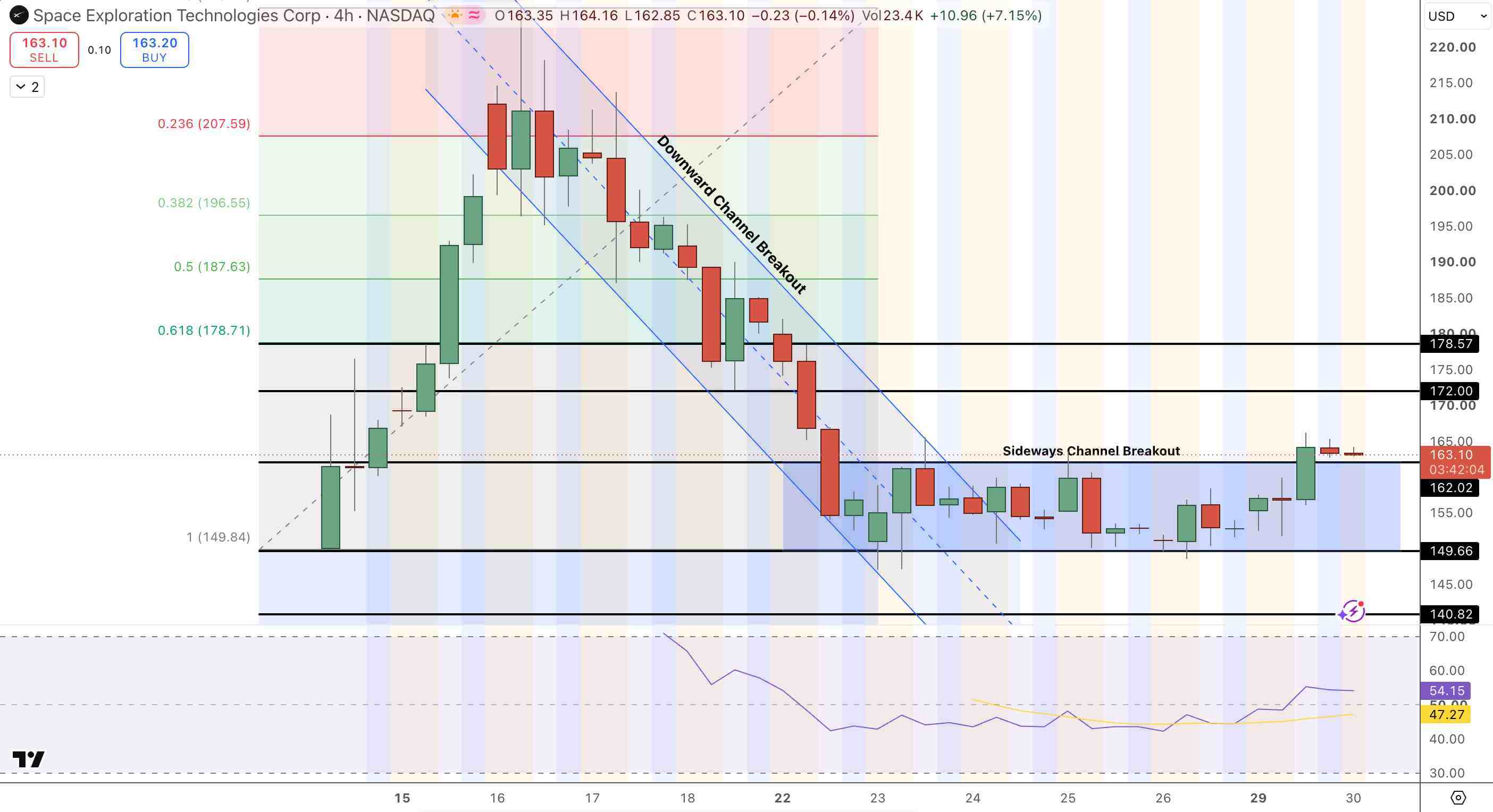
SpaceX Price Chart - Source: Tradingview
The RSI is at 54.15, a middling space that is not yet overbought on the upside nor showing divergence on the downside. The fibonacci map based on the low at $149.84 has an initial resistance zone around the 0.5 Fib ($187.63) and 0.382 Fib ($196.55), with primary upside targets at the 0.236 Fib ($207.59) and the 0 Fib ($225.42, prior ATH).
The extension projected from the sideways channel is at $172 to $178 on a continuation. On a confirmed close above $172.00, the immediate target is $187.60 on the Fib bounce.
- Entry: Long above $172.00 — sideways channel breakout confirmed
- Target 1: $187.60 — 0.5 Fib level
- Target 2: $207.59 — 0.236 Fib level
- Stop Loss: Close below $149.70 — sideways channel lower boundary fails
- Nasdaq-100 effective: After close July 6, trades in index from July 7 — est. $4.3B inflow
- Next earnings: August 6, 2026
What Is the SpaceX-Charter Mobile Phone Partnership?
The deal would meld SpaceX’s recently announced Starlink Direct-to-Cell satellite service with Charter’s existing Spectrum Mobile service, which currently supports 12.1 million wireless lines. Neither side has provided details about the terms or when the plan could be unveiled, as the discussions are still at an early stage. Charter would get a leg up on fixed wireless competitors like T-Mobile and Verizon, who have marketed their broadband networks as more reliable than cable internet. SpaceX could gain access to a retail mobile sales and billing system rather than trying to create the infrastructure from scratch.
How Much Buying Is Expected From SpaceX’s Nasdaq-100 Inclusion?
According to a TipRanks estimate, SPCX could receive a $4.3 billion boost in inflows from the Nasdaq-100 inclusion-driven buying of index funds.
Nasdaq announced that SPCX would be added to the index after markets close on July 6, 2026 and the index will be tradeable on July 7. The estimated inflows are based on modeling from funds that track the index, which includes the $300 billion-plus Invesco QQQ Trust, as well as SPCX’s likely weight in the index. With the company’s public float estimated between 4% and 5%, the $4.3 billion inflow estimate against limited shares available to buy could result in a disproportionate price impact.
Is SPCX a Buy at $164 After the Breakout?
SPCX shows confirmed upside of the consolidation channel with RSI 54.15, neutral with room to climb. Long above $172.00 targets $187.60 and $207.59 with stop below $149.70. SpaceX-Charter discussions and the $4.3 billion Nasdaq-100 inclusion-driven estimate are only incremental positives on top of the already-cleared September 2027 bridge loan risk from the bond settlement. Ongoing structural risks, xAI’s operating losses and S&P’s negative free cash flow projection through 2029, in addition to the low float potentially exaggerating both bullish and bearish price moves, have yet to be addressed. This is why FounderETFs’ Michael Monaghan cautioned that SPCX price action is likely to remain magnified relative to fundamentals.
Bottom Line
SPCX rose 7.15% to $164.19 on June 30, clearing the sideways consolidation channel on the back of two incremental positives: The Bloomberg report of SpaceX-Charter discussions on a potential mobile phone offering, giving SpaceX’s Starlink mobile service a real-world customer for the first time; and the $4.3 billion TipRanks estimate for Nasdaq-100 inclusion-driven buying ahead of the index’s July 7 effective date.
RSI at 54.15 is neutral with room to climb. The breakout above $172.00 targets $187.60 and $207.59. Stop below $149.70. The low float that has magnified both the prior selloff and the present rally remains the defining characteristic of SPCX’s trading action entering the Nasdaq-100 inclusion.
Recommended Articles


