


Rocket Lab, RTX, and Palantir: The Best SpaceX Alternatives for Investors Who Missed the IPO or Want Out
Key Points
Rocket Lab is evolving into a full-service space company, with a record launch backlog and the highly anticipated Neutron rocket set to debut in late 2026.
RTX combines a massive $271 billion backlog with decades of aerospace and defense leadership, providing visibility and recurring cash flows few companies can match.
Palantir has become deeply embedded in U.S. defense operations, with Maven AI now a permanent Pentagon program and long-term military contracts supporting future growth.
- These 10 stocks could mint the next wave of millionaires ›
Space Exploration Technologies (NASDAQ: SPCX), also known as SpaceX, is a remarkable engineering organization carrying the balance sheet of a company that borrowed its way into an artificial intelligence (AI) race it hasn't yet proven it can win. For investors who either missed the IPO window, watched the post-debut sell-off with concern, or simply want exposure to the aerospace and defense sector without signing up for $400 billion in projected net debt by 2031, there are three businesses worth knowing. Each is durable, generating real cash, and doing something in 2026 that makes the long-term case for ownership cleaner than it has been in years.
1. Rocket Lab
Rocket Lab (NASDAQ: RKLB) is the most direct SpaceX analog available to public investors, and the gap between what the two companies are doing today is much narrower than the market has historically priced.
Missed Nvidia in 2009? This Rare Signal Is Flashing Again. In 2009, a "Double Down" signal flashed for a little-known chipmaker called Nvidia. For the first time in years, that same "Total Conviction" signal is flashing for a company 1/100th the size of Nvidia. Continue »
Rocket Lab just signed the largest launch contract in its history. The contract is a multilaunch agreement with an undisclosed customer that includes five dedicated Neutron rocket flights and three Electron flights, all scheduled between now and 2029. That deal pushed the company's total backlog past $2.2 billion, a number that keeps growing as the customer pipeline matures. CEO Peter Beck has been building toward Neutron's debut in Q4 2026, targeting its first commercial flight and then a cadence of three launches in year two and five in year three -- the same disciplined ramp-up Electron followed when it debuted in 2017.
What makes Rocket Lab structurally different from the other pure-play space names is that it doesn't just launch rockets. It manufactures satellite components, builds complete spacecraft, and operates the entire mission lifecycle from design to orbit. That vertical integration means revenue flows even in quarters when no rockets fly, and it means Rocket Lab has real relationships with the defense and intelligence community that translate into contracted work in the future. The Electron rocket alone has accumulated more than 70 missions, making Rocket Lab the second most-launched U.S. orbital rocket behind SpaceX's Falcon 9. The Neutron chapter hasn't even started yet.
2. RTX
RTX (NYSE: RTX) is what SpaceX would look like if it had spent 80 years building the infrastructure of modern aerospace instead of promising to build it.
In Q1 2026, RTX reported a record backlog of $271 billion, $162 billion in commercial aerospace and $109 billion in defense. That backlog represents contracted future revenue already on the books, work that will be delivered regardless of what the stock market does next month. Pratt & Whitney's GTF Advantage engine -- the updated version of the engine that caused significant aircraft-on-ground disruptions in 2023 -- is now in full commercial rollout, and shop visit volumes are compounding as airlines bring their fleets back in for maintenance. Raytheon's munitions business is operating at capacity, with RTX investing $200 million in Columbus, Georgia, and $115 million in Huntsville, Alabama, to expand missile production infrastructure that demand has already outpaced.
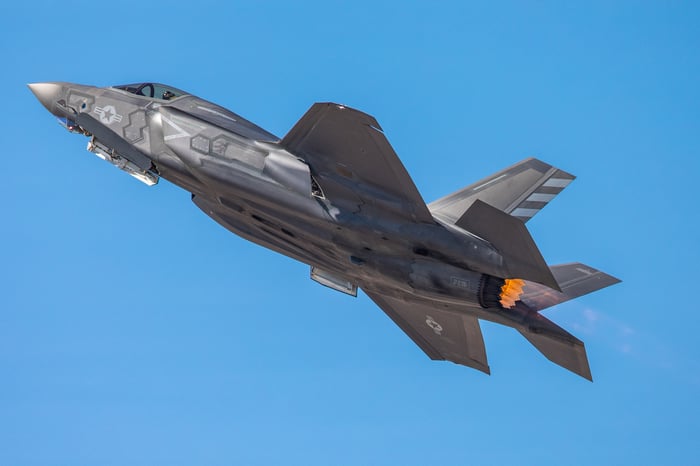
Image source: Getty Images.
RTX also secured a 20-year Patriot missile defense contract worth $50 billion through the Defense Logistics Agency in 2025, covering systems and sustainment for U.S. and international customers. A contract with a 20-year term is the opposite of a growth-stage narrative. It's a recurring revenue commitment that will still be generating cash when most of today's AI companies have been through multiple business cycles.
3. Palantir
Palantir Technologies (NASDAQ: PLTR) is the most unconventional of these three picks, but it belongs in this conversation for what it has built within the U.S. defense establishment over the past decade.
In March 2026, the Pentagon designated Palantir's Maven AI system as a formal program of record. This is the military's way of guaranteeing long-term budget allocation for a technology platform. Maven isn't a product Palantir sells to the Pentagon. It is the primary AI operating system the U.S. military uses for target identification, battlefield intelligence fusion, and operational decision-making across multiple theaters. Elevating Maven to a program of record means it now sits within the annual defense budget as a permanent line item, with funding protected from the uncertainty of contract-by-contract renewal.
On top of Maven, Palantir holds a $10 billion, decade-long enterprise agreement with the U.S. Army that consolidates 75 separate contracts into a single framework. The company is also fighting for access to the Defense Intelligence Agency's data analytics modernization program, asserting in a formal protest that the DIA is building from scratch what Palantir's commercial platform already does. That is the posture of a company deeply embedded in government operations, able to contest procurement decisions from a position of strength.
None of these three companies needs SpaceX to fail. They each have their own reasons to exist and grow. But for investors seeking aerospace exposure with a track record, a backlog, and a balance sheet not assembled through a bridge loan, these three businesses make a cleaner case.
Don’t miss this second chance at a potentially lucrative opportunity
Ever feel like you missed the boat in buying the most successful stocks? Then you’ll want to hear this.
On rare occasions, our expert team of analysts issues a “Double Down” stock recommendation for companies that they think are about to pop. If you’re worried you’ve already missed your chance to invest, now is the best time to buy before it’s too late. And the numbers speak for themselves:
- Nvidia: if you invested $1,000 when we doubled down in 2009, you’d have $499,979!*
- Apple: if you invested $1,000 when we doubled down in 2008, you’d have $54,086!*
- Netflix: if you invested $1,000 when we doubled down in 2004, you’d have $398,052!*
Right now, we’re issuing “Double Down” alerts for three incredible companies, available when you join Stock Advisor, and there may not be another chance like this anytime soon.
See the 3 stocks »
*Stock Advisor returns as of June 29, 2026.
Micah Zimmerman has no position in any of the stocks mentioned. The Motley Fool has positions in and recommends Palantir Technologies, RTX, and Rocket Lab. The Motley Fool has a disclosure policy.
Recommended Articles


