


1 Stock That's More Than Doubled in 3 Years, and 3 Reasons It Will Keep Soaring
Key Points
GM's massive share buybacks often go overlooked, but it has powered shareholder returns.
OnStar and Super Cruise represent software-like margins and incremental revenue.
Within three to five years, GM expects profitability with electric vehicles.
- 10 stocks we like better than General Motors ›
When investors are searching for high-flying stocks, they likely wouldn't start in the automotive industry. That said, General Motors (NYSE: GM) has been firing on all cylinders over the past three years. The stock is up 116% over that time. Over the past 12 months, it has gained more than 62% compared to the broader S&P 500's 21% rise.
The good news for investors who missed the rise is that GM is poised to keep driving higher for these three reasons.
Missed Nvidia in 2009? This Rare Signal Is Flashing Again. In 2009, a "Double Down" signal flashed for a little-known chipmaker called Nvidia. For the first time in years, that same "Total Conviction" signal is flashing for a company 1/100th the size of Nvidia. Continue »
1. GM is returning value to shareholders
Ford Motor Company (NYSE: F) and its Detroit rival, GM, have much in common, but the two return value in distinctly different ways. Ford is well-known for its lucrative dividend, currently yielding roughly 4.2%, and it often dishes out annual supplemental dividends when cash flow is strong.

A GMC Hummer. Image source: General Motors.
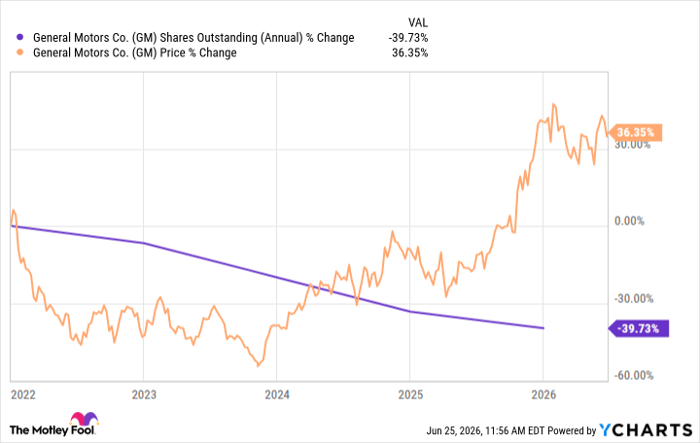
Ford gets more attention for the value it returns through its dividend than GM does for its buybacks, but GM's buybacks are quietly impressive. More specifically, over the past five years, GM has slashed its shares outstanding by a huge chunk, as you can see in the graph below.
Data by YCharts.
Thanks to high-margin, lucrative full-size truck sales and valuable SUV sales, the company generates significant cash. It's used this cash to fund development of a long list of new vehicle launches, and has also retired roughly 500 million shares valued at $30 billion over the past five years -- a staggering number.
While rival Ford's dividend yield sits at roughly 4.2%, much higher and more recognizable than GM's 0.9% dividend yield, the latter's total shareholder yield (which adds buybacks into the equation) sits at a much more impressive 7.6%. Expect GM to continue its buyback strategy, and more investors should be aware of just how valuable it is.
2. GM's OnStar is on point
Another factor that many investors overlook with General Motors is its ongoing bet with OnStar and Super Cruise. The automaker is making a long-term bet that it can generate meaningful recurring revenue through its software business.
Last year, GM logged roughly $2.7 billion in realized revenue. It has an even larger $5.4 billion in deferred revenue from OnStar and Super Cruise subscriptions. For context, that's real growth from the $1.7 billion realized and $200 million deferred as recently as 2020. There's more growth ahead, with the company expecting to generate $3.1 billion in realized revenue and $7.5 billion in deferred revenue this year.
Here's the kicker: Starting with 2025 model years, GM is including an eight-year subscription to OnStar services, as well as a three-year subscription to Super Cruise. The simple strategy behind this is gambling that when people go to purchase their next vehicle, they will have become so used to these services that they'll purchase them again. There is some evidence already that this strategy is working: At least 30% of the 35,000 GM owners who had expiring three-year subscriptions to Super Cruise resubscribed last year. These are high-margin sales, comparable to those seen in the software industry.
3. GM's vehicle model balancing act has been successful
Most investors are aware that almost everyone in the automotive industry misjudged electric vehicles (EVs) and how quickly they anticipated the shift in demand trends. This caused the broader industry to take billions and billions in charges to rebalance between production and capacity between EVs and traditional gasoline-powered vehicles. GM was no exception, taking a special items hit of $7 billion in the fourth quarter of 2025.
While EVs are largely unprofitable and continue to hinder most automakers' earnings, GM has invested much time, effort, and capital into LMR battery chemistry that is expected to reduce cell and battery pack costs by several thousand dollars per unit. That puts GM on the path to EV profitability, which management expects to achieve within three to five years, reversing billions in annual losses. Reversing EV losses is arguably the easiest way for GM to boost its bottom line and reward investors with an appreciating stock price -- and, likely, a better valuation.
What it all means
GM has quietly been thriving for the better part of the past decade, and has managed to talk Wall Street into rewarding it with a price-to-earnings ratio in the lower 30x. That's rare for automakers, which are typically valued around 10x price-to-earnings. That's simply because the automaker is well-positioned to continue thriving in the years ahead, for the three reasons stated above, among others. GM is far from the Detroit automaker of old, and don't be surprised if it keeps beating the broader market over the next three to five years.
Should you buy stock in General Motors right now?
Before you buy stock in General Motors, consider this:
The Motley Fool Stock Advisor analyst team just identified what they believe are the 10 best stocks for investors to buy now… and General Motors wasn’t one of them. The 10 stocks that made the cut could produce monster returns in the coming years.
Consider when Netflix made this list on December 17, 2004... if you invested $1,000 at the time of our recommendation, you’d have $398,052!* Or when Nvidia made this list on April 15, 2005... if you invested $1,000 at the time of our recommendation, you’d have $1,181,688!*
Now, it’s worth noting Stock Advisor’s total average return is 892% — a market-crushing outperformance compared to 205% for the S&P 500. Don't miss the latest top 10 list, available with Stock Advisor, and join an investing community built by individual investors for individual investors.
See the 10 stocks »
*Stock Advisor returns as of June 28, 2026.
Daniel Miller has positions in Ford Motor Company and General Motors. The Motley Fool recommends General Motors. The Motley Fool has a disclosure policy.
Recommended Articles


