


Nvidia Stock Hasn't Been This Cheap in 7 Years. Is This the Ultimate Buying Opportunity?
Key Points
Nvidia supplies the best data center chips for artificial intelligence (AI) workloads, and it's about to start shipping its most powerful hardware yet.
Demand for AI chips far exceeds supply, which is driving a surge in Nvidia's revenue and earnings.
Nvidia's price-to-earnings ratio just fell to the cheapest level in seven years, which could pave the way for significant returns for investors.
- 10 stocks we like better than Nvidia ›
Nvidia (NASDAQ: NVDA) had a market capitalization of $360 billion at the beginning of 2023, which was right before the artificial intelligence (AI) boom started gathering momentum. The company has since sold millions of its graphics processing units (GPUs) for data centers, which are the primary chips used in AI training and inference workloads, propelling its market cap to $4.8 trillion.
But despite a 13-fold increase in value over the last three years, Nvidia stock is still cheap by one of Wall Street's most widely used valuation metrics. In fact, here's why the stock could more than double from here.
Where to invest $1,000 right now? Our analyst team just revealed what they believe are the 10 best stocks to buy right now, when you join Stock Advisor. See the stocks »

Image source: Nvidia.
Nvidia is about to launch its most powerful chips yet
Nvidia's dominance in the market for AI data center chips started in 2022 with its H100 GPU, which was built on its Hopper architecture. The company has since launched Blackwell and Blackwell Ultra GPUs, the latter of which can deliver up to 50 times more performance than the H100 in certain configurations.
Blackwell Ultra GPUs are currently the most sought-after AI chips in the industry, but Nvidia is about to extend its advantage with its new Vera Rubin system, which will ship in the second half of this year. It includes the Rubin GPU, the Vera central processing unit (CPU), and a series of updated networking components. Nvidia says the platform is so powerful that developers can train AI models using 75% fewer GPUs compared to Blackwell.
Vera Rubin can also reduce inference token costs by up to 90% (inference tokens include the text, images, and symbols generated by an AI model in response to a query). In other words, Nvidia's new system will make AI substantially cheaper to use, which could make providers like OpenAI and Anthropic more profitable, driving more demand for chips as a result.
During a conference call with investors on May 20, Nvidia CEO Jensen Huang said every frontier AI company intends to adopt Vera Rubin at launch, which wasn't true for the Blackwell platform. Therefore, he expects it to be far more successful than its predecessor.
Nvidia's revenue and earnings continue to soar
Nvidia generated $215.9 billion in total revenue during its fiscal year 2026 (ended Jan. 26), which was up 65% from the prior year. Its data center business accounted for $193.7 billion of that revenue, and it grew by 68%.
Both of those growth rates accelerated in the first quarter of fiscal 2027 (ended April 26). The company generated $81.6 billion in total revenue and $75.2 billion in data center revenue, which represented year-over-year increases of 85% and 92%, respectively, highlighting the sheer momentum in AI-related hardware sales.
Since demand currently exceeds supply for GPUs, Nvidia is able to dictate prices, which is significantly boosting its profit margins. As a result, Wall Street expects the company's generally accepted accounting principles (GAAP) earnings to soar by 91% to $9.36 per share during fiscal 2027 (according to Yahoo! Finance), which could have very positive implications for its stock price.
Nvidia hasn't been this cheap in seven years
The price-to-earnings (P/E) ratio is one of the most widely used valuation metrics on Wall Street. If a stock has a P/E ratio of 10, investors are effectively paying $10 for every $1 of the company's earnings. Faster-growing companies tend to attract higher P/E ratios; investors are willing to pay more for their earnings because those companies will, in theory, earn their money back more quickly.
That's why the Nasdaq-100 index, which is full of high-growth technology companies, trades at a P/E ratio of 34.4, whereas the more diversified S&P 500 trades at a P/E ratio of 25.2.
Nvidia's P/E ratio recently fell to 30.09, which was the lowest level since 2019. Moreover, it was a substantial discount to its average P/E of 71.2 over that seven-year period.
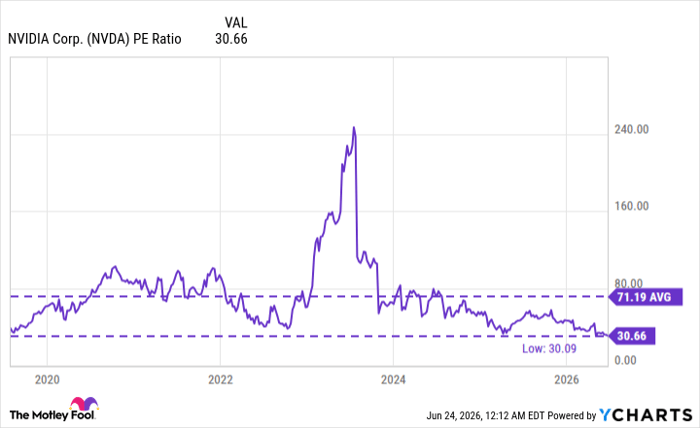
NVDA PE Ratio data by YCharts
In other words, Nvidia stock would have to more than double just to trade in line with its long-term average P/E ratio. I'm not suggesting that will happen immediately, but based on the company's projected earnings for fiscal 2027 (which I highlighted earlier), its stock trades at a forward P/E ratio of just 21.5. That means even if its stock doubles over the next six or seven months, its P/E would rise to just 43, which would still be far below its long-term average.
No matter which way you slice it, Nvidia stock looks extremely cheap right now, especially ahead of what could be the biggest product launch in its history. As a result, it could be a great buy right now.
Should you buy stock in Nvidia right now?
Before you buy stock in Nvidia, consider this:
The Motley Fool Stock Advisor analyst team just identified what they believe are the 10 best stocks for investors to buy now… and Nvidia wasn’t one of them. The 10 stocks that made the cut could produce monster returns in the coming years.
Consider when Netflix made this list on December 17, 2004... if you invested $1,000 at the time of our recommendation, you’d have $387,428!* Or when Nvidia made this list on April 15, 2005... if you invested $1,000 at the time of our recommendation, you’d have $1,221,398!*
Now, it’s worth noting Stock Advisor’s total average return is 895% — a market-crushing outperformance compared to 205% for the S&P 500. Don't miss the latest top 10 list, available with Stock Advisor, and join an investing community built by individual investors for individual investors.
See the 10 stocks »
*Stock Advisor returns as of June 26, 2026.
Anthony Di Pizio has no position in any of the stocks mentioned. The Motley Fool has positions in and recommends Nvidia. The Motley Fool has a disclosure policy.
Recommended Articles


