


Amazon Is Now the Worst Performer Among the "Magnificent Seven" Over the Last 5 Years. Is Amazon a No-Brainer Buy, or Is There More Room to Fall?
Key Points
Amazon has a powerful e-commerce business that's expensive to run.
CEO Andy Jassy estimates that Amazon Web Services' annual sales will grow to $600 billion in a decade.
- These 10 stocks could mint the next wave of millionaires ›
Amazon (NASDAQ: AMZN) has a lot going for it. The company has a huge e-commerce business that has transformed how people shop and disrupted the brick-and-mortar retail model. And its Amazon Web Services (AWS) is the biggest cloud computing company in the world, with a market share of nearly 30%.
The company also is emerging as a key player in satellite internet service. Its Amazon Leo is seeking to compete with Starlink, the satellite internet service of Space Exploration Technologies, or SpaceX, in operating networks of low-orbit satellites to provide mobile service and internet to underserved and rural areas.
Missed Nvidia in 2009? This Rare Signal Is Flashing Again. In 2009, a "Double Down" signal flashed for a little-known chipmaker called Nvidia. For the first time in years, that same "Total Conviction" signal is flashing for a company 1/100th the size of Nvidia. Continue »
Despite all this, Amazon shares aren't getting much love. Of all the members of the "Magnificent Seven" cohort, it has been the worst-performing stock, gaining only 33% over the last five years.
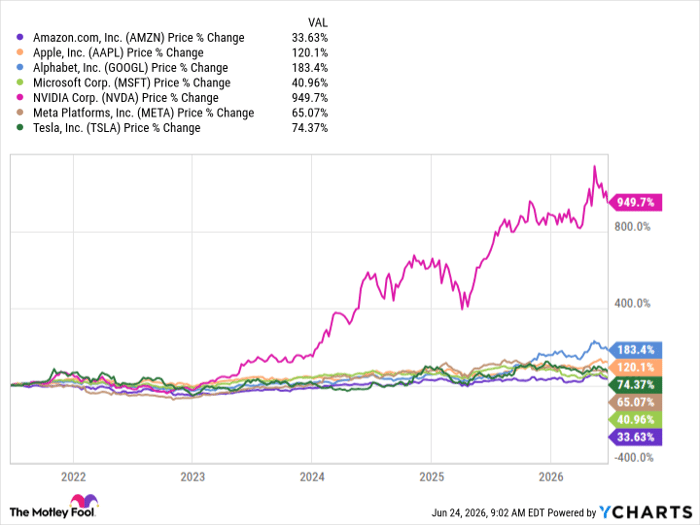
AMZN data by YCharts.
Why is Amazon struggling despite everything it has going for it? Let's take a look.
The headwinds facing Amazon
The company's e-commerce business is huge, but it's also very expensive. The problem is that it doesn't make much money despite generating hundreds of billions in sales every year.
In the first quarter, it had $181.5 billion in sales -- an impressive figure. Of that, $143.9 billion came from Amazon.com's domestic and international sales. But those sales also recorded $134.24 billion in expenses, leaving a small profit margin of just 6.7%.
Image source: The Motley Fool.
AWS is much more profitable and growing faster. In the first quarter, its sales were $37.58 billion, up 28.4% from a year ago. The segment generated $14.16 billion in profits, giving it a much healthier profit margin of 37.6%.
AWS is the most appealing part of Amazon's growth story right now. Grand View Research estimates that the cloud computing market is worth $1.1 trillion this year, up from $943 billion in 2025. And it forecasts that the industry will grow to $3.35 trillion by 2033, with a compound annual rate of 16%.
That's why hyperscalers like Amazon are building up their cloud computing capacity and buying GPUs from companies like Nvidia hand over fist. It had $131.8 billion in capital expenditures (capex) in 2025 and estimates it will spend $200 billion this year.
That's a scary number for many investors. AI chips such as GPUs are incredibly powerful, and you need to bundle hundreds of them in data centers to train and run AI programs. But GPUs also have a short lifespan because companies like Nvidia are constantly working to improve them and make them more powerful. So it's only natural for investors to question if Amazon and its peers can expect a reasonable return on their investments.
Amazon doubles down on AI
According to Reuters, CEO Andy Jassy projected that AWS will reach $600 billion in annual sales within a decade, doubling his previous estimate. At that rate, the segment would grow by about 17% per year, based on AWS' 2025 sales of $128.7 billion.
Jassy said AI provides a "very unusual opportunity to build this very large business, and we have very clear and significant demand signals. We're not just spending the $200 billion of capex because we're hoping AI is going to be big."
The size of the company's bet on AI is facing skepticism from Wall Street today, a major reason it is underperforming the rest of the Magnificent Seven. I think Amazon stock is still a buy, but only if you have a long-term investment horizon.
Don’t miss this second chance at a potentially lucrative opportunity
Ever feel like you missed the boat in buying the most successful stocks? Then you’ll want to hear this.
On rare occasions, our expert team of analysts issues a “Double Down” stock recommendation for companies that they think are about to pop. If you’re worried you’ve already missed your chance to invest, now is the best time to buy before it’s too late. And the numbers speak for themselves:
- Nvidia: if you invested $1,000 when we doubled down in 2009, you’d have $516,781!*
- Apple: if you invested $1,000 when we doubled down in 2008, you’d have $55,859!*
- Netflix: if you invested $1,000 when we doubled down in 2004, you’d have $387,428!*
Right now, we’re issuing “Double Down” alerts for three incredible companies, available when you join Stock Advisor, and there may not be another chance like this anytime soon.
See the 3 stocks »
*Stock Advisor returns as of June 26, 2026.
Patrick Sanders has positions in Nvidia. The Motley Fool has positions in and recommends Alphabet, Amazon, Apple, Meta Platforms, Microsoft, Nvidia, and Tesla. The Motley Fool has a disclosure policy.
Recommended Articles


