


Mara Holdings vs. Soluna Holdings: Which AI Pivot Is More Compelling?
Key Points
Soluna Holdings has a larger development pipeline, but it will take longer for the company to convert committed electricity supply into cash.
Mara Holdings is closer to monetizing its pipeline projects and has near-term goals, but it doesn't have as many gigawatts of secured power as Soluna Holdings.
- 10 stocks we like better than Soluna ›
When most tech sector investors think of neocloud businesses, the ones that come to mind are Nebius (NASDAQ: NBIS) and Iren (NASDAQ: IREN). And both of them have performed well for those who have held their shares over the last year and a half, delivering multibagger returns.
However, at this point, the AI data center operators offering investors the best chances for high returns may be a couple that aren't on most people's radars.
Where to invest $1,000 right now? Our analyst team just revealed what they believe are the 10 best stocks to buy right now, when you join Stock Advisor. See the stocks »
Mara Holdings (NASDAQ: MARA) and Soluna Holdings (NASDAQ: SLNH) don't receive as much attention in this industry. They are smaller than Nebius and Iren, but both have pivoted away from crypto mining and now have multigigawatt pipelines of AI data center projects under development. These projects should produce tremendous recurring revenues once they are complete. Here are some key details to consider when comparing these two growth stocks.
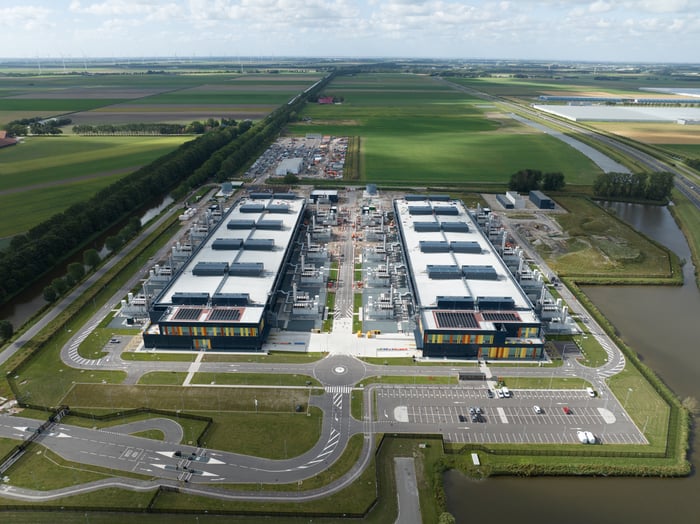
Image source: Getty Images.
Soluna Holdings has a larger gigawatt pipeline
If you're looking just at their development pipelines, Soluna Holdings is the winner. It closed out the first quarter with 4.3 gigawatts (GW) of data centers in the works. Mara Holdings only said it had 2.2 gigawatts of combined operational and development capacity in a recent press release.
For data center operators, securing gigawatts of power and development capacity puts them on course for higher annual recurring revenues in the future. Soluna Holdings has more potential, especially since it has added gigawatts quickly. The company's pipeline exceeded 1 gigawatt in Q3 2025 and reached 4.3 gigawatts in Q4 2025. Management cited "new curtailment assessments, active term sheet discussions, and six new development-stage projects" as the catalysts that resulted in that elevated power pipeline.
Soluna Holdings is following a similar playbook to Iren's: Get the gigawatts now and figure out the monetization later. For now, Soluna Holdings continues to burn through cash, but that's a problem across the entire industry.
Mara Holdings is closer to monetizing its sites
Although Soluna Holdings has a more impressive development pipeline, most of its sites are still in the early stages of construction. Mara Holdings is closer to artificial intelligence (AI) monetization, and the company recently outlined a near-term goal of delivering more than 1 gigawatt of IT capacity. Most of Soluna Holdings' 4.3 gigawatt pipeline is multiple years away from energization.
The longer it takes for neocloud providers to build and monetize AI data centers, the more they will have to rely on financing. Higher interest rates will take a toll on these companies' finances, but since Mara Holdings is closer to the finish line with its projects, it won't be affected as much.
Right now, neither of these companies is making much money. Soluna Holdings made $9.4 million in Q1, which was a 58% year-over-year increase, from a mix of data center hosting and crypto mining. Mara Holdings reported $174.6 million in revenue. Although it's a much higher figure, it represents an 18% year-over-year decline and is from crypto mining. Both companies reported heavy net losses as they work to break free from their unprofitable crypto mining business models.
Mara Holdings is making more progress in that regard. The company recently entered a partnership with Starwood Capital Group to jointly develop, finance, and operate digital infrastructure projects across Mara Holdings' existing energy capacity. That deal reduces Mara Holdings' financial burden as it seeks to capitalize on the AI build-out. Soluna Holdings also uses joint ventures to minimize its total costs.
These arrangements are good in the short run, but they involve giving up a percentage of the total revenue that these sites can generate. Since Mara Holdings is closer to monetization, it benefits from the present returns of joint ventures while maintaining greater near-term financial flexibility to build AI data centers without partners in the future.
The final verdict
There's no clear-cut answer as to which of these two picks is the better investment; your conclusion will depend largely on your risk tolerance. Soluna Holdings has greater potential due to its larger development pipeline. It can make substantially more money than Mara Holdings once it gets its new data centers energized and online.
However, Mara Holdings will likely make big tech deals with hyperscalers sooner and generate high annual recurring revenue. The fact that Mara Holdings is closer to monetization also reduces the execution and financial risks for its shareholders.
Both companies are well positioned to benefit from the rising demand for AI, which should continue for some time. Grand View Research projects that the AI market as a whole will grow at a 30.6% compound annual rate from now until 2033, and intensifying public activism in communities across the country against AI data center projects could make existing facilities more valuable.
Goldman Sachs recently released a report projecting that AI data center power demand in 2027 would be twice as much as it was in 2025. It's important to understand the tailwinds driving Mara Holdings' and Soluna Holdings' stock. It just comes down to how long investors are willing to wait for secured gigawatts to turn into dollars.
Should you buy stock in Soluna right now?
Before you buy stock in Soluna, consider this:
The Motley Fool Stock Advisor analyst team just identified what they believe are the 10 best stocks for investors to buy now… and Soluna wasn’t one of them. The 10 stocks that made the cut could produce monster returns in the coming years.
Consider when Netflix made this list on December 17, 2004... if you invested $1,000 at the time of our recommendation, you’d have $393,037!* Or when Nvidia made this list on April 15, 2005... if you invested $1,000 at the time of our recommendation, you’d have $1,280,627!*
Now, it’s worth noting Stock Advisor’s total average return is 913% — a market-crushing outperformance compared to 208% for the S&P 500. Don't miss the latest top 10 list, available with Stock Advisor, and join an investing community built by individual investors for individual investors.
See the 10 stocks »
*Stock Advisor returns as of June 23, 2026.
Marc Guberti has positions in Iren. The Motley Fool has positions in and recommends Goldman Sachs Group. The Motley Fool has a disclosure policy.
Recommended Articles


