


Fed Chair Kevin Warsh Dropped a Bombshell at the FOMC Meeting -- and It's What He Didn't Say That Matters Most
Key Points
Fed Chair Kevin Warsh oversaw his first FOMC meeting last week.
Though the central bank left interest rates unchanged (as expected), it's what was left out of the latest FOMC statement that holds the most weight.
Rate cuts appear to be firmly off the table, which is a potentially tough pill to swallow for an expensive stock market.
- 10 stocks we like better than S&P 500 Index ›
Over the last three weeks, Wall Street has witnessed the Dow Jones Industrial Average (DJINDICES: ^DJI), S&P 500 (SNPINDEX: ^GSPC), and Nasdaq Composite (NASDAQINDEX: ^IXIC) catapult to new highs, the debut of the largest-ever initial public offering (IPO), and a new Fed chair take the podium for the Federal Open Market Committee (FOMC). The FOMC is the 12-person body responsible for setting the nation's monetary policy.
After more than a year of public feuding over interest rates between President Donald Trump and now-former Fed Chair Jerome Powell, Trump's chosen successor to Powell, Kevin Warsh, was sworn in on May 22. Warsh entered last week's FOMC meeting with big shoes to fill, amid a three-year high for U.S. inflation.
Where to invest $1,000 right now? Our analyst team just revealed what they believe are the 10 best stocks to buy right now, when you join Stock Advisor. See the stocks »
While some aspects of Warsh's inaugural meeting as Fed chair went as expected, something big was missing -- and it has massive implications for Wall Street.
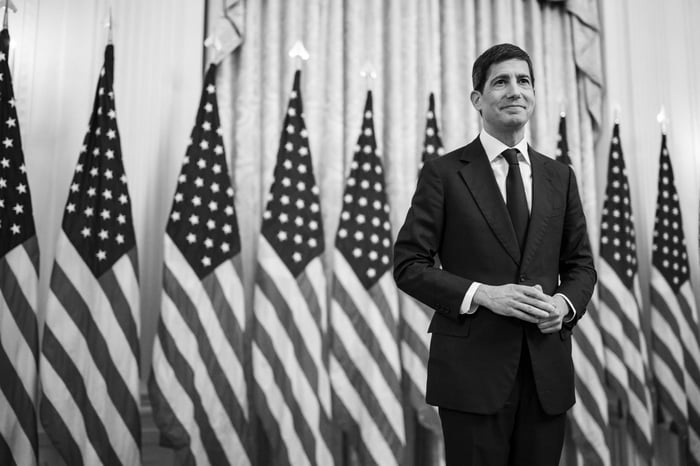
Fed Chair Kevin Warsh at his White House swearing-in ceremony. Image source: Official White House Photo by Daniel Torok.
It's what Fed Chair Warsh didn't say that holds the most weight
The headline of the FOMC's June statement is that all 12 voting members chose to leave the federal funds target rate unchanged at 3.5% to 3.75%. This was the first meeting in the last eight without a dissent.
But this headline misses what's arguably the biggest bombshell of Kevin Warsh's first FOMC meeting as Fed chair: the lack of an easing bias statement.
For well over a year, the FOMC's meeting statements have contained an easing bias -- i.e., a statement signaling that policymakers are more likely to cut interest rates as their next move. Between September 2024 and December 2025, the FOMC lowered the federal funds target rate six times.
Here are my three takeaways from the just-issued Federal Reserve statement:
-- Mohamed A. El-Erian (@elerianm) June 17, 2026
As widely expected, and by a 12-0 vote, the FOMC left interest rates and balance sheet management unchanged.
The new Chair's impact is already visible in today's communication. The statement itself... pic.twitter.com/cywpXmXPGa
But over the last 15 months, the U.S. economy has dealt with two price shocks. The first is President Trump's tariffs, which have added duties on select imported goods and pushed up prices for consumers.
However, the primary inflation catalyst is the Iran war. Iran's closure of the Strait of Hormuz shortly after U.S. military attacks began on Feb. 28 effectively halted the daily flow of 20 million barrels of petroleum liquids. The reaction in energy markets was swift, with fuel prices driving trailing 12-month inflation from 2.4% in February to 4.2% in May.
Perhaps unsurprisingly, three FOMC members dissented in Powell's final meeting in late April on the inclusion of the easing bias statement. In mid-May, the Fed meeting minutes showed a majority favored removing this statement.
Even though Warsh and the FOMC didn't officially shift to a neutral bias, the writing is on the wall that rate cuts are firmly off the table in the near term. It's a tough pill to swallow for Wall Street and investors, who were counting on a few rate cuts this year to fuel the debt-financed expansion of the artificial intelligence data center build-out.
Shiller PE is now less than 5% away from surpassing the level reached during the Dot Com Bubble which would give the stock market its most expensive valuation in history 🚨🚨🚨 pic.twitter.com/Qd8rvlVvUn
-- Barchart (@Barchart) May 14, 2026
Higher borrowing costs risk slowing this expansion and the otherworldly growth expectations attached to it. This is potentially problematic for a stock market that recently came within a stone's throw of its priciest valuation in 155 years.
What Fed Chair Kevin Warsh didn't say can completely reshape the stock market's outlook.
Should you buy stock in S&P 500 Index right now?
Before you buy stock in S&P 500 Index, consider this:
The Motley Fool Stock Advisor analyst team just identified what they believe are the 10 best stocks for investors to buy now… and S&P 500 Index wasn’t one of them. The 10 stocks that made the cut could produce monster returns in the coming years.
Consider when Netflix made this list on December 17, 2004... if you invested $1,000 at the time of our recommendation, you’d have $417,305!* Or when Nvidia made this list on April 15, 2005... if you invested $1,000 at the time of our recommendation, you’d have $1,293,148!*
Now, it’s worth noting Stock Advisor’s total average return is 936% — a market-crushing outperformance compared to 209% for the S&P 500. Don't miss the latest top 10 list, available with Stock Advisor, and join an investing community built by individual investors for individual investors.
See the 10 stocks »
*Stock Advisor returns as of June 23, 2026.
Sean Williams has no position in any of the stocks mentioned. The Motley Fool has no position in any of the stocks mentioned. The Motley Fool has a disclosure policy.
Recommended Articles


