


Crypto liquidations surpass $1.50 billion as Binance freezes $3 billion after hack
- Suspected hack of Binance wallets across the Bitcoin, Ethereum, and Tron networks triggers nearly $6 billion in outflows.
- CoinGlass data shows over $1.50 billion wiped out in the last 24 hours as broader market sentiment turns bearish.
- Bitcoin slips below $77,000 on Friday, extending Thursday’s 4% decline and heading toward a bearish October close with about 8% losses.
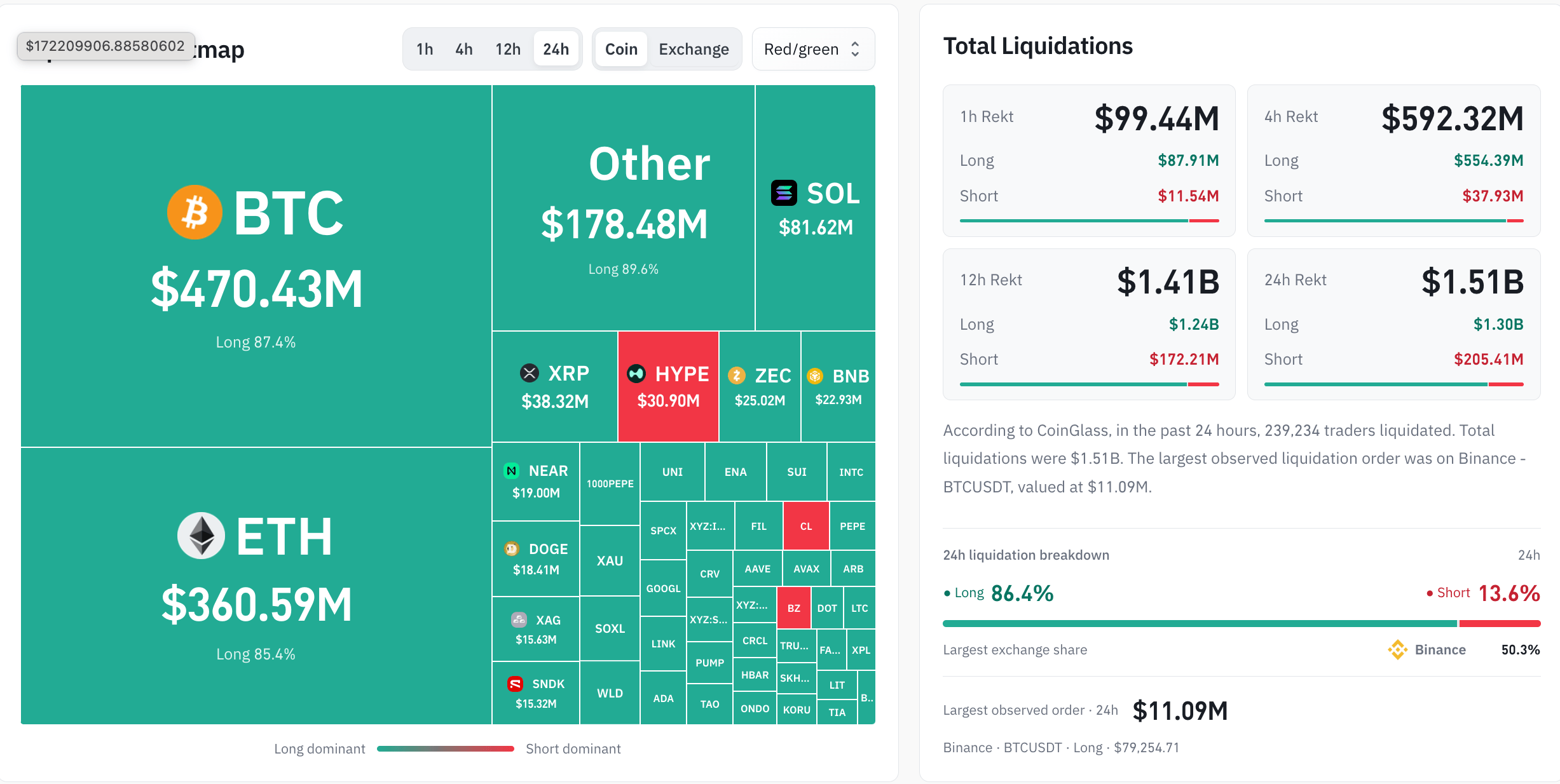
The broader cryptocurrency market is trading in the red on Friday, following news that the Binance wallets were hacked, resulting in the potential theft of $1.45 billion in Bitcoin (BTC) and $875 million in Ethereum (ETH), which could become the biggest crypto hack in history. The derivatives market witnessed over $1.50 billion in total liquidations over the last 24 hours, with Bitcoin slipping below $77,000.
Binance at risk of largest crypto hack ever
Changpeng Zhao, former CEO of Binance, was among the first to report a potential hack of Binance's hot wallet. The suspected hack affects wallets across the Bitcoin, Ethereum, and Tron (TRX) networks, putting $1.45 billion in BTC, $875 million in ETH, and other crypto assets at risk.
Binance, in a recent X post, announced the freezing of $3 billion in crypto assets, with the help of leading US Dollar-pegged stablecoin issuers, Tether and Circle. Paolo Ardoino, CEO of Tether, and Jeremy Allaire, Co-founder of Circle, revealed in separate X posts that they froze $1.567 billion in USDT and $800 million in USDC.
Binance continues to reaffirm in each of its social media updates that the user funds are safe, and the internal teams continue to work closely with law enforcement, issuers, blockchain intelligence firms, and industry partners to trace and freeze additional assets.
Bitcoin slips below $77,000, fueling crypto liquidations over $1.50 billion
The news of Binance, the largest crypto Centralized Exchange (CEX) by trading volume, being hacked for over $3 billion spread like wildfire among investors. Panic selling has pushed Bitcoin's price below $77,000 on Friday, extending the previous day's 4% decline.
In addition, the sell-off wiped out more than $1.50 billion in leveraged positions in the market. CoinGlass data shows total liquidations of $1.51 billion over the last 24 hours, led by $1.30 billion in long liquidations, reaffirming the near-term panic selling.
Technical outlook: Can Bitcoin extend its correction below $75,000?
Bitcoin trades around $76,676 at press time on Friday, retaining a bearish near-term bias below the 50-day Exponential Moving Average (EMA) at $80,556 while holding just above the 200-day EMA at $76,457. This configuration suggests the broader uptrend remains technically intact but under pressure, with price caught between long-term support and nearby overhead supply.
The Relative Strength Index (RSI) at 32 hovers near oversold territory, hinting at exhausted selling, yet the Moving Average Convergence Divergence (MACD) remains deeply negative, reinforcing the notion that downside risks persist.
Looking down, immediate support is seen at the 200-day EMA near $76,457, followed by the horizontal floor at $75,545. A daily close below this cluster would expose deeper levels at $70,000 as the next bearish target.
On the topside, initial resistance is provided by the 50-day EMA at $80,556, ahead of the horizontal barrier at $81,272, while a stronger recovery would need to clear $87,395 to ease the current bearish tone and reopen the path toward the recent highs.
(The technical analysis of this story was written with the help of an AI tool. Know more.)
Recommended Articles


