


Economists push back on Silicon Valley's AI job-loss warnings
Silicon Valley has been busy alerting workers about the risk of layoffs during the AI boom. However, empirical evidence collected by Stanford University, the U.S. Census Bureau, the Dallas Fed, and the London School of Economics (LSE) illustrates that the effect of AI has not been as drastic as expected.
The Financial Times pointed out this division effectively. While tech leaders are cautioning against the risk of large-scale displacement, economists looking at the payroll and employment numbers see the process working in a more targeted way, with younger workers under the greatest strain.
Silicon Valley’s numbers keep climbing
According to Anthropic’s CEO Dario Amodei, there is a high risk of AI putting into jeopardy almost half of the entry-level white-collar positions by 2030. Bill Gates has also stressed that if proper policies are not implemented, AI may result in even fewer jobs in as little as ten years.
Those forecasts go well beyond what researchers can measure today. They are not universally shared inside the industry either. OpenAI CEO Sam Altman said in May that he had been “pretty wrong” about the expected social and economic fallout and was “delighted” the feared jobs apocalypse had not arrived, as Cryptopolitan reported.
Payroll records tell a quieter story
The strongest proof is provided by the Stanford University Digital Economy Lab. In their study, Erik Brynjolfsson, Bharat Chandar and Ruyu Chen relied on ADP’s payroll data from a balanced panel covering roughly 3.5 million to 5 million employees monthly till June 2026. ADP handles payroll for employers of above 25 million people in the USA.
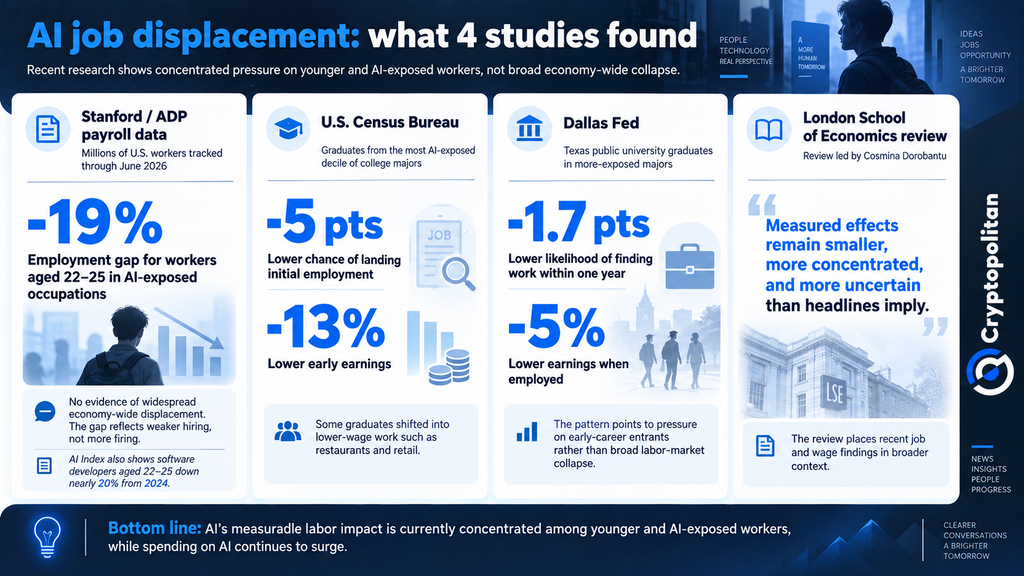
The Stanford study does not seem to indicate that job loss is widespread in the economy. Rather, it suggests that the impact is focused. Employment among those 22 to 25 years old working in AI-heavy jobs was approximately 19% lower than it would otherwise have been if it had followed the same trend as jobs that were not exposed to AI. The fall seems to be caused by fewer companies hiring people, rather than more companies firing them.
The Stanford 2026 AI Index shows almost the same trend in the area of software development. The employment of developers between 22 and 25 years of age went down by almost 20% starting in 2024.
The people getting squeezed are just starting out
A Census Bureau study found that graduates from the most AI-exposed decile of college majors were five percentage points less likely to land initial employment. Their early earnings were also 13% lower.
Some of that loss came from graduates moving into lower-paid work, including restaurants and retail.
The Dallas Fed found much the same. Computer science, computer engineering and languages ranked among the most exposed majors. Nursing, education and psychology were among the least exposed.
Graduates from areas where AI is more likely to have an impact on employment opportunities found jobs 1.7% less often in the first year after graduating. Additionally, those who did find a job received around 5% lower wages.
A paper that provides more information about the research was published by the LSE, and its authors have analyzed 138 sources, including 74 research papers. It concluded that the results are much less sensational than was expected. Overall, job and wage effects seem to be limited to certain groups and remain difficult to measure with certainty.
Spending can boom even if jobs don’t vanish
That distinction matters. AI does not need to trigger mass layoffs to reshape the labor market. It can weaken entry-level hiring first.
At the same time, spending keeps rising. Gartner expects worldwide AI spending to reach $2.7 trillion in 2026, up 49.5%, with AI infrastructure remaining the largest category.
For now, the bigger risk may not be entire jobs disappearing. It may be fewer ways for young workers to get their first one.
Don’t just read crypto news. Understand it. Subscribe to our newsletter. It's free.
บทความแนะนำ


