


Gold price plummets below $2,900 amid profit-taking, weak US Retail Sales
- Gold set to end the week up 0.80% despite Friday’s drop.
- US Retail Sales plunge, fueling US Dollar weakness and lower Treasury yields.
- Investors price in over one Fed rate cut, boosting bullion’s longer-term appeal.
Gold price has fallen below $2,900 on Friday, yet it will end the week with solid gains of over 0.80% as traders book profits ahead of the weekend. Economic data in the United States (US) was mixed, although the Greenback touched yearly lows and US Treasury yields plunged. XAU/USD trades at $2,883, down 1.48% daily.
Retail sales in the United States plunged sharply in January, weighing on the Greenback, which continues to weaken across the board. However, the golden metal benefitted from traders squaring off their positions amid tailwinds for bullion, which usually push prices higher.
After the data, investors priced in more than one interest rate cut by the Federal Reserve (Fed). Consequently, the US 10-year T-note yield dropped six basis points to 4.472%.
Other data revealed that Industrial Production improved in January after registering disappointing figures in the previous month.
Daily digest market movers: Gold price dives amid failing US yields, soft US Dollar
- The US 10-year Treasury bond yield tanks five basis points (bps) and is down at 4.48%.
- US real yields, which correlate inversely to Bullion prices, dip four basis points to 2.041%, a tailwind for XAU/USD.
- US Retail Sales contracted by -0.9% MoM in January, sharply underperforming the expected -0.1%, despite an upward revision of December’s figure to a 0.7% increase.
- Industrial Production grew by 0.5% MoM in January, slowing from December’s 1% expansion but exceeding the forecasted 0.3% increase.
- The World Gold Council (WGC) revealed that central banks purchased over 1,000 tons of gold for the third consecutive year in 2024. Following Trump's electoral victory, purchases by central banks surged by more than 54% year-over-year to 333 tons, according to WGC data.
- Money market fed funds rate futures are pricing 38.5 basis points of easing by the Federal Reserve in 2025.
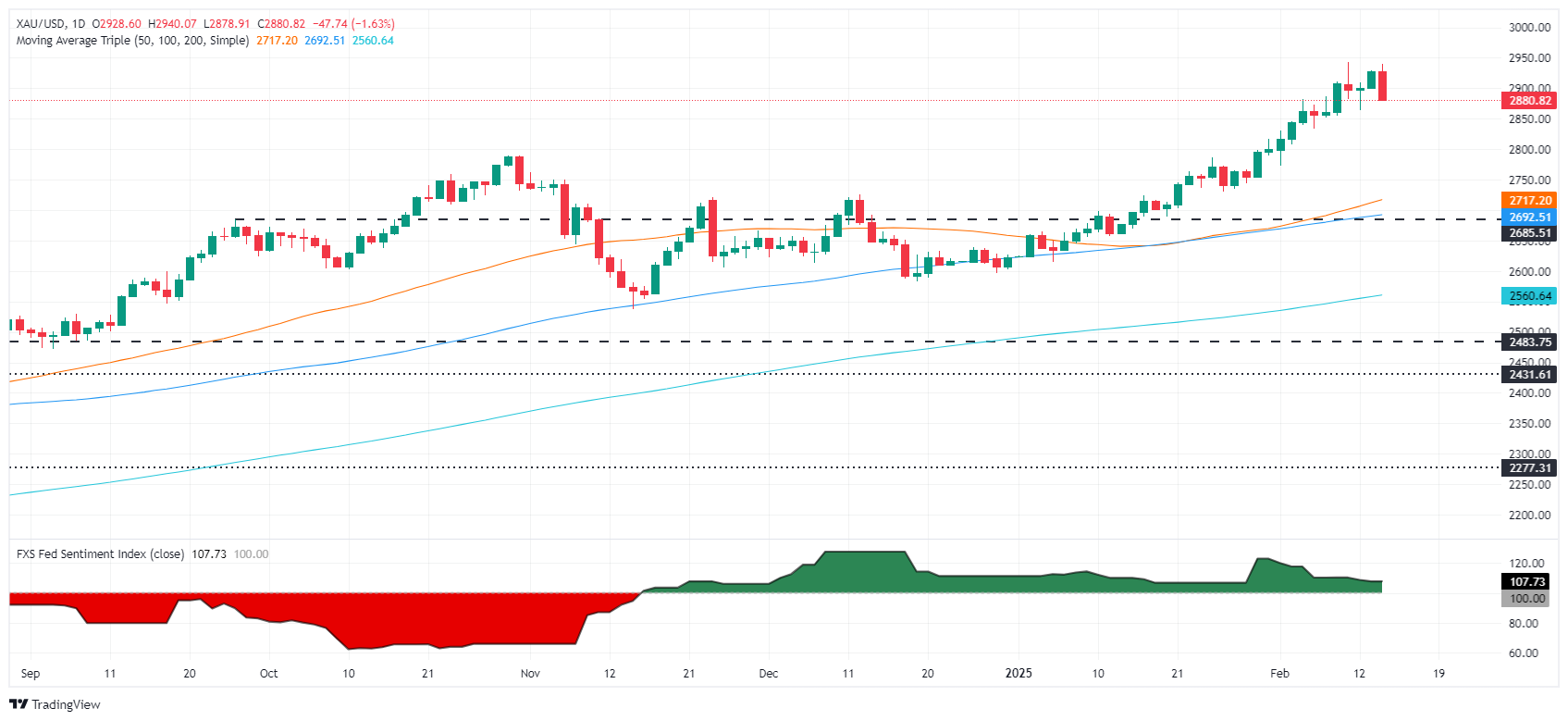
XAU/USD technical outlook: Gold price pulls back after reaching an all-time high
Gold price uptrend remains intact, though it is retracing and has hit a two-day low of $2,878. It should be said that the Relative Strength Index (RSI) exited from overbought territory after staying there for most of February. Therefore, XAU/USD’s drop might be halted if buyers defend the February 12 daily low of $2,864.
This exposed the first key support level as the psychological $2,850 mark. Once surpassed, the October 31 cycle high turned support at $2,790 is next, followed by January 27’s swing low of $2,730.
Conversely, if buyers lift Gold prices above $2,900, the next resistance would be the all-time high at $2,942. A breach of the latter will clear the path towards $2,950, followed by the $3,000 milestone for the golden metal.
Gold FAQs
Gold has played a key role in human’s history as it has been widely used as a store of value and medium of exchange. Currently, apart from its shine and usage for jewelry, the precious metal is widely seen as a safe-haven asset, meaning that it is considered a good investment during turbulent times. Gold is also widely seen as a hedge against inflation and against depreciating currencies as it doesn’t rely on any specific issuer or government.
Central banks are the biggest Gold holders. In their aim to support their currencies in turbulent times, central banks tend to diversify their reserves and buy Gold to improve the perceived strength of the economy and the currency. High Gold reserves can be a source of trust for a country’s solvency. Central banks added 1,136 tonnes of Gold worth around $70 billion to their reserves in 2022, according to data from the World Gold Council. This is the highest yearly purchase since records began. Central banks from emerging economies such as China, India and Turkey are quickly increasing their Gold reserves.
Gold has an inverse correlation with the US Dollar and US Treasuries, which are both major reserve and safe-haven assets. When the Dollar depreciates, Gold tends to rise, enabling investors and central banks to diversify their assets in turbulent times. Gold is also inversely correlated with risk assets. A rally in the stock market tends to weaken Gold price, while sell-offs in riskier markets tend to favor the precious metal.
The price can move due to a wide range of factors. Geopolitical instability or fears of a deep recession can quickly make Gold price escalate due to its safe-haven status. As a yield-less asset, Gold tends to rise with lower interest rates, while higher cost of money usually weighs down on the yellow metal. Still, most moves depend on how the US Dollar (USD) behaves as the asset is priced in dollars (XAU/USD). A strong Dollar tends to keep the price of Gold controlled, whereas a weaker Dollar is likely to push Gold prices up.
Artigos Recomendados


