

EUR/USD drifts further away from highs amid thin year-end trading
- EUR/USD extends losses for the sixth consecutive day, nearing 1.1700.
- The minutes of the December Fed meeting provided some support for the US Dollar.
- The pair has broken below trendline support, a negative sign.
EUR/USD loses ground for the sixth consecutive day on Wednesday, trading below 1.1740 after peaking above 1.1800 last week. The pair struggles amid a moderate US Dollar (USD) rebound following the release of December's Federal Reserve Monetary Policy Meeting minutes.
The pair, however, is set to close the year 14% higher, boosted by the monetary policy divergence between the European Central Bank (ECB) and the Fed. Apart from that, US President Donald Trump's erratic trade policies and the softening US economy have weighed heavily on the Greenback.
On Tuesday, the FOMC's minutes confirmed the wide divergence among policymakers. The monetary policy committee approved a 25 basis points rate cut by a lower margin than previously thought and conditioned further monetary policy easing to a steady decline of inflation, which casts doubts about the timing of the next interest rate cut. The US Dollar appreciated after the release of the minutes.
In the macroeconomic calendar, the release of the US Initial Jobless Claims will gather investors' attention. Still, volumes are likely to remain at thin levels as most markets will be closed on Thursday amid the New Year festivities and with Japanese markets shut for the rest of the week.
Euro Price Today
The table below shows the percentage change of Euro (EUR) against listed major currencies today. Euro was the strongest against the New Zealand Dollar.
| USD | EUR | GBP | JPY | CAD | AUD | NZD | CHF | |
|---|---|---|---|---|---|---|---|---|
| USD | 0.07% | 0.05% | 0.09% | 0.04% | 0.07% | 0.35% | 0.08% | |
| EUR | -0.07% | -0.02% | 0.02% | -0.02% | 0.00% | 0.28% | 0.02% | |
| GBP | -0.05% | 0.02% | 0.04% | -0.01% | 0.02% | 0.30% | 0.04% | |
| JPY | -0.09% | -0.02% | -0.04% | -0.05% | -0.03% | 0.25% | 0.01% | |
| CAD | -0.04% | 0.02% | 0.01% | 0.05% | 0.02% | 0.27% | 0.05% | |
| AUD | -0.07% | 0.00% | -0.02% | 0.03% | -0.02% | 0.28% | 0.03% | |
| NZD | -0.35% | -0.28% | -0.30% | -0.25% | -0.27% | -0.28% | -0.26% | |
| CHF | -0.08% | -0.02% | -0.04% | -0.01% | -0.05% | -0.03% | 0.26% |
The heat map shows percentage changes of major currencies against each other. The base currency is picked from the left column, while the quote currency is picked from the top row. For example, if you pick the Euro from the left column and move along the horizontal line to the US Dollar, the percentage change displayed in the box will represent EUR (base)/USD (quote).
Daily Digest Market Movers: Fed minutes push the US Dollar higher
- The Euro accelerated its pullback on Tuesday as the minutes of December's Fed meeting cast doubt on the date of the next interest rate cut. The US Dollar, however, is set to close its worst yearly performance in the last eight years.
- The Dollar Index (DXY), which measures the value of the USD against a basket of six currencies, has depreciated nearly 10% in the last 12 months.
- The minutes of the December 9-10 Fed Monetary Policy Meeting confirmed that the decision to cut rates by a quarter-point was approved by 9 votes against 3, the highest number of dissenters in the last six years. The divergence within the monetary policy committee reflects the challenging task of setting monetary policy to support a deteriorating labour market without boosting the already strong inflationary pressures.
- The minutes also revealed that most committee members judged that further rate cuts would likely be appropriate if inflation declined in line with the central bank's projections, and signalled one rate cut in 2026 and another one in 2027.
- On Wednesday, the focus will turn to the weekly US Jobless Claims report, which is expected to show that first-time applications for unemployment benefits rose to 220K in the week of December 26 from 214K on the previous one.
Technical Analysis: EUR/USD dips below trendline support
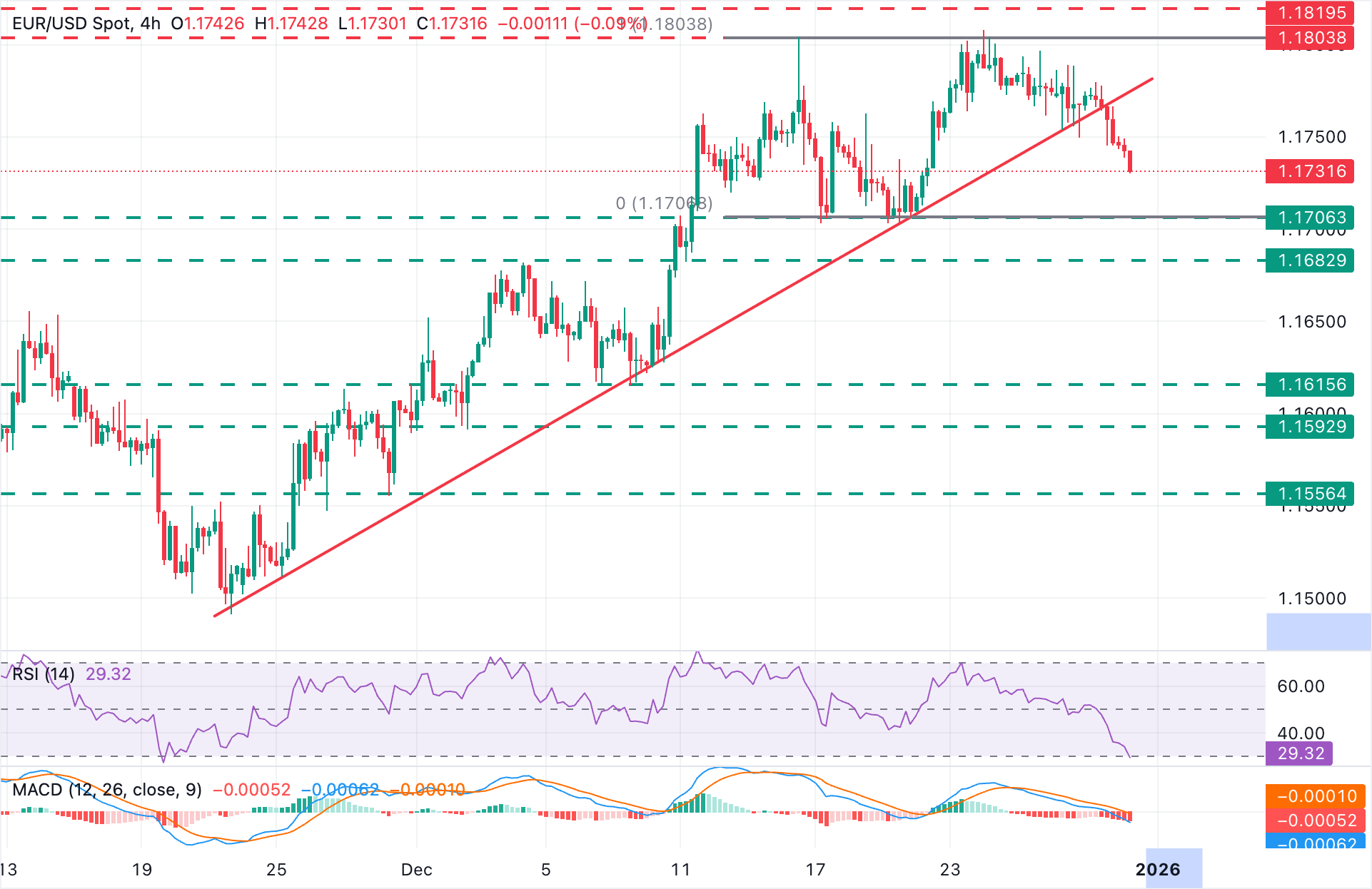
The EUR/USD pair's reversal from last week's high at 1.1808 has extended below the trendline support, highlighting the pair's growing bearish pressure. The 4-hour Relative Strength Index (RSI) is low, flirting with oversold levels, and the Moving Average Convergence Divergence (MACD) indicator trends lower, reflecting a growing negative momentum.
Bears are now looking at the December 17 and 19 lows near 1.1700. Further down, the next targets are the December 4 high and December 11 low, around 1.1680, ahead of the December 8 and 9 lows in the area of 1.1615.
To the upside, the reverse trendline, now at 1.1760, is likely to pose a significant resistance in case of a bullish reversal. This level closes the path towards the December 16 and 24 highs near 1.1805 area, and the September 23 and 24 highs near 1.1820.
Interest rates FAQs
Interest rates are charged by financial institutions on loans to borrowers and are paid as interest to savers and depositors. They are influenced by base lending rates, which are set by central banks in response to changes in the economy. Central banks normally have a mandate to ensure price stability, which in most cases means targeting a core inflation rate of around 2%. If inflation falls below target the central bank may cut base lending rates, with a view to stimulating lending and boosting the economy. If inflation rises substantially above 2% it normally results in the central bank raising base lending rates in an attempt to lower inflation.
Higher interest rates generally help strengthen a country’s currency as they make it a more attractive place for global investors to park their money.
Higher interest rates overall weigh on the price of Gold because they increase the opportunity cost of holding Gold instead of investing in an interest-bearing asset or placing cash in the bank. If interest rates are high that usually pushes up the price of the US Dollar (USD), and since Gold is priced in Dollars, this has the effect of lowering the price of Gold.
The Fed funds rate is the overnight rate at which US banks lend to each other. It is the oft-quoted headline rate set by the Federal Reserve at its FOMC meetings. It is set as a range, for example 4.75%-5.00%, though the upper limit (in that case 5.00%) is the quoted figure. Market expectations for future Fed funds rate are tracked by the CME FedWatch tool, which shapes how many financial markets behave in anticipation of future Federal Reserve monetary policy decisions.
Artigos Recomendados


