

Australian Dollar moves little due to thin holiday trading
- Australian Dollar rebounds toward a 14-month high of 0.6727.
- The RBA board is prepared to tighten policy should inflation not moderate as anticipated.
- FOMC December Meeting Minutes will be eyed on Tuesday for insight into the Fed’s 2026 outlook.
The Australian Dollar (AUD) inches higher against the US Dollar (USD), rebounding toward the 14-month high of 0.6727 on Tuesday. The AUD finds support amid growing expectations of interest rate hikes from the Reserve Bank of Australia (RBA). Volumes are expected to be thin due to the New Year's holiday in Australia.
The Reserve Bank of Australia’s (RBA) December Meeting Minutes signaled growing uncertainty among board members about whether monetary policy remains sufficiently restrictive. The policymakers indicated it stands ready to tighten policy if inflation fails to ease as expected, placing increased focus on the Q4 CPI report due January 28. Analysts note that a stronger-than-expected Q4 core inflation reading could trigger a rate hike at the RBA’s February 3 meeting.
The AUD/USD pair could rise as the US Dollar (USD) could face challenges amid ongoing expectations of two more rate cuts by the Federal Reserve (Fed) in 2026. Traders are likely to focus on the Federal Open Market Committee (FOMC) December Meeting Minutes due later in the day.
US Dollar holds ground despite Fed rate cut bets
- The US Dollar Index (DXY), which measures the value of the US Dollar against six major currencies, is gaining ground and trading around 98.00 at the time of writing.
- The Fed lowered the interest rates by 25 basis points (bps) at the December meeting, bringing the target range to 3.50%–3.75%. The Fed delivered a cumulative 75 bps of rate cuts in 2025 amid a cooling labor market and still-elevated inflation.
- The CME FedWatch tool shows an 83.9% probability of rates being held at the Fed’s January meeting, up from 80.1% a week earlier. Meanwhile, the likelihood of a 25-basis-point rate cut has fallen to 16.1% from 19.9% a week ago.
- US Initial Jobless Claims declined to 214K from 224K in the prior week, beating the 223K market forecast. Meanwhile, Continuing Jobless Claims rose to 1.923 million from 1.885 million, while the four-week average of Initial Claims edged lower to 216.75K from 217.5K.
- The US Bureau of Economic Analysis (BEA) released delayed data showing that preliminary US Gross Domestic Product (GDP) Annualized expanded 4.3% in the July–September period. The reading exceeded market expectations of a 3.3% increase and surpassed the 3.8% growth recorded in the previous quarter.
- Bloomberg reported Sunday that China’s Ministry of Finance plans to expand targeted investment in priority sectors, including advanced manufacturing, technological innovation, and human capital development. The announcement followed a year-end meeting outlining next year’s fiscal policy priorities. Any impact on China’s economy could affect the AUD, given Australia’s close trade ties with China.
- Australia’s headline inflation rose to 3.8% in October 2025 from 3.6% in September, remaining above the RBA’s 2–3% target range. As a result, markets are increasingly pricing in a rate hike as early as February 2026, with both the Commonwealth Bank of Australia and National Australia Bank projecting a rise to 3.85% at the RBA’s first policy meeting of the year.
- Australia’s Consumer Inflation Expectations rose to 4.7% in December from November’s three-month low of 4.5%, supporting the Reserve Bank of Australia’s (RBA) hawkish stance.
Australian Dollar tests 0.6700 barrier after rebounding from nine-day EMA
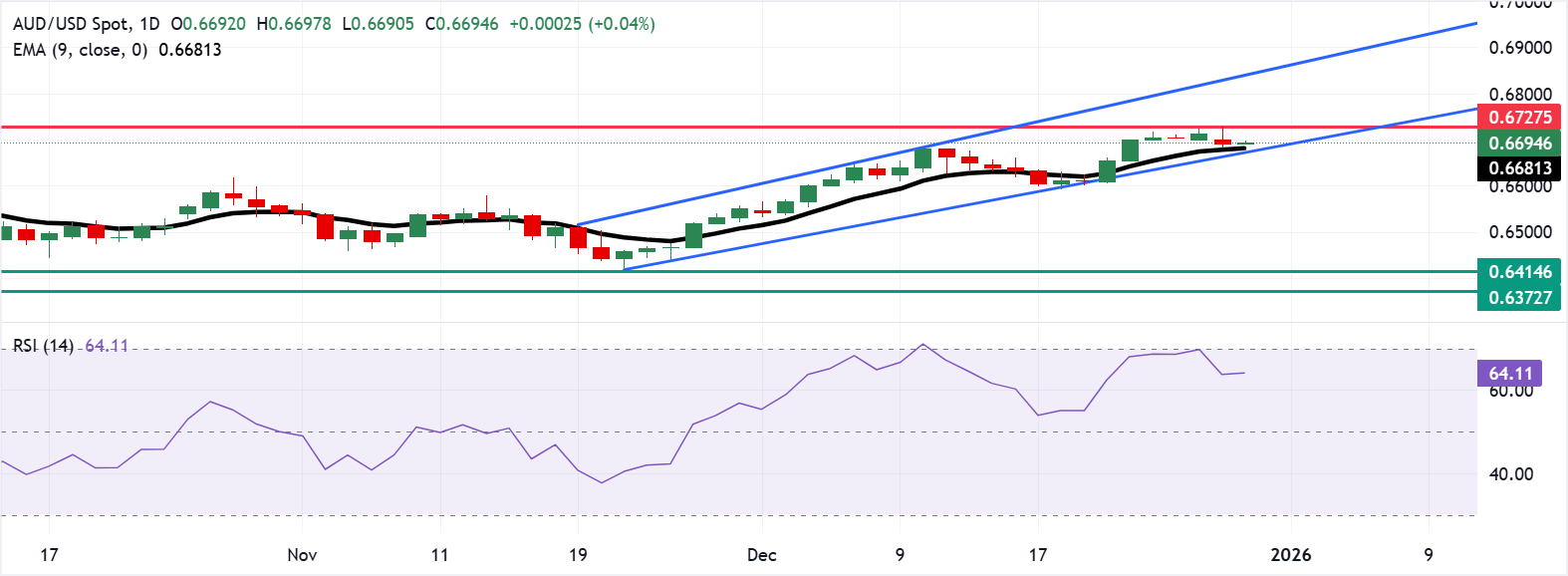
AUD/USD is trading around 0.6690 on Tuesday. The technical analysis of the daily chart indicates that the pair remains within the ascending channel pattern, suggesting a persistent bullish bias. The pair holds above a rising nine-day Exponential Moving Average (EMA), preserving the short-term uptrend. The average continues to advance, keeping a bullish bias in place. The 14-day Relative Strength Index (RSI) at 64.22 signals strong momentum.
After rebounding from a nine-day EMA support, the AUD/USD pair is testing the immediate resistance at the psychological level of 0.6700, followed by the 0.6727, the highest level since October 2024, reached on December 29. The daily tone stays positive above the moving average, which could support the pair to break above the latter and explore the region around the upper boundary of the ascending channel at 0.6840.
On the downside, a break below the nine-day EMA at 0.6681, followed by the lower ascending channel boundary around 0.6670, would open the doors for the AUD/USD pair to navigate the region around the six-month low near 0.6414, marked on August 21.
Australian Dollar Price Today
The table below shows the percentage change of Australian Dollar (AUD) against listed major currencies today. Australian Dollar was the strongest against the Japanese Yen.
| USD | EUR | GBP | JPY | CAD | AUD | NZD | CHF | |
|---|---|---|---|---|---|---|---|---|
| USD | -0.01% | 0.02% | 0.13% | -0.04% | -0.05% | -0.03% | -0.09% | |
| EUR | 0.01% | 0.03% | 0.13% | -0.02% | -0.04% | -0.01% | -0.06% | |
| GBP | -0.02% | -0.03% | 0.13% | -0.07% | -0.07% | -0.04% | -0.11% | |
| JPY | -0.13% | -0.13% | -0.13% | -0.17% | -0.17% | -0.16% | -0.17% | |
| CAD | 0.04% | 0.02% | 0.07% | 0.17% | 0.00% | 0.05% | -0.04% | |
| AUD | 0.05% | 0.04% | 0.07% | 0.17% | -0.01% | 0.02% | -0.04% | |
| NZD | 0.03% | 0.01% | 0.04% | 0.16% | -0.05% | -0.02% | -0.06% | |
| CHF | 0.09% | 0.06% | 0.11% | 0.17% | 0.04% | 0.04% | 0.06% |
The heat map shows percentage changes of major currencies against each other. The base currency is picked from the left column, while the quote currency is picked from the top row. For example, if you pick the Australian Dollar from the left column and move along the horizontal line to the US Dollar, the percentage change displayed in the box will represent AUD (base)/USD (quote).
Australian Dollar FAQs
One of the most significant factors for the Australian Dollar (AUD) is the level of interest rates set by the Reserve Bank of Australia (RBA). Because Australia is a resource-rich country another key driver is the price of its biggest export, Iron Ore. The health of the Chinese economy, its largest trading partner, is a factor, as well as inflation in Australia, its growth rate and Trade Balance. Market sentiment – whether investors are taking on more risky assets (risk-on) or seeking safe-havens (risk-off) – is also a factor, with risk-on positive for AUD.
The Reserve Bank of Australia (RBA) influences the Australian Dollar (AUD) by setting the level of interest rates that Australian banks can lend to each other. This influences the level of interest rates in the economy as a whole. The main goal of the RBA is to maintain a stable inflation rate of 2-3% by adjusting interest rates up or down. Relatively high interest rates compared to other major central banks support the AUD, and the opposite for relatively low. The RBA can also use quantitative easing and tightening to influence credit conditions, with the former AUD-negative and the latter AUD-positive.
China is Australia’s largest trading partner so the health of the Chinese economy is a major influence on the value of the Australian Dollar (AUD). When the Chinese economy is doing well it purchases more raw materials, goods and services from Australia, lifting demand for the AUD, and pushing up its value. The opposite is the case when the Chinese economy is not growing as fast as expected. Positive or negative surprises in Chinese growth data, therefore, often have a direct impact on the Australian Dollar and its pairs.
Iron Ore is Australia’s largest export, accounting for $118 billion a year according to data from 2021, with China as its primary destination. The price of Iron Ore, therefore, can be a driver of the Australian Dollar. Generally, if the price of Iron Ore rises, AUD also goes up, as aggregate demand for the currency increases. The opposite is the case if the price of Iron Ore falls. Higher Iron Ore prices also tend to result in a greater likelihood of a positive Trade Balance for Australia, which is also positive of the AUD.
The Trade Balance, which is the difference between what a country earns from its exports versus what it pays for its imports, is another factor that can influence the value of the Australian Dollar. If Australia produces highly sought after exports, then its currency will gain in value purely from the surplus demand created from foreign buyers seeking to purchase its exports versus what it spends to purchase imports. Therefore, a positive net Trade Balance strengthens the AUD, with the opposite effect if the Trade Balance is negative.
Artigos Recomendados


