

USD/INR hits record high above 90.00 on surging India’s fiscal deficit, foreign outflow
- The Indian Rupee slumps to 90.30 against the US Dollar, the lowest level ever.
- Continuous FIIs selling in Indian stock market and rising fiscal deficit have weighed on the Indian Rupee.
- White House economic adviser Hassett’s selection as the Fed’s chair could dampen the central bank’s independence.
The Indian Rupee (INR) extends its losing streak against the US Dollar (USD) for the third trading day on Wednesday, sliding to a fresh all-time low around 90.30 in the opening session. The USD/INR pair enters uncharted territory as the synergetic effect of consistent foreign outflows and soaring fiscal deficit is hitting India’s forex reserves, resulting in significant pressure on the Indian Rupee.
Foreign Institutional Investors (FIIs) have been paring stake in the Indian equity market for months. Overseas investors have turned out to be net sellers in the first two trading days of December, extending their five-month selling spree further. Cumulatively, FIIs have pared their stake worth Rs. 4,813.61 crore on Monday and Tuesday.
Additionally, India’s surging Balance of Payments (BoP) deficit due to higher tariffs on imports from India to the United States (US) is also a major drag on the Indian Rupee. In the third quarter, net capital flows fell to just $0.6 billion, from $8 billion recorded in the second quarter this year.
Going forward, the next major trigger for the Indian Rupee will be the monetary policy announcement by the Reserve Bank of India (RBI) on Friday. The Indian central bank is expected to cut its Repo Rate by 25 basis points (bps) to 5.25% as inflation in India has remained well below the tolerance range of 2%-6% in the past few months.
White House economic adviser Hassett appears to be frontrunner for Fed’s next chair
- The Indian Rupee struggles to gain ground against the US Dollar, even as the latter underperforms broadly. During the press time, the US Dollar Index (DXY), which tracks the Greenback’s value against six major currencies, trades 0.12% lower to near 99.20, narrowly distant from its monthly low of 99.00.
- The US Dollar has come under pressure amid growing expectations that White House Economic Adviser Kevin Hassett could be hired as the next Federal Reserve (Fed) Chairman.
- While addressing reporters at a White House event on Tuesday, US President Donald Trump stated that he has narrowed his choices for Fed Chair Jerome Powell’s successor to one, whose term will end in May 2026, and took the name of economic adviser Hassett in the end of his comments.
- I guess a potential Fed chair is here too. Am I allowed to say that? Potential. He’s a respected person, that I can tell you. Thank you, Kevin," Trump said, Reuters reported.
- White House economic adviser Hassett’s selection as the Fed’s next chair would raise questions over the credibility of the central bank’s decisions going forward, assuming that his decisions will be biased towards US President Trump’s economic agenda.
- US President Trump has criticized Fed Chair Powell several times for maintaining a restrictive monetary policy stance despite inflationary pressures remaining well above the 2% target.
- White House economic adviser Hassett’s decisions, bent towards Trump’s favoured policies, will be unfavourable for the US Dollar.
- On the economic data front, investors await the US ADP Employment Change and the ISM Services PMI data for November, which will be published during the North American session. Economists expect private employers to have added fresh 10K workers, significantly lower than 42K in October. The ISM Services PMI is expected to come in lower at 52.1 from 52.4 in October.
Technical Analysis: USD/INR refreshes all-time high near 90.30
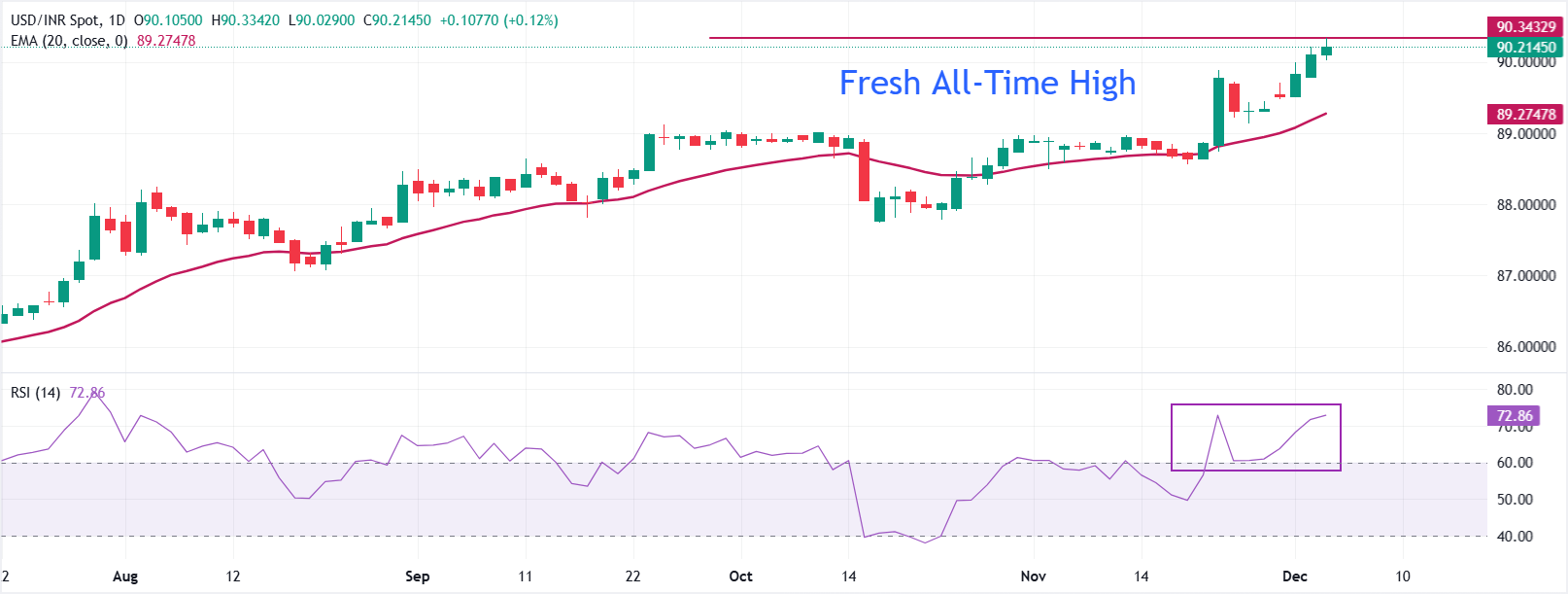
USD/INR trades at 90.2145 in the opening trade on Wednesday. The 20-day Exponential Moving Average (EMA) keeps rising, and the price holds above it, reinforcing a bullish short-term tone.
RSI at 72.86 is overbought, flagging stretched momentum that could prompt consolidation. Initial support is the 20-day EMA at 89.2748; above this gauge, the uptrend would stay in place.
The 20-day EMA slope has accelerated in recent sessions, confirming trend strength and suggesting buyers retain control on pullbacks.
RSI remains elevated, and a cooling of momentum could precede another push higher rather than mark a trend change. A daily close back below the average would start to ease upward pressure, while sustained trade above it keeps risks tilted to the upside.
(The technical analysis of this story was written with the help of an AI tool)
Indian Rupee FAQs
The Indian Rupee (INR) is one of the most sensitive currencies to external factors. The price of Crude Oil (the country is highly dependent on imported Oil), the value of the US Dollar – most trade is conducted in USD – and the level of foreign investment, are all influential. Direct intervention by the Reserve Bank of India (RBI) in FX markets to keep the exchange rate stable, as well as the level of interest rates set by the RBI, are further major influencing factors on the Rupee.
The Reserve Bank of India (RBI) actively intervenes in forex markets to maintain a stable exchange rate, to help facilitate trade. In addition, the RBI tries to maintain the inflation rate at its 4% target by adjusting interest rates. Higher interest rates usually strengthen the Rupee. This is due to the role of the ‘carry trade’ in which investors borrow in countries with lower interest rates so as to place their money in countries’ offering relatively higher interest rates and profit from the difference.
Macroeconomic factors that influence the value of the Rupee include inflation, interest rates, the economic growth rate (GDP), the balance of trade, and inflows from foreign investment. A higher growth rate can lead to more overseas investment, pushing up demand for the Rupee. A less negative balance of trade will eventually lead to a stronger Rupee. Higher interest rates, especially real rates (interest rates less inflation) are also positive for the Rupee. A risk-on environment can lead to greater inflows of Foreign Direct and Indirect Investment (FDI and FII), which also benefit the Rupee.
Higher inflation, particularly, if it is comparatively higher than India’s peers, is generally negative for the currency as it reflects devaluation through oversupply. Inflation also increases the cost of exports, leading to more Rupees being sold to purchase foreign imports, which is Rupee-negative. At the same time, higher inflation usually leads to the Reserve Bank of India (RBI) raising interest rates and this can be positive for the Rupee, due to increased demand from international investors. The opposite effect is true of lower inflation.
Artigos Recomendados


