

Japanese Yen climbs to over one-week top vs USD amid divergent BoJ-Fed expectations
- The Japanese Yen kicks off the new week on a positive note amid rising BoJ rate hike bets.
- A softer risk tone benefits the safe-haven JPY and weighs on USD/JPY amid a weaker USD.
- Dovish Fed expectations drag the USD to a nearly two-week low during the Asian session.
The Japanese Yen (JPY) jumps to a one-and-a-half-week top against a broadly weaker US Dollar (USD) during the Asian session on Monday. The latest comments from Bank of Japan (BoJ) Governor Kazuo Ueda reaffirmed bets for an imminent interest rate hike, pushing Japanese government bond (JGB) yields to their highest levels in years. The resultant narrowing of the rate differential between Japan and other major economies provides a goodish lift to the JPY at the start of a new week.
Apart from this, a softer tone around the equity markets is seen as another factor that benefits the JPY's safe-haven status. The USD, on the other hand, remains depressed amid dovish Federal Reserve (Fed) expectations and further contributes to the USD/JPY pair's downfall to the 155.50-155.45 region. Traders now look forward to this week's key US macro releases, scheduled at the beginning of a new month, starting with the ISM Manufacturing PMI later today, for a fresh impetus.
Japanese Yen bulls look to seize control amid hawkish BoJ expectations
- Bank of Japan Governor Kazuo Ueda reiterated on Monday that the central bank remains on track to raise interest rates further if prices and the economy continue to unfold as expected. The likelihood of the BoJ’s baseline scenario for growth and inflation being realised is gradually increasing, Ueda added further.
- This reaffirms market bets for a BoJ rate hike move, either in December or January, and lifts the rate-sensitive two-year Japanese government bond yield to 1% for the first time since June 2008. Moreover, the 20-year yield advances to levels not seen since November 2020 and lifts the lower-yielding Japanese Yen.
- Japan's Ministry of Finance reported earlier today that Capital Spending rose for the third straight quarter, by 2.9% from a year earlier during the July-September quarter. This, however, marks a notable slowdown from the 7.6% rise recorded in the previous quarter, though it does little to influence the JPY.
- Japan's Composite PMI 2025 was finalized at 52.0 for November, up from 51.5 in the previous month. This pointed to modest growth in the overall private sector due to a combination of the slower decline in factory activity, which shrank for the fifth straight month, and continued growth in services.
- Meanwhile, Japan's Prime Minister Sanae Takaichi promises to continue fiscal management, while paying close attention to interest rate trends and other factors. This, along with the US Dollar (USD) selling bias, exerts some downward pressure on the USD/JPY pair during the Asian session.
- The recent dovish remarks by several Federal Reserve officials lifted market bets for another interest rate cut in December. This, in turn, drags the USD Index (DXY), which tracks the Greenback against a basket of currencies, to a nearly two-week low and further weighs on the USD/JPY pair.
- Traders now look forward to the release of the US ISM Manufacturing PMI for some impetus later during the North American session. Furthermore, this week's important US macro releases, scheduled at the start of a new month, will play a key role in influencing the USD and the USD/JPY pair.
USD/JPY could accelerate the fall below the 155.40-155.35 confluence support
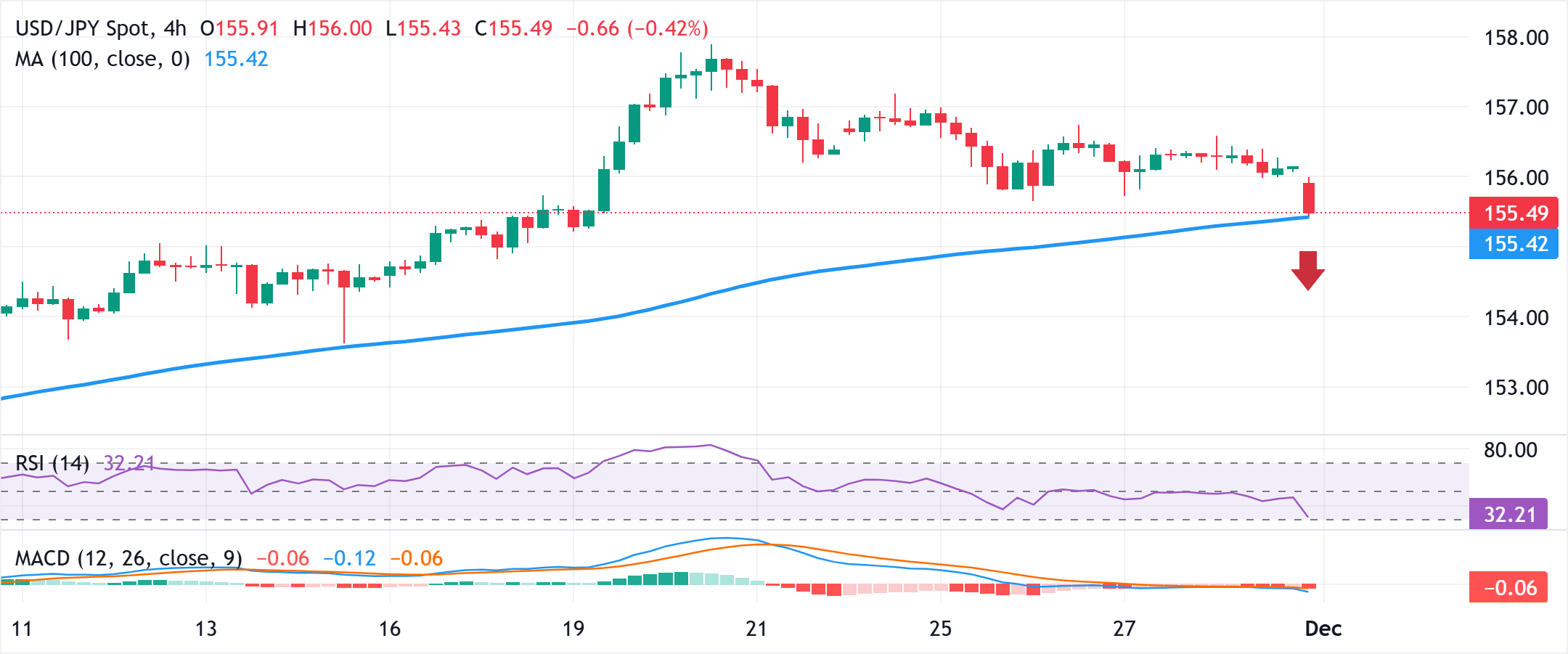
Bears now await a sustained break below the 155.40-155.35 region, representing the 100-period Simple Moving Average (SMA) on the 4-hour chart. Meanwhile, oscillators on the said chart have been gaining negative traction, though technical indicators on the daily chart are still holding in positive territory. This, in turn, suggests that the USD/JPY pair is more likely to find decent support near the 155.00 psychological mark. Some follow-through selling, however, will confirm a breakdown and set the stage for an extension of a one-week-old downtrend.
On the flip side, any meaningful recovery attempt might now confront an immediate hurdle ahead of the 156.00 round figure. A sustained strength beyond could trigger a short-covering move towards the 156.65-156.70 region, above which the USD/JPY pair could reclaim the 157.00 mark. The momentum could extend further toward the 157.45-157.50 intermediate hurdle en route to the multi-month high, around the 158.00 neighborhood, touched in November.
Japanese Yen FAQs
The Japanese Yen (JPY) is one of the world’s most traded currencies. Its value is broadly determined by the performance of the Japanese economy, but more specifically by the Bank of Japan’s policy, the differential between Japanese and US bond yields, or risk sentiment among traders, among other factors.
One of the Bank of Japan’s mandates is currency control, so its moves are key for the Yen. The BoJ has directly intervened in currency markets sometimes, generally to lower the value of the Yen, although it refrains from doing it often due to political concerns of its main trading partners. The BoJ ultra-loose monetary policy between 2013 and 2024 caused the Yen to depreciate against its main currency peers due to an increasing policy divergence between the Bank of Japan and other main central banks. More recently, the gradually unwinding of this ultra-loose policy has given some support to the Yen.
Over the last decade, the BoJ’s stance of sticking to ultra-loose monetary policy has led to a widening policy divergence with other central banks, particularly with the US Federal Reserve. This supported a widening of the differential between the 10-year US and Japanese bonds, which favored the US Dollar against the Japanese Yen. The BoJ decision in 2024 to gradually abandon the ultra-loose policy, coupled with interest-rate cuts in other major central banks, is narrowing this differential.
The Japanese Yen is often seen as a safe-haven investment. This means that in times of market stress, investors are more likely to put their money in the Japanese currency due to its supposed reliability and stability. Turbulent times are likely to strengthen the Yen’s value against other currencies seen as more risky to invest in.
Artigos Recomendados


