


Federal Reserve set to pause after three consecutive interest-rate cuts
- The US Federal Reserve is expected to leave the policy rate unchanged after the first meeting of 2026.
- Fed Chair Powell’s comments on the policy outlook will be watched closely by investors.
- The US Dollar struggles to stay resilient against its rivals following a bullish start to the year.
The United States (US) Federal Reserve (Fed) announces its interest rate decision on Wednesday. Markets widely expect the US central bank to keep the policy rate unchanged in the range of 3.5%-3.75%. As this decision is nearly fully priced in, Fed Chair Jerome Powell’s comments in the post-meeting press conference could impact the US Dollar’s (USD) performance.
The CME FedWatch Tool shows that investors see about a 98% probability of a policy hold in January, and price in a 15% chance of a 25-basis-point (bps) rate cut in March.
According to a recently conducted Reuters poll, all 100 economists surveyed expect the Fed to hold the federal funds rate unchanged in January. Moreover, 58% of respondents forecast no rate changes during the first quarter, compared with December’s poll, when at least one cut by March was anticipated.
TD Securities analysts agree that the Fed will keep rates on hold at the 3.50%-3.75% range, arguing that risk-management cuts are now over and the policy is closer to neutral.
"While Powell is likely to sound noncommittal around near term rate cuts, we expect him to remind market participants that the median Fed official still looks for easing this year," they add. "Overall, we expect a relatively neutral reaction from the FOMC meeting. While we continue to look for rates to move lower later this year amid a combination of less prohibitive supply dynamics, strong demand, and further Fed rate cuts, the risk in the near-term is a Fed on hold for longer."
When will the Fed announce its interest rate decision and how could it affect EUR/USD?
The Fed is scheduled to announce its interest rate decision and publish the monetary policy statement at 19:00 GMT. This will be followed by Fed Chair Jerome Powell's press conference starting at 19:30 GMT.
The rate decision itself is unlikely to trigger a significant market reaction, but Powell’s tone could influence the USD valuation and drive EUR/USD price action.
In case Powell adopts an optimistic tone on the inflation outlook and emphasizes the need to support the labor market amid worsening conditions, investors could see this as a dovish sign. In this scenario, the USD could come under renewed selling pressure and allow EUR/USD to gather bullish momentum. Conversely, the pair could turn south if Powell notes that the central bank is not as concerned about the labor market as it was at the end of 2025 and that there are still upside risks to inflation. Investors could remain convinced of another monetary policy hold in March as a result, and the market positioning suggests that there is some room for USD gains.
Market participants will also pay close attention to headlines over the nomination of the next Fed chair. US President Donald Trump could take the opportunity to criticize Powell and announce his nomination just before or after the Fed event, ramping up the market volatility and clouding the market reaction.
US Treasury Secretary Scott Bessent said recently that Trump could reach a decision by the end of the month. The US president also told CNBC that he would prefer to keep White House economic adviser Kevin Hassett in his current position.
BlackRock's chief bond investment manager, Rick Rieder, Fed Governor Christopher Waller and former Fed Governor Kevin Warsh are the last three candidates in the race. Powell’s term as head of the Fed ends in May, but his term on the central bank runs through 2028. During the press conference, he is likely to be asked whether he intends to finish out his term. If Powell hints that his retirement will be sooner rather than later, and Trump names either Waller or Warsh as the next Fed chair, markets could lean toward a more dovish policy outlook, hurting the USD and boosting EUR/USD.
On the other hand, Rieder is widely seen as someone who would be less influenced by politics and who would assess economic conditions to make the right policy decisions. Although that doesn’t necessarily mean he wouldn’t embrace a dovish stance, he is a market person after all, and his nomination could at least ease market concerns over the Fed losing its independence.
In a post published on X in response to the inflation data, “we think the Fed is likely to become increasingly concerned about genuine labor market weakness and will respond with modest reductions in the policy interest rate,” said Rieder and added:
“However, given the noisiness of recent data, including this report, the Fed will probably choose to wait a meeting, or so, to begin cutting rates again. 2026 is likely to bring much greater dispersion across monetary policy paths, economic growth trends, and credit markets.”
Eren Sengezer, European Session Lead Analyst at FXStreet, provides a short-term technical outlook for EUR/USD:
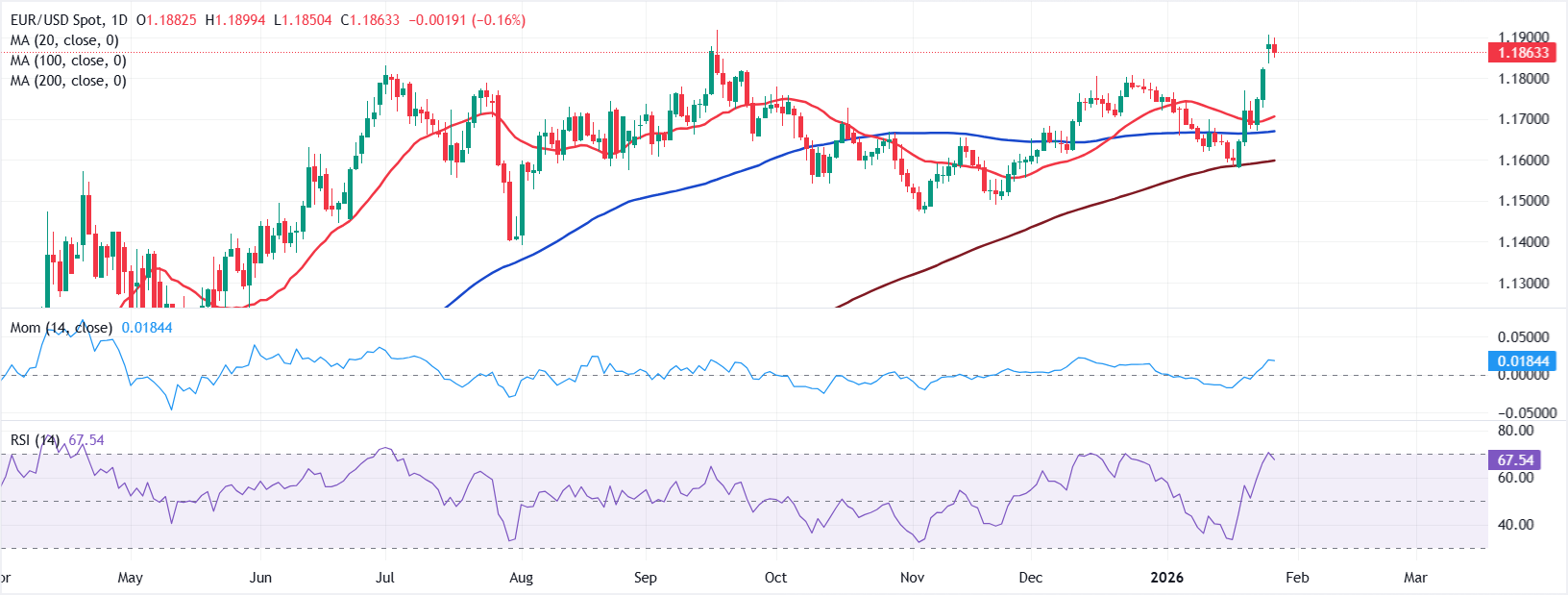
“The Relative Strength Index (RSI) indicator keeps near overbought conditions on the daily chart, and EUR/USD holds firm above its 20-day and 100-day Simple Moving Averages (SMA), highlighting a bullish tilt in the short-term technical outlook. On the upside, 1.1918 (September high) aligns as the immediate resistance level ahead of 1.2000 (round level). On the flip side, 1.1821 (Friday’s close) could be seen as the first support level before 1.1760 (static level), followed by 1.1710 (20-day SMA). A daily close below the latter could open the door for a steeper slide toward the 1.1600 mark.”
Fed FAQs
Monetary policy in the US is shaped by the Federal Reserve (Fed). The Fed has two mandates: to achieve price stability and foster full employment. Its primary tool to achieve these goals is by adjusting interest rates. When prices are rising too quickly and inflation is above the Fed’s 2% target, it raises interest rates, increasing borrowing costs throughout the economy. This results in a stronger US Dollar (USD) as it makes the US a more attractive place for international investors to park their money. When inflation falls below 2% or the Unemployment Rate is too high, the Fed may lower interest rates to encourage borrowing, which weighs on the Greenback.
The Federal Reserve (Fed) holds eight policy meetings a year, where the Federal Open Market Committee (FOMC) assesses economic conditions and makes monetary policy decisions. The FOMC is attended by twelve Fed officials – the seven members of the Board of Governors, the president of the Federal Reserve Bank of New York, and four of the remaining eleven regional Reserve Bank presidents, who serve one-year terms on a rotating basis.
In extreme situations, the Federal Reserve may resort to a policy named Quantitative Easing (QE). QE is the process by which the Fed substantially increases the flow of credit in a stuck financial system. It is a non-standard policy measure used during crises or when inflation is extremely low. It was the Fed’s weapon of choice during the Great Financial Crisis in 2008. It involves the Fed printing more Dollars and using them to buy high grade bonds from financial institutions. QE usually weakens the US Dollar.
Quantitative tightening (QT) is the reverse process of QE, whereby the Federal Reserve stops buying bonds from financial institutions and does not reinvest the principal from the bonds it holds maturing, to purchase new bonds. It is usually positive for the value of the US Dollar.
Economic Indicator
Fed Interest Rate Decision
The Federal Reserve (Fed) deliberates on monetary policy and makes a decision on interest rates at eight pre-scheduled meetings per year. It has two mandates: to keep inflation at 2%, and to maintain full employment. Its main tool for achieving this is by setting interest rates – both at which it lends to banks and banks lend to each other. If it decides to hike rates, the US Dollar (USD) tends to strengthen as it attracts more foreign capital inflows. If it cuts rates, it tends to weaken the USD as capital drains out to countries offering higher returns. If rates are left unchanged, attention turns to the tone of the Federal Open Market Committee (FOMC) statement, and whether it is hawkish (expectant of higher future interest rates), or dovish (expectant of lower future rates).
Read more.Next release: Wed Jan 28, 2026 19:00
Frequency: Irregular
Consensus: 3.75%
Previous: 3.75%
Source: Federal Reserve
추천 기사


