


Dow Jones Industrial Average futures rebound from Hormuz selloff amid ceasefire
- Dow futures climbed roughly 0.7% Wednesday after President Donald Trump extended the US ceasefire with Iran.
- Nasdaq Composite hit a fresh intraday all-time high, gaining 1.3% as mega-cap tech led the rally.
- Brent crude punched above $100 per barrel after Iran's navy seized two container ships in the Strait of Hormuz.
- Boeing and GE Vernova posted standout earnings beats, reinforcing a Q1 season that has seen over 80% of S&P 500 reporters top expectations.
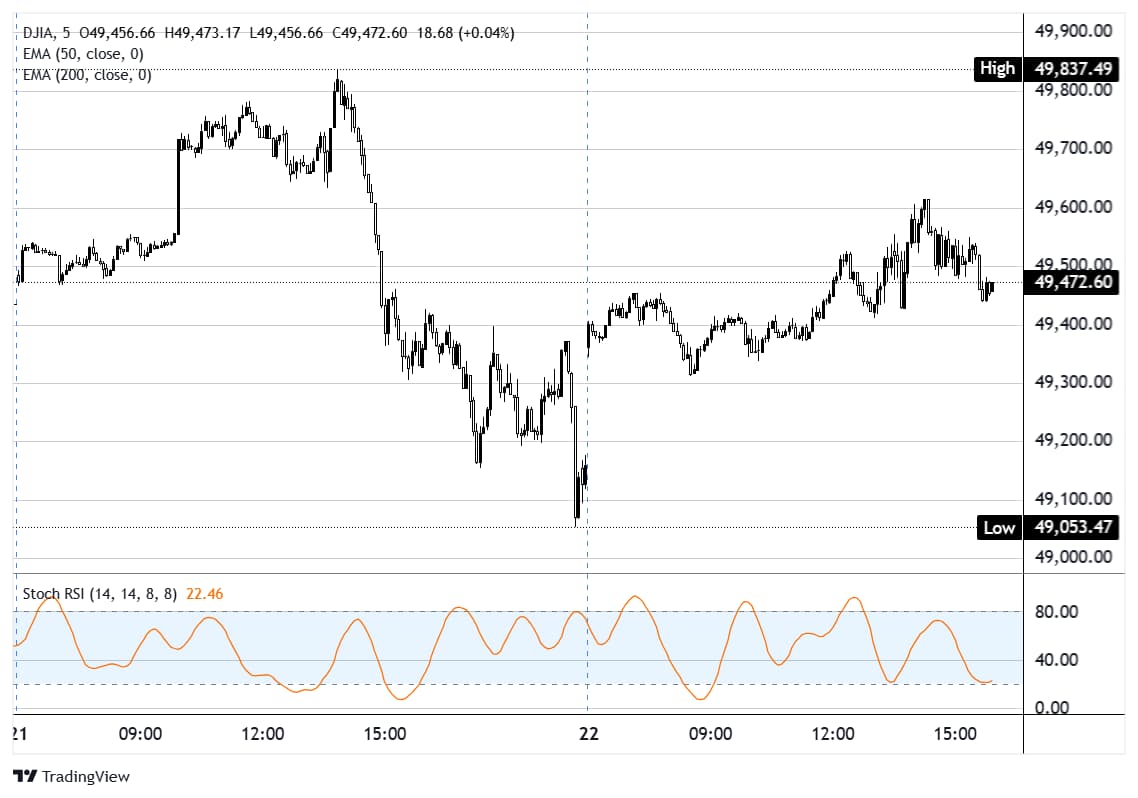
DJIA futures turned higher during the Wednesday US session, with the contract recovering from an overnight low below 49,100 to trade back near 49,500 as risk appetite rebuilt. The bounce came after Trump extended the Iran ceasefire following a request from Pakistan's Field Marshal Asim Munir and Prime Minister Shehbaz Sharif, with the president citing Tehran's "seriously fractured" government. The move effectively bought more time for a negotiated settlement, even as the White House kept the Iranian blockade in place. Dow futures had sold off hard through Tuesday afternoon and into Wednesday's European hours, with the contract shedding roughly 750 points from Tuesday's peak above 49,800 before finding a bid.
Oil climbs back above $100 as Hormuz tensions persist
Even with the ceasefire extension in place, Iran's navy seized two container ships in the Strait of Hormuz on Wednesday, a reminder that the flashpoint in the world's most important oil chokepoint is far from resolved. Brent crude futures advanced more than 2% to around $101 per barrel, while US West Texas Intermediate (WTI) futures gained 2% to near $92. Oil has been the cleanest beneficiary of the US-Iran standoff, and the Hormuz headlines limited the bid for transport-heavy names on the DJIA. Equity markets largely looked past the shipping disruption, with WEBs Investments CEO Ben Fulton noting that investors are increasingly ready to put the Middle East story in the rear-view mirror.
Earnings beats do the heavy lifting
The Q1 reporting cycle continues to over-deliver, providing a fundamental floor under the indices. Boeing (BA) shares jumped 5% after the planemaker reported a smaller-than-expected first-quarter loss, easing concerns about its cash burn trajectory. GE Vernova (GEV) surged 12% after Q1 revenue topped consensus, as power-generation demand tied to AI data center buildouts continues to surprise to the upside. FactSet data shows more than 80% of S&P 500 companies reporting so far have surpassed expectations, a beat rate that reinforces Fulton's bull case for US equities relative to international peers.
Nasdaq prints record as tech leads tape
The Nasdaq Composite tagged a fresh intraday all-time high during Wednesday's session before closing 1.3% higher, with S&P 500 adding 0.8% and wiping out the last of its Iran-related drawdown. DJIA futures price action has tracked the broader tape but with less enthusiasm, as the index's heavier weighting toward industrials and financials has left it lagging the tech-heavy benchmarks. With Boeing and GE Vernova doing much of the heavy lifting, the Dow's earnings-driven narrative looks set to carry into Thursday's pre-market.
Calendar turns to jobless claims and PMIs
Attention shifts to Thursday's 12:30 GMT Initial Jobless Claims print, with consensus at 212K versus 207K prior, a modest uptick that would still keep the labor market in benign territory. At 13:45 GMT, the preliminary S&P Global Purchasing Managers Index (PMI) reads for April land, with Manufacturing seen at 52.5 versus 52.3 prior and Services at 50.0 versus 49.8. Friday's 14:00 GMT University of Michigan (UoM) sentiment and inflation expectations releases round out the week, with 1-year inflation expectations pegged at 4.8%, a level that continues to complicate the Federal Reserve (Fed) rate-cut path. For Dow futures, the question is whether the earnings bid can hold through a data slate that has the potential to wobble risk sentiment.
Dow Jones 5-minute chart
Dow Jones FAQs
The Dow Jones Industrial Average, one of the oldest stock market indices in the world, is compiled of the 30 most traded stocks in the US. The index is price-weighted rather than weighted by capitalization. It is calculated by summing the prices of the constituent stocks and dividing them by a factor, currently 0.152. The index was founded by Charles Dow, who also founded the Wall Street Journal. In later years it has been criticized for not being broadly representative enough because it only tracks 30 conglomerates, unlike broader indices such as the S&P 500.
Many different factors drive the Dow Jones Industrial Average (DJIA). The aggregate performance of the component companies revealed in quarterly company earnings reports is the main one. US and global macroeconomic data also contributes as it impacts on investor sentiment. The level of interest rates, set by the Federal Reserve (Fed), also influences the DJIA as it affects the cost of credit, on which many corporations are heavily reliant. Therefore, inflation can be a major driver as well as other metrics which impact the Fed decisions.
Dow Theory is a method for identifying the primary trend of the stock market developed by Charles Dow. A key step is to compare the direction of the Dow Jones Industrial Average (DJIA) and the Dow Jones Transportation Average (DJTA) and only follow trends where both are moving in the same direction. Volume is a confirmatory criteria. The theory uses elements of peak and trough analysis. Dow’s theory posits three trend phases: accumulation, when smart money starts buying or selling; public participation, when the wider public joins in; and distribution, when the smart money exits.
There are a number of ways to trade the DJIA. One is to use ETFs which allow investors to trade the DJIA as a single security, rather than having to buy shares in all 30 constituent companies. A leading example is the SPDR Dow Jones Industrial Average ETF (DIA). DJIA futures contracts enable traders to speculate on the future value of the index and Options provide the right, but not the obligation, to buy or sell the index at a predetermined price in the future. Mutual funds enable investors to buy a share of a diversified portfolio of DJIA stocks thus providing exposure to the overall index.
추천 기사


