


Dow Jones Industrial Average climbs 150 points after cooler PCE inflation print
- The Dow Jones gained slim ground on Friday, rising around 150 points.
- Equities are ending the week on a high note after backdated US PCE inflation showed cooling core pressures.
- Market expectations for a threepeat interest rate cut in December remain pinned to the ceiling.
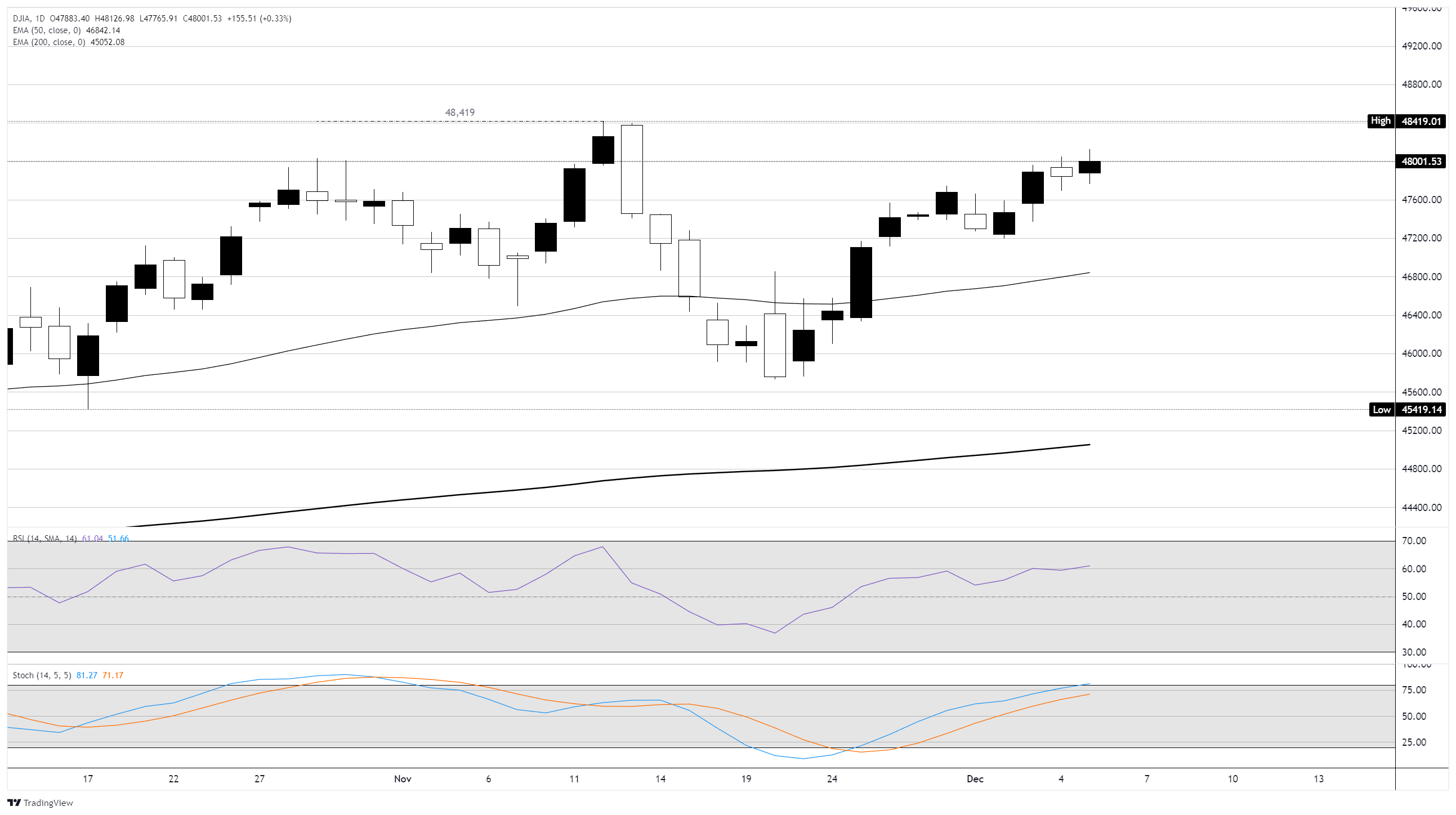
The Dow Jones Industrial Average (DJIA) made slim gains on Friday, climbing another 150 points and ending a moderately bullish week near the 48,000 handle. US Personal Consumption Expenditures Price Index (PCE) data, despite being from September, helped bolster market confidence that the Federal Reserve (Fed) will be delivering a third straight interest rate cut on December 10.
The Standard & Poor’s 500 (SP500) also climbed around 0.3% on Friday, putting the broad-market index on pace to challenge all-time highs.
PCE inflation cools slightly, bolsters Fed rate cut hopes
Core PCE inflation ticked down to 2.8% YoY in September, while the monthly figure held steady at 0.2% from August. The figures are well backdated as federal agencies struggle to play catch-up following the longest US government shutdown in history, but any sign of not-runaway inflation is being taken in stride by markets that are aching for a third straight rate cut before the end of the year.
The University of Michigan (UoM) Consumer Sentiment and Expectations Indexes for December both rose faster than expected. UoM 1-year and 5-year Consumer Inflation Expectations also ticked lower.
Coming up next week: Fed threepeat?
Market momentum will likely flatten heading into next week’s Fed rate call, slated for Wednesday. December’s Fed rate meeting will also include an update to the Summary of Economic Projections (SEP), which includes the dot plot of interest rate expectations from Fed policymakers, a key tool used by markets to gauge Fed appetite for interest rate moves looking forward.
Dow Jones daily chart
Dow Jones FAQs
The Dow Jones Industrial Average, one of the oldest stock market indices in the world, is compiled of the 30 most traded stocks in the US. The index is price-weighted rather than weighted by capitalization. It is calculated by summing the prices of the constituent stocks and dividing them by a factor, currently 0.152. The index was founded by Charles Dow, who also founded the Wall Street Journal. In later years it has been criticized for not being broadly representative enough because it only tracks 30 conglomerates, unlike broader indices such as the S&P 500.
Many different factors drive the Dow Jones Industrial Average (DJIA). The aggregate performance of the component companies revealed in quarterly company earnings reports is the main one. US and global macroeconomic data also contributes as it impacts on investor sentiment. The level of interest rates, set by the Federal Reserve (Fed), also influences the DJIA as it affects the cost of credit, on which many corporations are heavily reliant. Therefore, inflation can be a major driver as well as other metrics which impact the Fed decisions.
Dow Theory is a method for identifying the primary trend of the stock market developed by Charles Dow. A key step is to compare the direction of the Dow Jones Industrial Average (DJIA) and the Dow Jones Transportation Average (DJTA) and only follow trends where both are moving in the same direction. Volume is a confirmatory criteria. The theory uses elements of peak and trough analysis. Dow’s theory posits three trend phases: accumulation, when smart money starts buying or selling; public participation, when the wider public joins in; and distribution, when the smart money exits.
There are a number of ways to trade the DJIA. One is to use ETFs which allow investors to trade the DJIA as a single security, rather than having to buy shares in all 30 constituent companies. A leading example is the SPDR Dow Jones Industrial Average ETF (DIA). DJIA futures contracts enable traders to speculate on the future value of the index and Options provide the right, but not the obligation, to buy or sell the index at a predetermined price in the future. Mutual funds enable investors to buy a share of a diversified portfolio of DJIA stocks thus providing exposure to the overall index.
추천 기사


