


Dow Jones Industrial Average looks upward as government restart gears turn
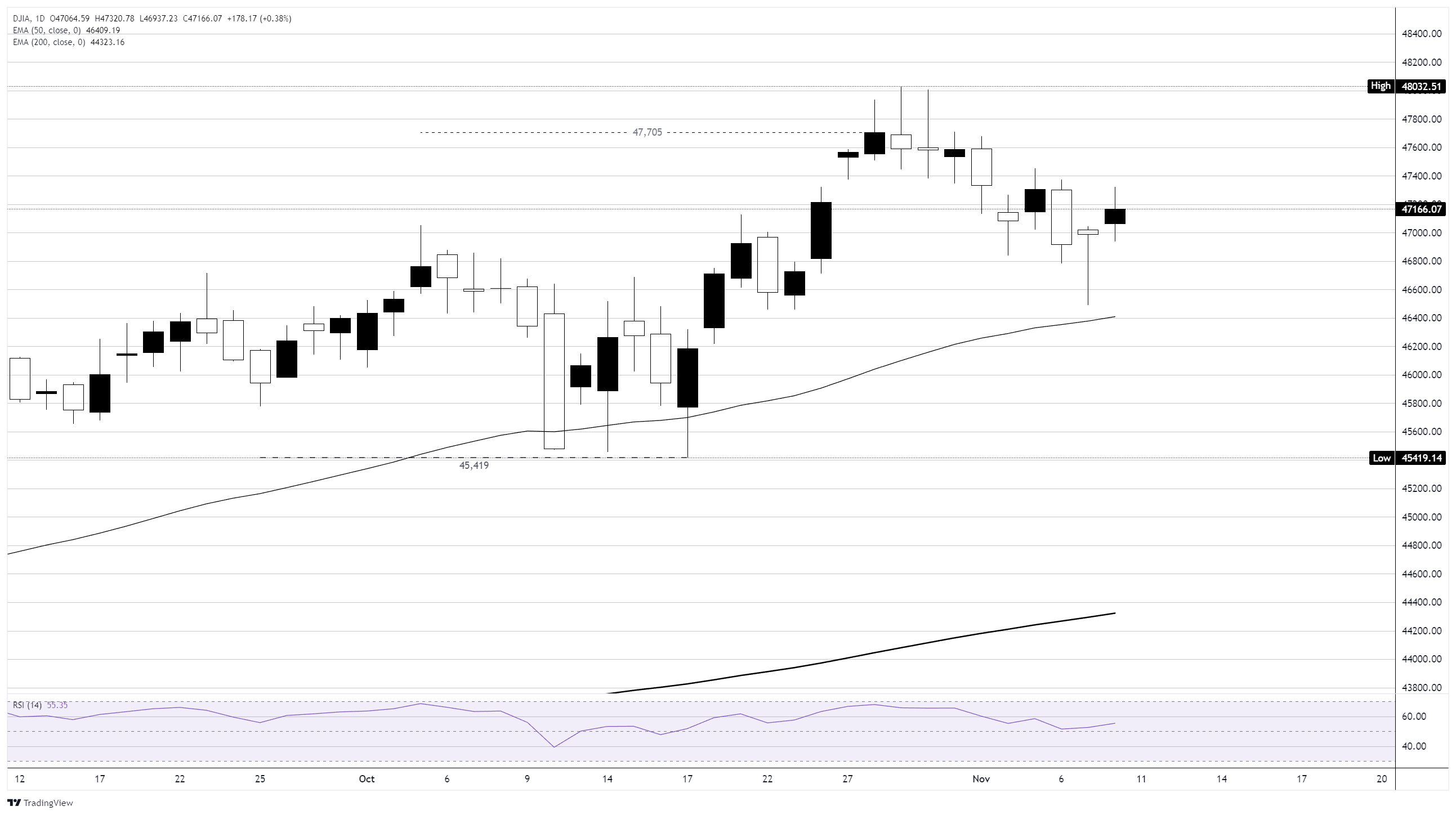
- The Dow Jones is holding steady near 47,000 as investors look for an end to the federal shutdown.
- Equity markets retreated last week as market risks on multiple fronts continue to simmer.
- A government funding solution means the flow of official datasets should resume, for better or worse.
The Dow Jones Industrial Average (DJIA) steadies its grip on Monday, starting the new trading week holding near the 47,000 major handle. Equity markets pulled back last week as the AI tech rally shows signs of unwinding, or at least taking a breather, and investors are looking for an end to what has become the longest US government funding shutdown in history.
Following a week of exhaustion-based pullbacks, AI tech leaders are back at the forefront as investors await meaningful details on a possible funding gap for federal operations to resume. The funding bill, which only keeps the US government open through January, will put markets on a collision course with further political unease in a few months’ time.
Hopes for a temporary funding solution reignite investor hopes
The longest US government shutdown in history has pushed consumer confidence to its lowest readings on record, according to data from the University of Michigan last week. A lack of official numbers on inflation and employment has also pushed investors to increase their reliance on volatile public datasets.
This week would have seen the release of the latest US Consumer Price Index (CPI) and Producer Price Index (PPI) inflation datasets, but there is hope that the US House of Representatives will push a pending temporary funding measure through in time to get a fresh round of inflation and employment statistics before the Federal Reserve’s (Fed) next interest rate decision on December 10. At the latest interest rate decision, Fed Chair Jerome Powell expressed unease about making further interest rate moves amid a lack of critical government data, sending December rate cut hopes into a tailspin.
Dow Jones daily chart
Dow Jones FAQs
The Dow Jones Industrial Average, one of the oldest stock market indices in the world, is compiled of the 30 most traded stocks in the US. The index is price-weighted rather than weighted by capitalization. It is calculated by summing the prices of the constituent stocks and dividing them by a factor, currently 0.152. The index was founded by Charles Dow, who also founded the Wall Street Journal. In later years it has been criticized for not being broadly representative enough because it only tracks 30 conglomerates, unlike broader indices such as the S&P 500.
Many different factors drive the Dow Jones Industrial Average (DJIA). The aggregate performance of the component companies revealed in quarterly company earnings reports is the main one. US and global macroeconomic data also contributes as it impacts on investor sentiment. The level of interest rates, set by the Federal Reserve (Fed), also influences the DJIA as it affects the cost of credit, on which many corporations are heavily reliant. Therefore, inflation can be a major driver as well as other metrics which impact the Fed decisions.
Dow Theory is a method for identifying the primary trend of the stock market developed by Charles Dow. A key step is to compare the direction of the Dow Jones Industrial Average (DJIA) and the Dow Jones Transportation Average (DJTA) and only follow trends where both are moving in the same direction. Volume is a confirmatory criteria. The theory uses elements of peak and trough analysis. Dow’s theory posits three trend phases: accumulation, when smart money starts buying or selling; public participation, when the wider public joins in; and distribution, when the smart money exits.
There are a number of ways to trade the DJIA. One is to use ETFs which allow investors to trade the DJIA as a single security, rather than having to buy shares in all 30 constituent companies. A leading example is the SPDR Dow Jones Industrial Average ETF (DIA). DJIA futures contracts enable traders to speculate on the future value of the index and Options provide the right, but not the obligation, to buy or sell the index at a predetermined price in the future. Mutual funds enable investors to buy a share of a diversified portfolio of DJIA stocks thus providing exposure to the overall index.
추천 기사


