


Does it really matter who Satoshi is?
The recent investigation by the New York Times has put the focus back on Bitcoin’s creator. Little is known about Satoshi’s true identity – whether it was one individual, a team, or even a collective –, so speculation and theories have been circulating in the markets. But does this really matter for traders?
Bitcoin, which was introduced back in 2008, was described in a whitepaper titled “Bitcoin: A Peer-to-Peer Electronic Cash System” by an anonymous person (or group) using the pseudonym Satoshi Nakamoto.
From coder to cypherpunk to CEO, however, the identity has remained a mystery for the last 18 years. With Bitcoin’s market capitalization now at $1.47 trillion, what matters isn’t that much who is behind the project but rather what happens with their huge holdings.
Satoshi is the largest holder of BTC
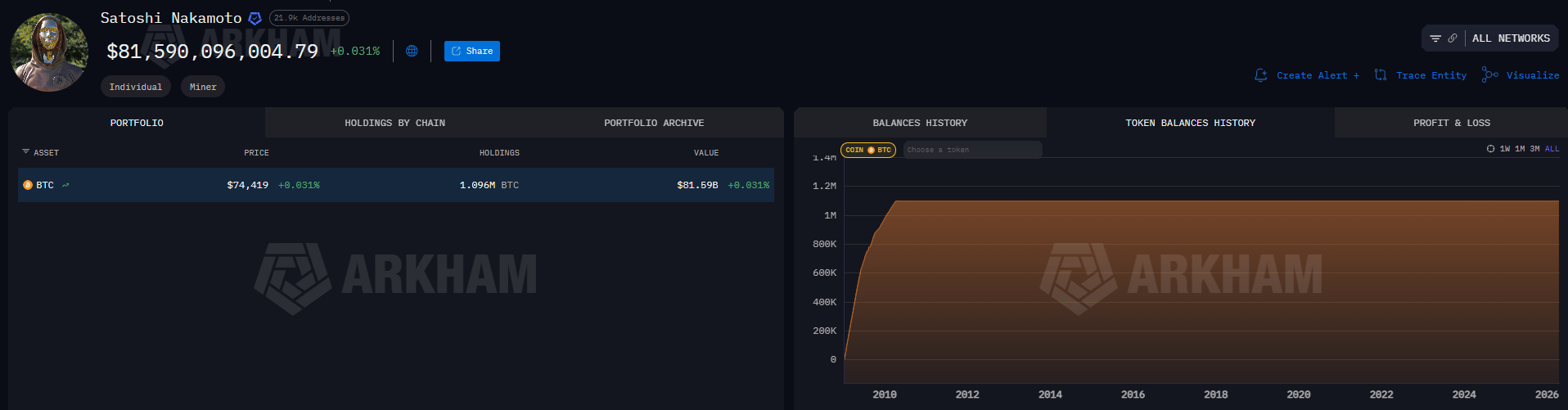
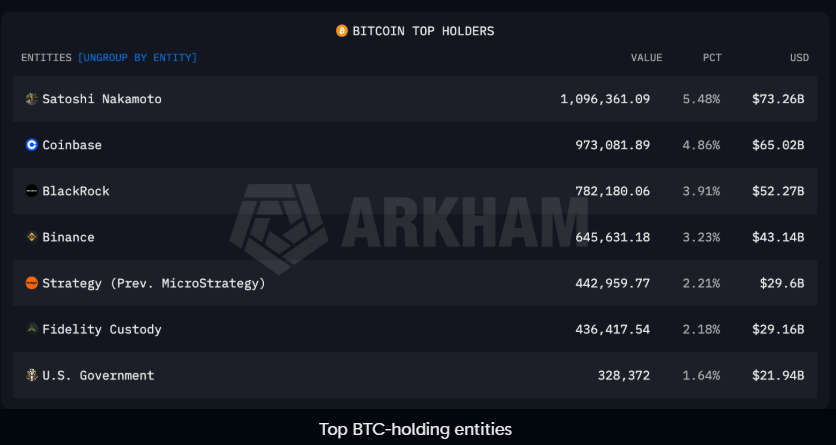
Since blockchain transactions are transparent, Satoshi’s BTC wallets used for early mining are not a mystery to market participants. Satoshi Nakamoto is the largest holder of Bitcoin with 1.096 million BTC, worth around $81.50 billion. Arkham’s research indicates Nakamoto acquired this amount as a reward for mining 22,000 blocks in the early days.
These coins sit in thousands of addresses (often linked via the “Patoshi pattern” analysis) and have remained untouched since 2010. The maximum supply of Bitcoin is 21 million. Of all the Bitcoins that have ever existed, Satoshi holds 5.2%, making Nakamoto one of the richest people in the world.
Markets’ assessment: The “Dead Coin” thesis
One of the biggest assumptions in the crypto space is that Satoshi’s Bitcoin holdings do not exist. It’s treated like a long-lost treasure – so deeply buried and untouched over time that many have stopped believing it will ever resurface.
The creator has been silent since 2011, with the last email to Mike Hearn, a Bitcoin developer, on April 23, 2011, saying, “I had a few other things on my mind (as always).”
The principles behind Bitcoin’s creation reflect a clear ideological foundation. Satoshi Nakamoto launched the peer-to-peer, decentralized asset in the aftermath of the 2008 financial crisis, embedding a powerful message in the genesis block (the first BTC block mined): “Chancellor on brink of second bailout for banks.”
This headline, taken from The Times newspaper, sheds light on Sathosi’s intent to challenge the traditional financial system and highlight the flaws of centralized control.
Bitcoin was designed as a form of “people’s money,” where power is distributed across a decentralized network rather than concentrated in institutions. Within this framework, Satoshi’s continued silence — even as Bitcoin reaches new highs — can be seen as consistent with these founding principles and as indicating that he doesn’t care much about BTC holdings or personal wealth.
Other assumptions about Satoshi in the crypto space range from the assumption that the creator might have lost access to his private keys, while others assume that Satoshi destroyed access to the wallets or even that Satoshi is dead by now.
What if a single coin is moved?
The only thing that traders should care about is whether activity from these wallets resumes. If a single BTC was moved from the Satoshi link wallet, the market could enter panic mode, with a huge wave of first see Fear, Uncertainty and Doubt (FUD) that would cause the prices of not just BTC but the entire crypto market to fall.
The prospect of increased supply from the creator wallets, which are generally assumed to be dead, would trigger a decline in demand and prices, disrupting the Bitcoin scarcity narrative.
This could lead to a downward spiral with most institutions and the rest of the dormant wallets offloading BTC. The narrative of Bitcoin, whose creator disappeared, leaving the truly decentralized system without a controlling authority, has been part of Bitcoin’s strength. This narrative would fade, leaving one of the biggest scams in the world.
Moreover, the return of Satoshi Nakamoto could significantly influence the Bitcoin Core development community, which takes key development decisions through decentralized consensus. Satoshi’s voice would likely carry disproportionate weight, potentially disrupting this balance and undermining Bitcoin’s core objective of maintaining a truly decentralized system.
On the government and regulatory front, the re-emergence of Nakamoto (a figure long respected within the crypto community) could trigger heightened scrutiny from governments worldwide. As Bitcoin has now been adopted as legal tender in some countries and is held in treasury reserves, law enforcement agencies may intensify efforts to identify and locate the creator, introducing uncertainty that could ripple across the broader crypto market and disrupt sentiment.
Following the New York Times investigation, Binance founder Changpeng Zhao said it is a “good thing” that the Bitcoin founder’s identity continues to be a mystery. Vitalik Buterin, founder of Ethereum, said in an interview that “Satoshi’s disappearance was the second best thing he did, the first being Bitcoin.”
Satoshi’s anonymity and absence are not weaknesses but foundational strengths that preserve Bitcoin’s decentralized nature, preventing any single figure from exerting undue influence over the network and aligns with the ideological foundation. While curiosity hunts us all, what’s best for the overall crypto market is to never know who Satoshi really is – and for those wallets containing a fortune to remain dormant.
Bitcoin, altcoins, stablecoins FAQs
Bitcoin is the largest cryptocurrency by market capitalization, a virtual currency designed to serve as money. This form of payment cannot be controlled by any one person, group, or entity, which eliminates the need for third-party participation during financial transactions.
Altcoins are any cryptocurrency apart from Bitcoin, but some also regard Ethereum as a non-altcoin because it is from these two cryptocurrencies that forking happens. If this is true, then Litecoin is the first altcoin, forked from the Bitcoin protocol and, therefore, an “improved” version of it.
Stablecoins are cryptocurrencies designed to have a stable price, with their value backed by a reserve of the asset it represents. To achieve this, the value of any one stablecoin is pegged to a commodity or financial instrument, such as the US Dollar (USD), with its supply regulated by an algorithm or demand. The main goal of stablecoins is to provide an on/off-ramp for investors willing to trade and invest in cryptocurrencies. Stablecoins also allow investors to store value since cryptocurrencies, in general, are subject to volatility.
Bitcoin dominance is the ratio of Bitcoin's market capitalization to the total market capitalization of all cryptocurrencies combined. It provides a clear picture of Bitcoin’s interest among investors. A high BTC dominance typically happens before and during a bull run, in which investors resort to investing in relatively stable and high market capitalization cryptocurrency like Bitcoin. A drop in BTC dominance usually means that investors are moving their capital and/or profits to altcoins in a quest for higher returns, which usually triggers an explosion of altcoin rallies.
추천 기사


