


Ripple Price Forecast: XRP falters amid sell-off jitters and negative funding rates
- XRP declines amid a volatile crypto market, weighed down by risk-off sentiment due to the ongoing war in the Middle East.
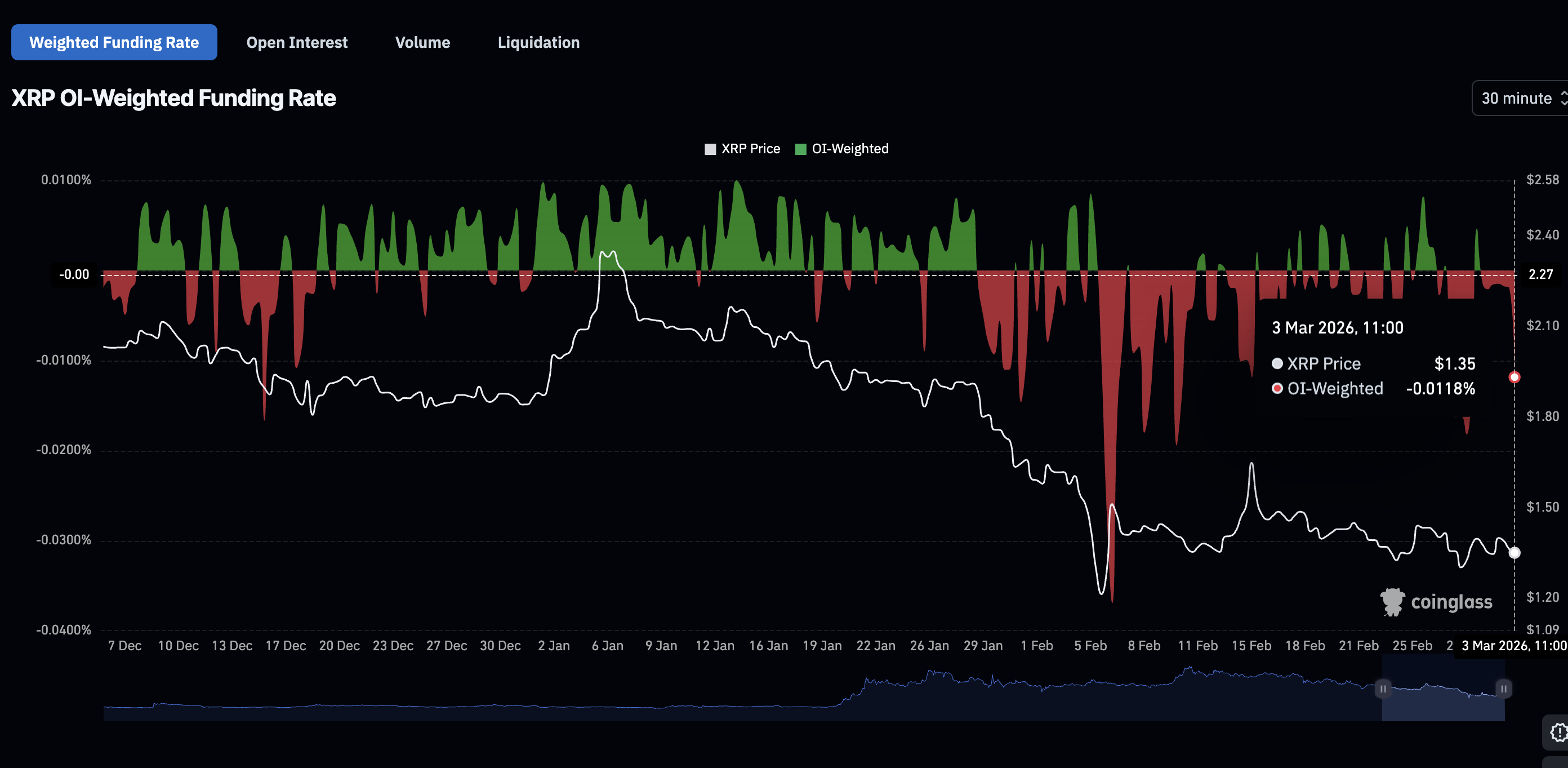
- Traders increasingly pile into short positions, with futures Open Interest-weighted funding rate falling to -0.0118%.
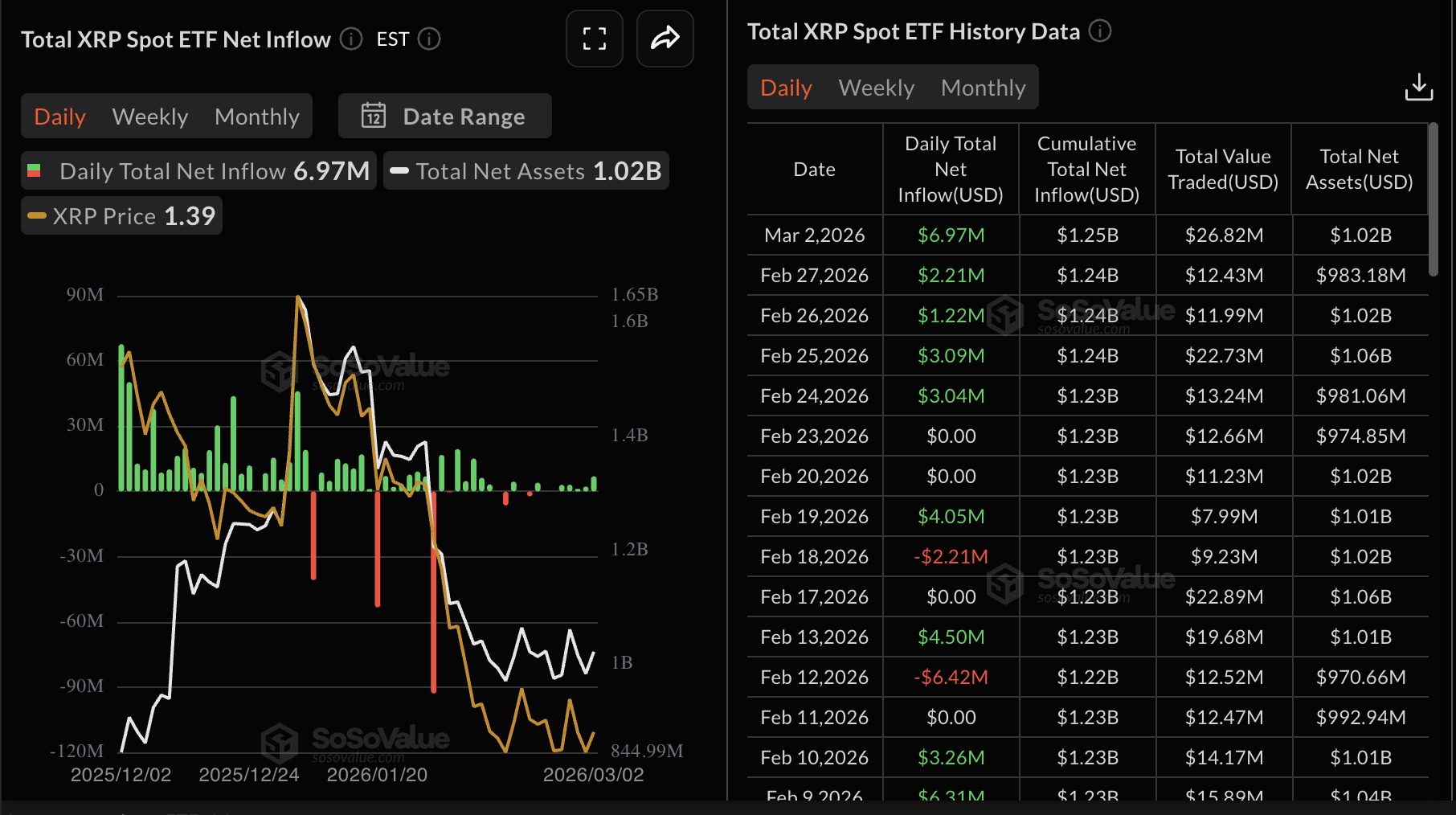
- XRP’s pullback unfazed by steady inflows into US-listed spot ETFs.
Ripple (XRP) has come under pressure, drifting lower to $1.35 at the time of writing on Tuesday. The over 2% correction looks poised to erase the previous day’s gains, which lifted the remittance token to $1.42.
Global markets remain on edge amid uncertainty due to the war between the United States (US) and Iran, which has since Saturday spread across several Middle East countries.
Despite calls for de-escalation of the conflict by global leaders, US President Donald Trump has warned that the war could last several weeks, according to a report by the Associated Press.
Sentiment across the crypto market remains in extremely fear as investors navigate geopolitical uncertainty.
Retail demand wanes amid uncertainty and risk-off sentiment
Interest in XRP is on the back foot, as evidenced by the futures Open Interest (OI) Weighted Funding Rate remaining in negative territory. At -0.0118%, the weighted funding rate suggests that the majority of leveraged participants are positioned expecting further downside. Besides, this scenario often snuffs out minor price rebounds, which are met with short selling or the liquidation of long positions.
However, prolonged periods of deeply negative OI-weighted sentiment may trigger a short squeeze, lifting XRP to higher levels or marking potential local bottoms.
Despite escalating geopolitical tensions, institutional interest has remained intact, with US-listed XRP spot Exchange-Traded Funds (ETFs) recording inflows of approximately $7 million on Monday. Bitwise and Canary Capital’s ETFs accounted for all inflows, totaling $4.69 million and $2.28 million, respectively. Cumulative inflows stand at $1.25 billion, and net assets under management at $1.02 billion.
Technical outlook: XRP at risk of a deeper pullback
XRP hovers around $1.35 amid a strong bearish outlook. The price sits below a descending trendline resistance and trades below the 50-day, 100-day, and 200-day Exponential Moving Averages (EMAs), clustered between $1.58 and $2.03, underscoring a dominant overhead supply zone.
At the same time, the SuperTrend at $1.61 remains well above spot and continues to track lower, keeping downside pressure intact. The Moving Average Convergence Divergence (MACD) remains marginally above its signal while green histogram bars contract on the daily chart, suggesting modest momentum. This outlook aligns with a corrective, rather than impulsive tone.
-1772543212063-1772543212065.png)
Meanwhile, initial resistance emerges at the trendline around $1.40, followed by Monday's high at $1.42. A daily close above $1.42 would open the way toward the 50-day EMA around $1.58 as the next upside barrier. On the downside, immediate support sits at Monday's low of $1.33, with a break exposing the February support at $1.12.
Crypto ETF FAQs
An Exchange-Traded Fund (ETF) is an investment vehicle or an index that tracks the price of an underlying asset. ETFs can not only track a single asset, but a group of assets and sectors. For example, a Bitcoin ETF tracks Bitcoin’s price. ETF is a tool used by investors to gain exposure to a certain asset.
Yes. The first Bitcoin futures ETF in the US was approved by the US Securities & Exchange Commission in October 2021. A total of seven Bitcoin futures ETFs have been approved, with more than 20 still waiting for the regulator’s permission. The SEC says that the cryptocurrency industry is new and subject to manipulation, which is why it has been delaying crypto-related futures ETFs for the last few years.
Yes. The SEC approved in January 2024 the listing and trading of several Bitcoin spot Exchange-Traded Funds, opening the door to institutional capital and mainstream investors to trade the main crypto currency. The decision was hailed by the industry as a game changer.
The main advantage of crypto ETFs is the possibility of gaining exposure to a cryptocurrency without ownership, reducing the risk and cost of holding the asset. Other pros are a lower learning curve and higher security for investors since ETFs take charge of securing the underlying asset holdings. As for the main drawbacks, the main one is that as an investor you can’t have direct ownership of the asset, or, as they say in crypto, “not your keys, not your coins.” Other disadvantages are higher costs associated with holding crypto since ETFs charge fees for active management. Finally, even though investing in ETFs reduces the risk of holding an asset, price swings in the underlying cryptocurrency are likely to be reflected in the investment vehicle too.
(The technical analysis of this story was written with the help of an AI tool.)
추천 기사


