


Gold eases within range as US CPI looms
- Gold trades under mild pressure as investors await the US CPI report.
- Fed easing expectations for 2026 remain in focus, with inflation data set to guide the monetary policy outlook.
- Technically, XAU/USD continues to consolidate below $4,350, with strong support near $4,250 helping preserve the bullish structure.
Gold (XAU/USD) consolidates with modest losses on Thursday as traders trim exposure ahead of the US inflation report. At the time of writing, XAU/USD is trading around $4,325, remaining confined to the familiar range that has dominated price action so far this week.
The US Bureau of Labor Statistics is scheduled to release the November Consumer Price Index (CPI) report at 13:30 GMT. A softer-than-expected inflation reading could reinforce expectations for further monetary policy easing by the Federal Reserve (Fed) in 2026. Lower interest rates generally favour non-yielding assets such as Gold.
Elsewhere, escalating tensions between the United States (US) and Venezuela support safe-haven flows, keeping the precious metal anchored just below record highs despite the lack of near-term upside momentum.
Market movers: US CPI and Fed leadership in focus
- Due to the recent government shutdown, the November inflation report will exclude October data and monthly CPI readings, leaving markets to focus squarely on the annual inflation readings. Economists expect headline CPI to accelerate to 3.1% YoY, up from 3.0% in September, while core CPI, which strips out food and energy prices, is seen holding steady at 3.0% YoY.
- US Initial Jobless Claims are also in focus, with claims forecast at 225K from 236K, as markets watch for further signs that labour market conditions are losing momentum, after the delayed November Nonfarm Payrolls (NFP) release showed the Unemployment Rate rising to 4.6%, its highest level since September 2021.
- A firmer US Dollar (USD) is also capping upside momentum. The US Dollar Index (DXY), which tracks the Greenback's value against a basket of six major currencies, is trading around 98.50, recovering after briefly slipping below 98.00 on Tuesday, its lowest level since October 3.
- Markets are closely monitoring developments around the Fed’s leadership, as US President Donald Trump’s repeated calls for lower interest rates continue to raise questions around the Fed’s independence. Trump said on Wednesday, “I’ll soon announce our next chairman of the Federal Reserve, someone who believes in lower interest rates, by a lot.”
- President Donald Trump told the Wall Street Journal last week that he was leaning toward either White House economic adviser Kevin Hassett or former Fed Governor Kevin Warsh to lead the Federal Reserve. The WSJ also reported on Tuesday that Fed Governor Christopher Waller is set to be interviewed for the role.
- Governor Christopher Waller said on Wednesday that policymakers are in no rush to ease policy aggressively, noting that the Fed can proceed cautiously as inflation remains above target. He added that interest rates could be lowered gradually toward a neutral setting, which he estimates to be around 50-100 basis points below current levels.
Technical analysis: XAU/USD holds bullish bias within the $4,250-$4,350 range
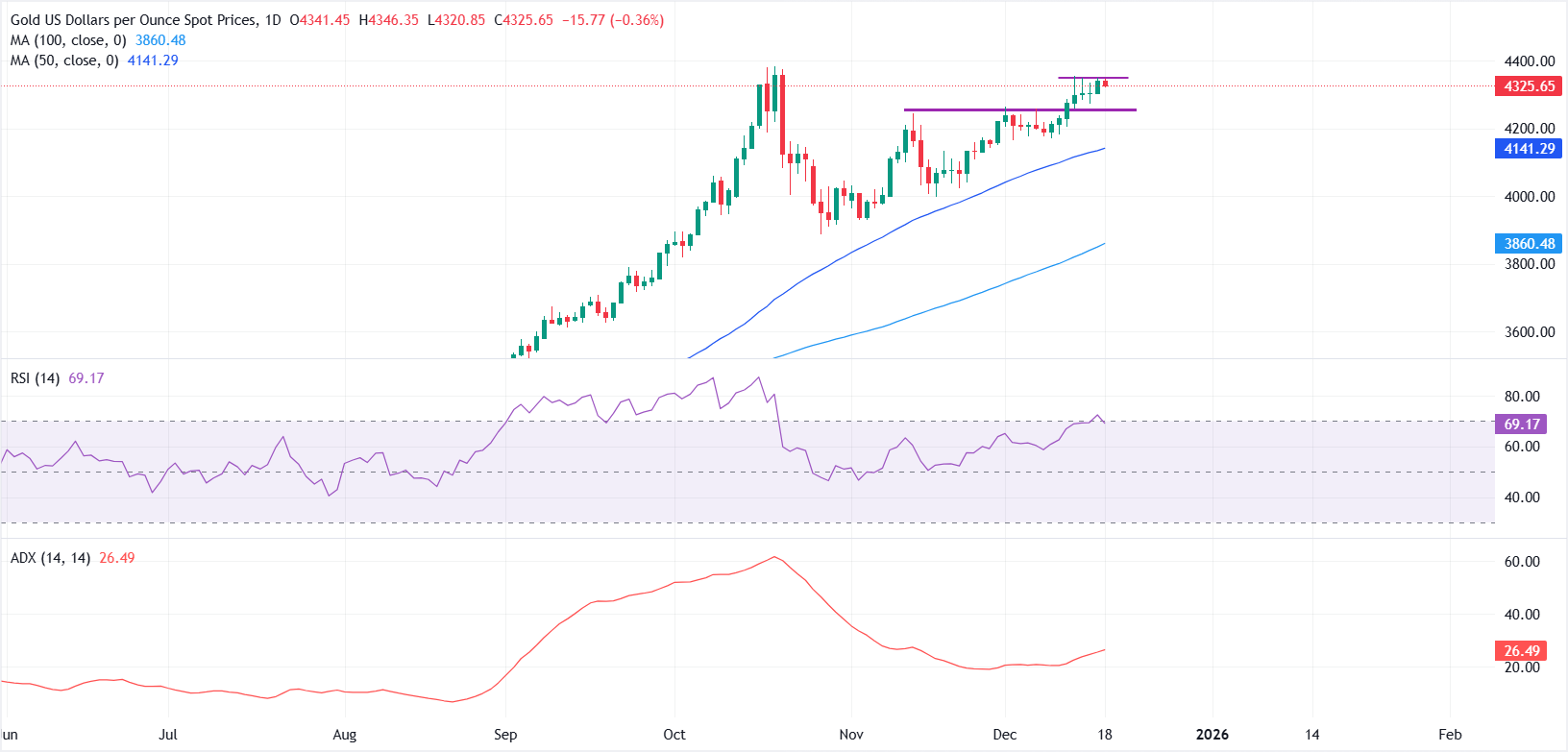
From a technical perspective, Gold (XAU/USD) remains range-bound on the daily chart, with price action capped by repeated rejections near the $4,350 zone. On the downside, dip-buying interest continues to emerge around the $4,250 area, helping the metal defend its broader bullish structure.
On the daily timeframe, the 50-day Simple Moving Average (SMA) rises above the 100-day SMA, with both slopes advancing and price holding above them, preserving a bullish bias. The 50-day SMA currently stands at $4,141.31, offering nearby dynamic support. The Relative Strength Index eases to 69 from 72, just below the overbought level, hinting that upside momentum cools but remains firm.
Trend strength builds as the Average Directional Index ticks up to 26.49, reinforcing a directional market. A shallow pullback could be absorbed near dynamic support, while a break would expose the 100-day SMA at $3,860.49 as the next trend floor. A sustained hold above the 50-day average would keep the upside path open for bulls.
Gold FAQs
Gold has played a key role in human’s history as it has been widely used as a store of value and medium of exchange. Currently, apart from its shine and usage for jewelry, the precious metal is widely seen as a safe-haven asset, meaning that it is considered a good investment during turbulent times. Gold is also widely seen as a hedge against inflation and against depreciating currencies as it doesn’t rely on any specific issuer or government.
Central banks are the biggest Gold holders. In their aim to support their currencies in turbulent times, central banks tend to diversify their reserves and buy Gold to improve the perceived strength of the economy and the currency. High Gold reserves can be a source of trust for a country’s solvency. Central banks added 1,136 tonnes of Gold worth around $70 billion to their reserves in 2022, according to data from the World Gold Council. This is the highest yearly purchase since records began. Central banks from emerging economies such as China, India and Turkey are quickly increasing their Gold reserves.
Gold has an inverse correlation with the US Dollar and US Treasuries, which are both major reserve and safe-haven assets. When the Dollar depreciates, Gold tends to rise, enabling investors and central banks to diversify their assets in turbulent times. Gold is also inversely correlated with risk assets. A rally in the stock market tends to weaken Gold price, while sell-offs in riskier markets tend to favor the precious metal.
The price can move due to a wide range of factors. Geopolitical instability or fears of a deep recession can quickly make Gold price escalate due to its safe-haven status. As a yield-less asset, Gold tends to rise with lower interest rates, while higher cost of money usually weighs down on the yellow metal. Still, most moves depend on how the US Dollar (USD) behaves as the asset is priced in dollars (XAU/USD). A strong Dollar tends to keep the price of Gold controlled, whereas a weaker Dollar is likely to push Gold prices up.
추천 기사


