


GBP/USD trapped below 1.33 as the BoE's rate dilemma deepens
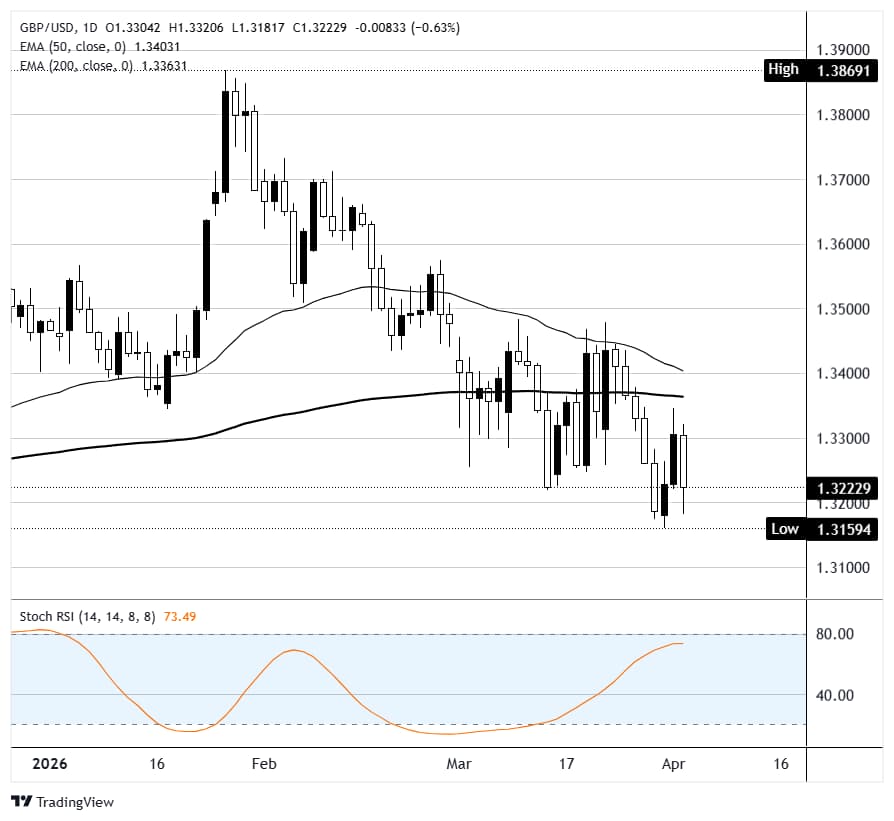
- GBP/USD dropped 0.65% on Thursday to close near 1.3220; the pair has now fallen more than 650 pips from January's high near 1.3870, and the 2026 low around 1.3080 is the next obvious level of interest.
- BoE Governor Andrew Bailey pushed back on rate hike pricing on Tuesday, saying markets are "getting ahead of themselves," but traders are still betting on at least two hikes this year.
- Friday's US NFP report drops at 12:30 GMT while equity markets are closed for Good Friday, creating a thin-liquidity setup that could amplify moves in either direction.
Thursday's session was a downer for the British Pound. GBP/USD opened near 1.3300, sold off steadily through the day, and closed around 1.3220, losing 0.65%. The 50-day exponential moving average (EMA) near 1.3400 and the 200-day EMA around 1.3360 both remain a tricky technical hurdle, and the pair continues to close well below both. The Stochastic RSI sits at 73, which is elevated but not yet overbought, meaning there is room for the selloff to extend before momentum indicators start flashing warning signs. Looking lower, there is not much standing between current levels and the 2026 low near 1.3080 set in mid-March.
How the Pound went from rate cuts to rate hikes in six weeks
It is worth stepping back and appreciating how dramatically the outlook for the Bank of England (BoE) has shifted since the Iran war began. In February, markets were pricing in at least two rate cuts for 2026, with a move as early as March looking like a near certainty. The BoE had already cut rates by 150 basis points since August 2024, bringing the Bank Rate to 3.75%, and UK inflation had been falling toward the 2% target. Then the Strait of Hormuz closed, Oil surged above $100, and everything changed. By mid-March, swap markets had flipped entirely, pricing in as many as four rate hikes. That number has since come down to around two, but the mere fact that the market went from expecting easing to pricing tightening in the span of weeks tells you how much damage the energy shock has done to the UK's inflation outlook. The BoE's own staff now projects Consumer Price Index (CPI) inflation reaching 3.5% by the third quarter of 2026, up from a pre-war forecast of around 2%.
Bailey says hold, but the data might not let him
BoE Governor Andrew Bailey tried to calm things down on Tuesday, telling Reuters that markets are "getting ahead of themselves" on rate hike expectations. His message was clear: the BoE held in March by unanimous vote, and the April 30 meeting will be another assessment, not a foregone conclusion. But Bailey is walking a tightrope. JP Morgan economist Allan Monks has argued that the conditions for an April hike could be met if energy prices stay elevated and firms begin passing costs through to consumers. Deutsche Bank's Sanjay Raja has gone further, saying that risks of "early and multiple hikes no longer look misplaced." The UK is particularly vulnerable here. The country imports roughly 40% of its Oil and up to 60% of its natural gas, making it one of the most energy-exposed economies in the G7. The Ofgem price cap shields households until July, but after that, the full force of higher wholesale energy costs will hit consumer bills. BoE policymaker Megan Greene noted in the March minutes that "the risk of inflation persistence has risen, perhaps significantly" in light of the supply shock.
The technical damage is hard to ignore
From a chart perspective, Thursday's breakdown is the kind of session that changes the tone of a trend. GBP/USD had been consolidating between 1.3200 and 1.3450 for most of March, with the 200-day EMA acting as a rough floor. That floor is gone now. The pair closed more than 100 pips below the 200-day EMA, and both moving averages are likely to begin curling lower if price stays at these levels. The 2026 range is well defined, with the January high at 1.3870 as the ceiling and the March low near 1.3080 as the floor. A retest of that floor from current levels would represent barely another 140 pips of downside. Below 1.3080, the next area of interest does not emerge until the 1.2950-1.3000 zone, which dates back to late 2025 price action. On the upside, the broken 200-day EMA close to 1.3350 becomes the first level that bulls would need to reclaim to stabilize the picture, and that is now more than 100 pips overhead.
Friday's NFP and the long weekend gap risk
The immediate catalyst is Friday's Nonfarm Payrolls (NFP) report out of the US, due at 12:30 GMT. The consensus is for roughly +57K jobs, a rebound from February's -92K, and Thursday's strong jobless claims print of 202K suggests the risks may be skewed to the upside. US equity markets are closed for Good Friday, which means liquidity across all Dollar pairs, including GBP/USD, will be thinner than usual. A strong NFP number would likely push the Dollar higher and drag GBP/USD closer to the March lows. A miss could offer a brief reprieve, but with the BoE stuck between an inflation shock and a stalling economy, Sterling does not have a clean bullish catalyst of its own to lean on. The broader picture remains one where the Pound is caught between a Federal Reserve (Fed) that cannot cut and a BoE that cannot decide whether to hike. Until one of those central banks blinks, or the Oil shock resolves, the path of least resistance for GBP/USD continues to point lower. The question heading into the long weekend is not whether the pair retests 1.3080, but whether it holds when it gets there.
GBP/USD daily chart
Pound Sterling FAQs
The Pound Sterling (GBP) is the oldest currency in the world (886 AD) and the official currency of the United Kingdom. It is the fourth most traded unit for foreign exchange (FX) in the world, accounting for 12% of all transactions, averaging $630 billion a day, according to 2022 data. Its key trading pairs are GBP/USD, also known as ‘Cable’, which accounts for 11% of FX, GBP/JPY, or the ‘Dragon’ as it is known by traders (3%), and EUR/GBP (2%). The Pound Sterling is issued by the Bank of England (BoE).
The single most important factor influencing the value of the Pound Sterling is monetary policy decided by the Bank of England. The BoE bases its decisions on whether it has achieved its primary goal of “price stability” – a steady inflation rate of around 2%. Its primary tool for achieving this is the adjustment of interest rates. When inflation is too high, the BoE will try to rein it in by raising interest rates, making it more expensive for people and businesses to access credit. This is generally positive for GBP, as higher interest rates make the UK a more attractive place for global investors to park their money. When inflation falls too low it is a sign economic growth is slowing. In this scenario, the BoE will consider lowering interest rates to cheapen credit so businesses will borrow more to invest in growth-generating projects.
Data releases gauge the health of the economy and can impact the value of the Pound Sterling. Indicators such as GDP, Manufacturing and Services PMIs, and employment can all influence the direction of the GBP. A strong economy is good for Sterling. Not only does it attract more foreign investment but it may encourage the BoE to put up interest rates, which will directly strengthen GBP. Otherwise, if economic data is weak, the Pound Sterling is likely to fall.
Another significant data release for the Pound Sterling is the Trade Balance. This indicator measures the difference between what a country earns from its exports and what it spends on imports over a given period. If a country produces highly sought-after exports, its currency will benefit purely from the extra demand created from foreign buyers seeking to purchase these goods. Therefore, a positive net Trade Balance strengthens a currency and vice versa for a negative balance.
추천 기사


