


USD/JPY sits below 160.00 as Tokyo's intervention threat collides with Friday's NFP
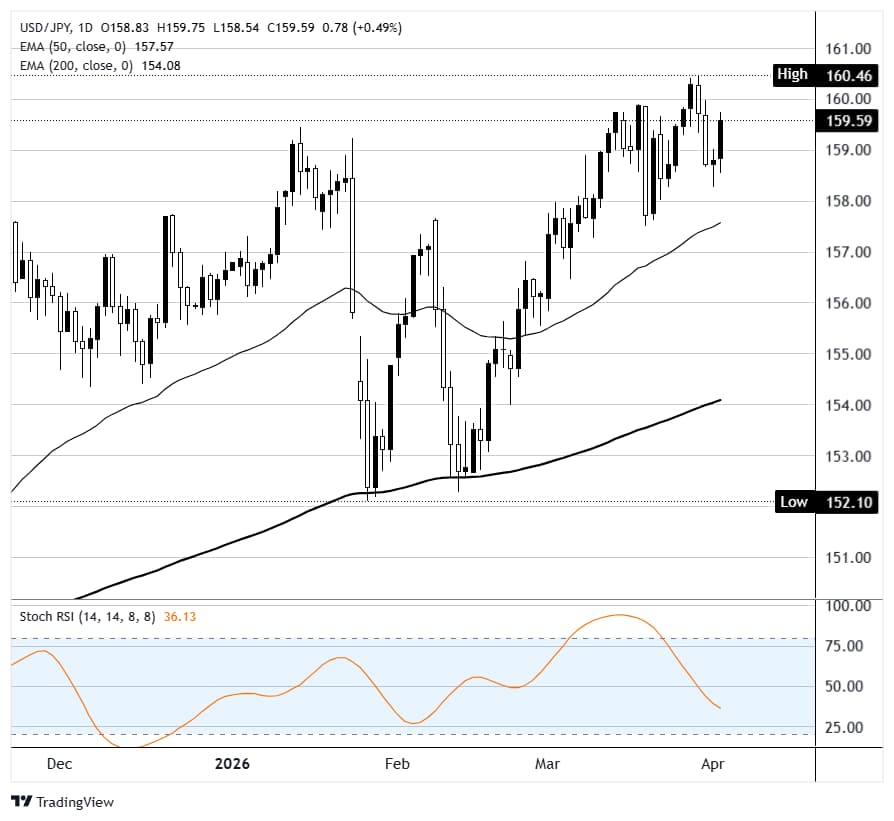
- USD/JPY climbed to near 159.60 on Thursday as the US Dollar strengthened on surging Oil prices and fading Fed rate cut expectations, putting the pair within striking distance of the critical 160.00 level.
- Japan's MOF has repeatedly warned of "decisive action" against disorderly Yen moves, and 160 is the exact level that triggered nearly $62 billion in intervention spending back in 2024.
- Friday's NFP report drops at 12:30 GMT while US equity markets sit closed for Good Friday, creating a dangerous setup where the US Dollar could move sharply on a thin liquidity backdrop.
- The BoJ's April 27-28 meeting looms as the next major policy inflection point, with markets pricing roughly a 71% chance of a rate hike.
USD/JPY is heading into Friday's Asia session trading just below 159.60, and the setup going into the long Easter weekend is about as uncomfortable as it gets for Yen traders on either side. The pair has rallied roughly a full figure from Wednesday's lows near 158.50, driven entirely by the US Dollar reasserting itself after President Trump's Wednesday night address killed the de-escalation narrative that had briefly pulled Oil below $100 per barrel. West Texas Intermediate (WTI) Crude Oil surged around 8% on Thursday to near $110, Treasury yields firmed, and Federal Reserve (Fed) rate cut expectations faded further. All of that is Yen-negative. But the closer USD/JPY gets to 160, the louder Tokyo's warnings get, and the more dangerous it becomes to be long.
The 160.00 line: Why this number matters more than most
This is not just a round number. In April-May 2024, when USD/JPY last pushed through 160, Japan's Ministry of Finance (MOF) deployed a record $62 billion in intervention over roughly a month, causing violent multi-hundred pip reversals with no warning. In January 2026, the pair briefly breached 159, and speculation immediately surfaced that Tokyo had conducted a stealth intervention, a suspicion bolstered by reports that the New York Fed had conducted a "rate check" on behalf of the US Treasury. The MOF has never formally confirmed the January episode, but the market got the message. Since then, Vice Finance Minister for International Affairs Atsushi Mimura and Finance Minister Satsuki Katayama have both explicitly stated that authorities are prepared to take "decisive action" against excessive Yen depreciation. That language is the standard pre-intervention playbook. The problem for Tokyo right now is that the Yen's weakness is not being driven by speculative carry trades the way it was in 2024. This time it is Oil. Japan imports roughly 90% of its crude from the Middle East, and with WTI above $110 and the Strait of Hormuz effectively closed, the country faces an energy import bill that structurally weakens the Yen regardless of what the MOF does. That makes intervention a bandage, not a fix. But it does not mean Tokyo will not use it.
NFP drops into a closed market
Friday's March Nonfarm Payrolls (NFP) report lands at 12:30 GMT, and here is the problem: US equity markets are closed for Good Friday. The New York Stock Exchange, Nasdaq, and bond markets are all dark. CME Globex futures will trade, but liquidity will be a fraction of a normal session. The consensus expectation is for roughly +57K jobs, a rebound from February's brutal -92K print, which was the worst single-month loss in recent memory. Thursday's weekly jobless claims reading of 202K, well below the 212K consensus, suggests the labor market may be stronger than the February number implied. ADP's March print of +62K, released Wednesday, also pointed to a modest recovery. But here is what matters for USD/JPY: a strong NFP print would push Fed rate cut expectations even further out, widening the US-Japan yield gap and putting more upward pressure on the pair heading into Monday's reopening. A weak print could give the Yen a temporary lifeline, but with Oil still elevated, any relief would likely be short-lived.
The BoJ is stuck, and the market knows it
The Bank of Japan (BoJ) held rates at 0.75% at its last meeting, and the April 27-28 meeting is shaping up as the most consequential in months. Markets currently price a roughly 71% probability of a hike, and new board member Toichiro Asada signaled a "cautious, data-driven" approach at his first briefing this week. The fundamental case for hiking is strong: Japanese wage growth is running above 4% annually, core-core inflation (excluding food and energy) sits at 2.5%, and Yen weakness is amplifying imported inflation through higher fuel and freight costs. But the BoJ is trapped. Hiking into an energy shock risks tipping an already fragile recovery, while standing pat allows the Yen to weaken further, compounding the very inflation problem rates are supposed to address. Wellington Management noted in a recent report that the January intervention episode, particularly the suspected US Treasury involvement, actually makes an April hike more likely, not less. Their view is that intervention buys time but does not fix the underlying cause, which is the still-wide US-Japan rate differential sitting at roughly 275 basis points.
Heading into Asia with no good options
For USD/JPY traders heading into Friday's Asia session, the risk matrix is unusually lopsided. Longs face the intervention cliff at 160, a level where history says the MOF has been willing to spend tens of billions of dollars to defend. Shorts face the structural headwinds of a rising Oil price, a firmer US Dollar, and a BoJ that is still months behind the curve on normalization. NFP adds another layer of uncertainty on a day when liquidity will be thin and US equity futures will be the only real-time gauge of Dollar sentiment. The path of least resistance still looks modestly higher for USD/JPY, but "modestly" is doing a lot of heavy lifting in that sentence. If the pair pushes above 160 in thin Friday trade, the MOF will face a choice: intervene into a holiday-thinned market and risk being overwhelmed by fundamental flows, or wait until Monday and risk the pair running even further. Neither option is good. And that is the story of USD/JPY right now: a pair where every participant, from the BoJ to the MOF to the speculative community, has a reason to act and a reason to wait.
USD/JPY daily chart
Japanese Yen FAQs
The Japanese Yen (JPY) is one of the world’s most traded currencies. Its value is broadly determined by the performance of the Japanese economy, but more specifically by the Bank of Japan’s policy, the differential between Japanese and US bond yields, or risk sentiment among traders, among other factors.
One of the Bank of Japan’s mandates is currency control, so its moves are key for the Yen. The BoJ has directly intervened in currency markets sometimes, generally to lower the value of the Yen, although it refrains from doing it often due to political concerns of its main trading partners. The BoJ ultra-loose monetary policy between 2013 and 2024 caused the Yen to depreciate against its main currency peers due to an increasing policy divergence between the Bank of Japan and other main central banks. More recently, the gradually unwinding of this ultra-loose policy has given some support to the Yen.
Over the last decade, the BoJ’s stance of sticking to ultra-loose monetary policy has led to a widening policy divergence with other central banks, particularly with the US Federal Reserve. This supported a widening of the differential between the 10-year US and Japanese bonds, which favored the US Dollar against the Japanese Yen. The BoJ decision in 2024 to gradually abandon the ultra-loose policy, coupled with interest-rate cuts in other major central banks, is narrowing this differential.
The Japanese Yen is often seen as a safe-haven investment. This means that in times of market stress, investors are more likely to put their money in the Japanese currency due to its supposed reliability and stability. Turbulent times are likely to strengthen the Yen’s value against other currencies seen as more risky to invest in.
추천 기사


