




USD/INR falls on positive outcome from US-India trade talks
- The Indian Rupee rises against the US Dollar as hopes of a US-India trade deal have improved.
- India’s External Affairs Minister Jaishankar said that trade talks with US Secretary of State Rubio were good.
- Investors await India-US wholesale inflation data.
The Indian Rupee (INR) trades higher against the US Dollar in the opening session on Wednesday. The USD/INR pair drops to near 90.30 as the Indian Rupee gains on the outcome of trade talks between the United States (US) and India on Tuesday.
India’s External Affairs Minister Subrahmanyam Jaishankar stated in a post on X, formerly known as Twitter, that trade discussions with US Secretary of State Marco Rubio were good and will continue discussing issues. ”Just concluded a good conversation with @SecRubio. Discussed trade, critical minerals, nuclear cooperation, defence, and energy. Agreed to remain in touch on these and other issues,” Jaishankar posted.
In response, US Ambassador to India, Sergio Gor, stated in a post on X that it was a “positive call” and the next meeting is very likely to be in February.
Easing trade frictions between the US and India is favorable for the Indian Rupee, which turned out to be Asia’s worst-performing currency in 2025 due to the steepest tariffs by Washington on imports from New Delhi. The US raised tariffs on India to 50%, added 25% punitive tariffs for buying oil from Russia.
Meanwhile, foreign investors continue to dump their stake in the Indian stock market amid a trade stalemate between the US and India. So far in January, Foreign Institutional Investors (FIIs) have remained net sellers in eight out of nine trading days, and have offloaded their stake worth Rs. 16,925.03 crore.
In Wednesday’s session, investors will focus on the WPI Inflation data for December, which will be published at 12:00 PM IST (06:30 GMT). Inflation at the wholesale level is expected to have grown by 0.3% after declining at a similar pace in November.
Daily digest market movers: US Dollar gains on steady inflation data
- The Indian Rupee rises against the US Dollar, even as the latter trades firmly against its other peers, following the release of the US Consumer Price Index (CPI) data for December. During the press time, the US Dollar Index (DXY), which tracks the Greenback’s value against six major currencies, holds onto gains near a monthly high around 99.25.
- On Tuesday, US Bureau of Labor Statistics (BLS) showed that inflationary pressures remained steady, keeping hopes for the Federal Reserve (Fed) to maintain interest rates at their current levels intact. On an annualized basis, the US headline and core CPI came in at 2.7% and 2.6%, respectively.
- Richmond Federal Reserve President Tom Barkin called December’s inflation data "encouraging," adding that he expects price pressures to remain at modest levels in the next couple of months, Reuters reported.
- US President Donald Trump welcomed steady inflation figures and extended its force on Fed Chair Jerome Powell to reduce interest rates further. We have very low inflation. That would give ’too late Powell’ the chance to give us a nice beautiful big rate cut," Trump told reporters at Detroit, Reuters reported.
- Meanwhile, Fed’s Powell is facing criminal charges for cost overruns in the renovation of the Fed's Washington headquarters, which he called a “pretext” for not taking monetary decisions as per the president’s preferences. The event has raised concerns over the Fed’s independence.
- In response, chiefs from global central banks have shown support for Fed’s Powell, citing that “independence of central banks is a cornerstone of price, financial and economic stability in the interest of the citizens that we serve.”
- In Wednesday’s session, investors will focus on the US Producer Price Index (PPI) data for October and November, and Retail Sales data for November, which will be published at 13:30 GMT.
Technical Analysis: USD/INR wobbles near 20-day EMA
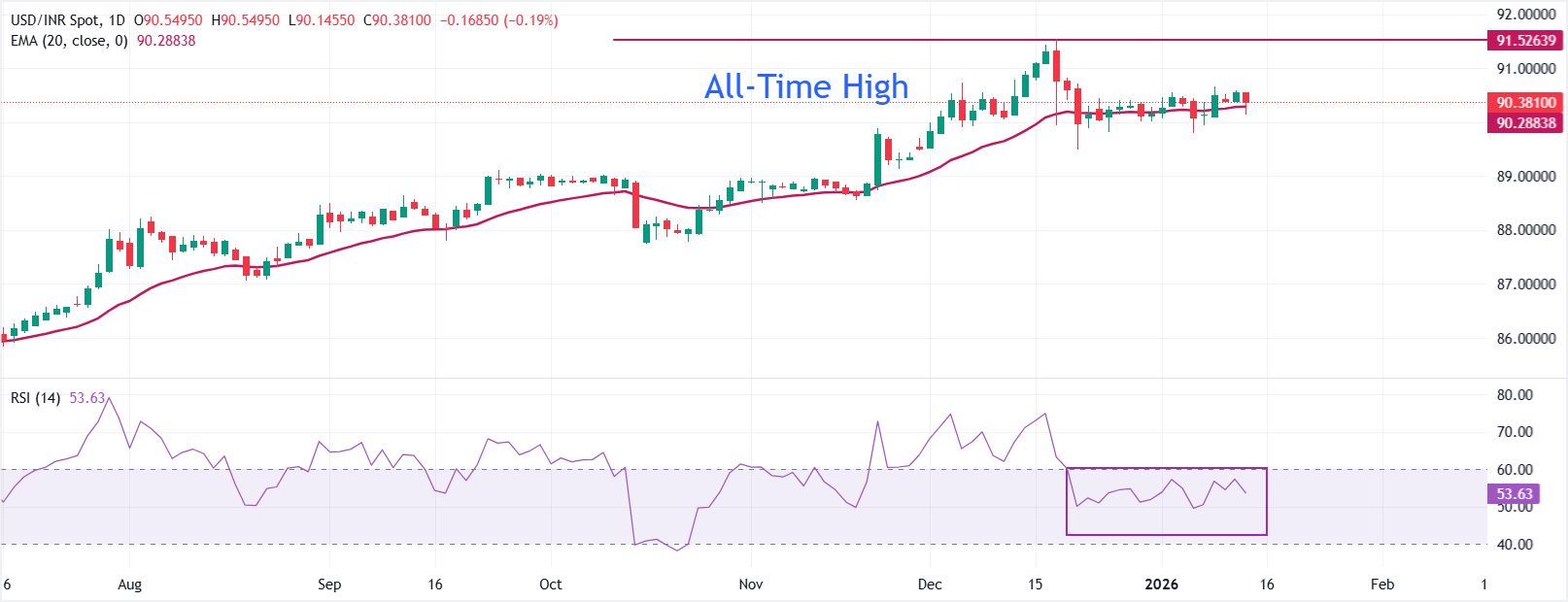
USD/INR trades lower near 90.3810 as of writing. Price holds above the 20-day Exponential Moving Average (EMA) at 90.29, sustaining a short-term upward bias. The 20-day EMA is edging higher, supporting the path of least resistance to the upside.
The 14-day Relative Strength Index (RSI) at 53 (neutral) has eased from prior readings, confirming moderated momentum.
As long as the pair holds above the rising 20-day EMA, the bias stays positive and dips remain supported, while a daily close below that gauge could open room for a deeper retracement. RSI hovering near the midline suggests balanced conditions; a further fade in momentum would favor consolidation, whereas a pickup could underpin an extension of the advance.
(The technical analysis of this story was written with the help of an AI tool.)
Indian Rupee FAQs
The Indian Rupee (INR) is one of the most sensitive currencies to external factors. The price of Crude Oil (the country is highly dependent on imported Oil), the value of the US Dollar – most trade is conducted in USD – and the level of foreign investment, are all influential. Direct intervention by the Reserve Bank of India (RBI) in FX markets to keep the exchange rate stable, as well as the level of interest rates set by the RBI, are further major influencing factors on the Rupee.
The Reserve Bank of India (RBI) actively intervenes in forex markets to maintain a stable exchange rate, to help facilitate trade. In addition, the RBI tries to maintain the inflation rate at its 4% target by adjusting interest rates. Higher interest rates usually strengthen the Rupee. This is due to the role of the ‘carry trade’ in which investors borrow in countries with lower interest rates so as to place their money in countries’ offering relatively higher interest rates and profit from the difference.
Macroeconomic factors that influence the value of the Rupee include inflation, interest rates, the economic growth rate (GDP), the balance of trade, and inflows from foreign investment. A higher growth rate can lead to more overseas investment, pushing up demand for the Rupee. A less negative balance of trade will eventually lead to a stronger Rupee. Higher interest rates, especially real rates (interest rates less inflation) are also positive for the Rupee. A risk-on environment can lead to greater inflows of Foreign Direct and Indirect Investment (FDI and FII), which also benefit the Rupee.
Higher inflation, particularly, if it is comparatively higher than India’s peers, is generally negative for the currency as it reflects devaluation through oversupply. Inflation also increases the cost of exports, leading to more Rupees being sold to purchase foreign imports, which is Rupee-negative. At the same time, higher inflation usually leads to the Reserve Bank of India (RBI) raising interest rates and this can be positive for the Rupee, due to increased demand from international investors. The opposite effect is true of lower inflation.
추천 기사


