

EUR/USD ends week near 1.1640, posts 0.7% loss as Dollar dominates
- EUR/USD slides for the week as Dollar strength overshadows mixed US payrolls and housing data.
- Eurozone Retail Sales beat forecasts, but gains fail to shift sentiment away from US-driven flows.
- Markets eye inflation data and central bank speakers in Europe and the US next week.
EUR/USD prolonged its agony throughout the week, poising to print losses of 0.70%, as it fell 0.20% on Friday, despite the release of mixed economic data in the US. In the European Union, Retail Sales exceeded forecasts, but traders’ focus remains around the dynamics of the US and the Dollar. The pair trades at 1.1636 after hitting a daily peak of 1.1662.
Euro remains under pressure despite mixed US data, as investors stay focused on Dollar dynamics
December’s US Nonfarm Payroll figures were mixed as the economy added 50K jobs, below forecast for a 60K increase, also below November’s 64K print. Nevertheless, the Unemployment Rate edged lower from 4.6& to 4.4%, revealed the US Bureau of Labor Statistics (BLS).
Other data revealed that the housing market continued to lose momentum, as Building Permits and Housing Starts in October both declined relative to November’s readings. Meanwhile the University of Michigan Consumer Sentiment preliminary report for January came in stronger than expected.
In the Eurozone, consumers consumption increased in November, up 0.2% MoM an improvement compared to October’s flat reading and beat estimates. German data was also mixed during the day, as Industrial Production exceeded forecasts, though the trade balance narrowed as exports declined.
Next week: Busy schedule in Europe and the US
The Eurozone economic docket will feature speeches by European Central Bank policymakers, the release of the Sentix Investor Confidence, the Harmonized Index of Consumer Prices (HICP) in the bloc, Germany, Spain and Italy.
In the US, the calendar will feature consumer and producer price indices, Retail sales, jobless claims and Fed officials’ comments.
Euro Price This week
The table below shows the percentage change of Euro (EUR) against listed major currencies this week. Euro was the strongest against the Canadian Dollar.
| USD | EUR | GBP | JPY | CAD | AUD | NZD | CHF | |
|---|---|---|---|---|---|---|---|---|
| USD | 0.78% | 0.45% | 0.66% | 1.22% | -0.18% | 0.47% | 1.07% | |
| EUR | -0.78% | -0.34% | -0.04% | 0.44% | -0.95% | -0.31% | 0.29% | |
| GBP | -0.45% | 0.34% | 0.19% | 0.78% | -0.63% | 0.03% | 0.62% | |
| JPY | -0.66% | 0.04% | -0.19% | 0.53% | -0.87% | -0.22% | 0.42% | |
| CAD | -1.22% | -0.44% | -0.78% | -0.53% | -1.24% | -0.75% | -0.15% | |
| AUD | 0.18% | 0.95% | 0.63% | 0.87% | 1.24% | 0.66% | 1.26% | |
| NZD | -0.47% | 0.31% | -0.03% | 0.22% | 0.75% | -0.66% | 0.60% | |
| CHF | -1.07% | -0.29% | -0.62% | -0.42% | 0.15% | -1.26% | -0.60% |
The heat map shows percentage changes of major currencies against each other. The base currency is picked from the left column, while the quote currency is picked from the top row. For example, if you pick the Euro from the left column and move along the horizontal line to the US Dollar, the percentage change displayed in the box will represent EUR (base)/USD (quote).
Daily digest market movers: Euro weighed by US Dollar strength
- Beyond the US jobs data report, October’s US Building Permits slipped 0.2%, easing from 1.415 million to 1.412 million. Housing Starts also softened, with starts falling 4.6% MoM to 1.246 million, down from 1.306 million in September.
- The University of Michigan Consumer Sentiment preliminary reading for January rose to 54, up from November’s final 52.9, and beating forecasts of 53.5. American’s inflation expectations for one-year were unchanged at 4.2%, while five-year expectations edged up to 3.4% from 3.2%.
- Money markets continued to price in 50 basis points of easing towards the year’s end, reveled the CME FedWatch Tool.
- Atlanta’s Fed President Raphael Bostic said that job growth “was modest,” adding on inflation that it “will take more time to make up for missing reports from last fall.”
- Later, Richmond Fed Thomas Barkin revealed that the Labor market is steady, but hiring remains uncomfortable narrow. He added that it will take through April for inflation data to be fully caught up.
Technical outlook: EUR/USD slumps as sellers pile in, pushing the pair below 1.1650
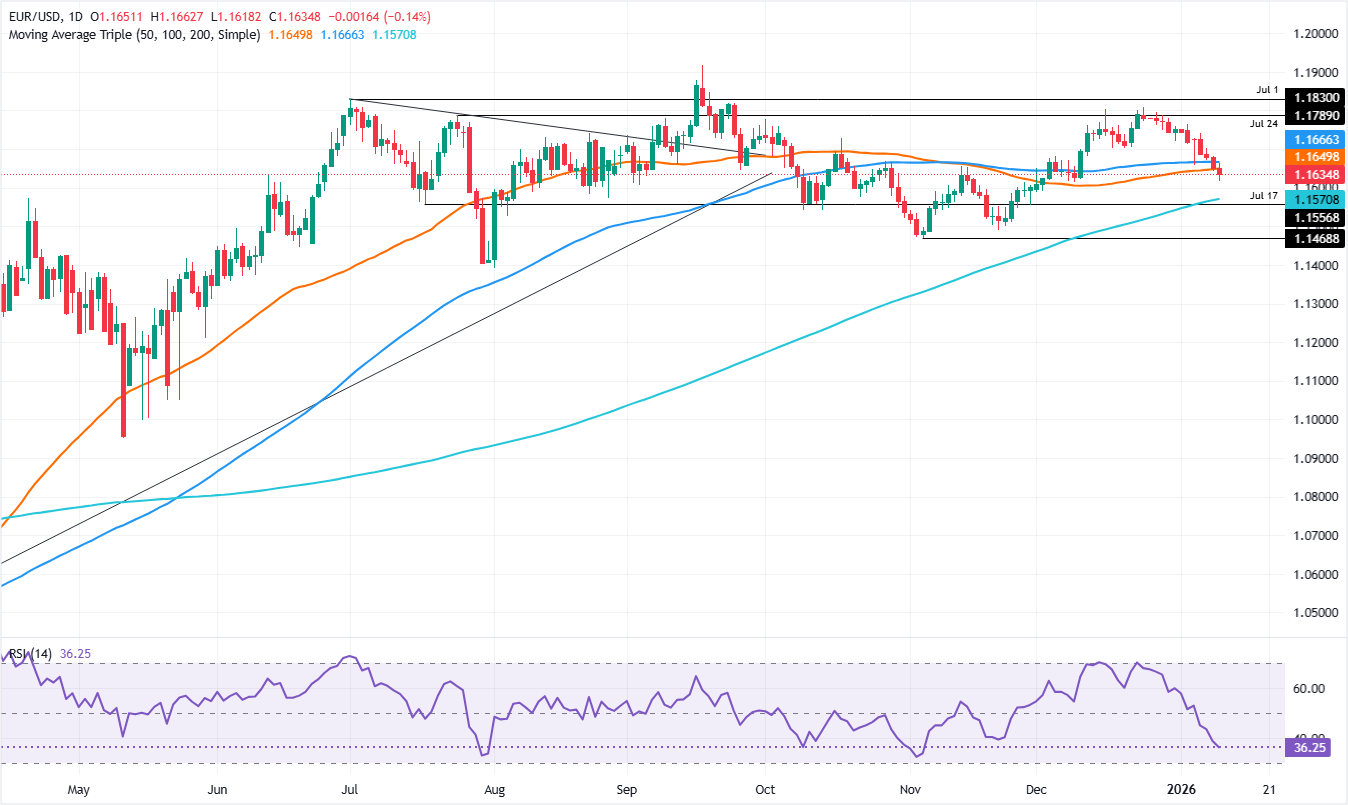
The technical picture shows the EUR/USD as neutral to downward biased, as bearish momentum picked up, due to the fall of the pair, which cleared key support levels like the 100- and the 50-day Simple Moving Averages (SMAs) each at 1.1663 and 1.1641, respectively.
The Relative Strength Index (RSI) shows that bears are gathering strength after the index hit the 38 thresholds, being closer to oversold territory. Therefore, the path of least resistance is downwards.
The EUR/USD first support would be 1.1600. A breach of the latter will expose the 200-day SMA at 1.1565, the last line of defense for bulls, before the pair turns bearish. Further downside lies below at 1.1500 and the August 1 low of 1.1391.
On the other hand, if buyers regain the 50 and 100-day SMAs, 1.1700 would be the next resistance level. Once cleared, traders will eye the 20-day SMA at 1.1730.
Euro FAQs
The Euro is the currency for the 20 European Union countries that belong to the Eurozone. It is the second most heavily traded currency in the world behind the US Dollar. In 2022, it accounted for 31% of all foreign exchange transactions, with an average daily turnover of over $2.2 trillion a day. EUR/USD is the most heavily traded currency pair in the world, accounting for an estimated 30% off all transactions, followed by EUR/JPY (4%), EUR/GBP (3%) and EUR/AUD (2%).
The European Central Bank (ECB) in Frankfurt, Germany, is the reserve bank for the Eurozone. The ECB sets interest rates and manages monetary policy. The ECB’s primary mandate is to maintain price stability, which means either controlling inflation or stimulating growth. Its primary tool is the raising or lowering of interest rates. Relatively high interest rates – or the expectation of higher rates – will usually benefit the Euro and vice versa. The ECB Governing Council makes monetary policy decisions at meetings held eight times a year. Decisions are made by heads of the Eurozone national banks and six permanent members, including the President of the ECB, Christine Lagarde.
Eurozone inflation data, measured by the Harmonized Index of Consumer Prices (HICP), is an important econometric for the Euro. If inflation rises more than expected, especially if above the ECB’s 2% target, it obliges the ECB to raise interest rates to bring it back under control. Relatively high interest rates compared to its counterparts will usually benefit the Euro, as it makes the region more attractive as a place for global investors to park their money.
Data releases gauge the health of the economy and can impact on the Euro. Indicators such as GDP, Manufacturing and Services PMIs, employment, and consumer sentiment surveys can all influence the direction of the single currency. A strong economy is good for the Euro. Not only does it attract more foreign investment but it may encourage the ECB to put up interest rates, which will directly strengthen the Euro. Otherwise, if economic data is weak, the Euro is likely to fall. Economic data for the four largest economies in the euro area (Germany, France, Italy and Spain) are especially significant, as they account for 75% of the Eurozone’s economy.
Another significant data release for the Euro is the Trade Balance. This indicator measures the difference between what a country earns from its exports and what it spends on imports over a given period. If a country produces highly sought after exports then its currency will gain in value purely from the extra demand created from foreign buyers seeking to purchase these goods. Therefore, a positive net Trade Balance strengthens a currency and vice versa for a negative balance.
Nonfarm Payrolls FAQs
Nonfarm Payrolls (NFP) are part of the US Bureau of Labor Statistics monthly jobs report. The Nonfarm Payrolls component specifically measures the change in the number of people employed in the US during the previous month, excluding the farming industry.
The Nonfarm Payrolls figure can influence the decisions of the Federal Reserve by providing a measure of how successfully the Fed is meeting its mandate of fostering full employment and 2% inflation. A relatively high NFP figure means more people are in employment, earning more money and therefore probably spending more. A relatively low Nonfarm Payrolls’ result, on the either hand, could mean people are struggling to find work. The Fed will typically raise interest rates to combat high inflation triggered by low unemployment, and lower them to stimulate a stagnant labor market.
Nonfarm Payrolls generally have a positive correlation with the US Dollar. This means when payrolls’ figures come out higher-than-expected the USD tends to rally and vice versa when they are lower. NFPs influence the US Dollar by virtue of their impact on inflation, monetary policy expectations and interest rates. A higher NFP usually means the Federal Reserve will be more tight in its monetary policy, supporting the USD.
Nonfarm Payrolls are generally negatively-correlated with the price of Gold. This means a higher-than-expected payrolls’ figure will have a depressing effect on the Gold price and vice versa. Higher NFP generally has a positive effect on the value of the USD, and like most major commodities Gold is priced in US Dollars. If the USD gains in value, therefore, it requires less Dollars to buy an ounce of Gold. Also, higher interest rates (typically helped higher NFPs) also lessen the attractiveness of Gold as an investment compared to staying in cash, where the money will at least earn interest.
Nonfarm Payrolls is only one component within a bigger jobs report and it can be overshadowed by the other components. At times, when NFP come out higher-than-forecast, but the Average Weekly Earnings is lower than expected, the market has ignored the potentially inflationary effect of the headline result and interpreted the fall in earnings as deflationary. The Participation Rate and the Average Weekly Hours components can also influence the market reaction, but only in seldom events like the “Great Resignation” or the Global Financial Crisis.
추천 기사


