


Australian Dollar moves little following Trade Balance data
- Australian Dollar steadies as trade surplus narrowed to 2,936M MoM in November.
- Australia’s mixed November inflation leaves RBA policy uncertain, with focus turning to the quarterly CPI later this month.
- The US ISM Services PMI rose to 54.4 in December from 52.6, beating expectations of 52.3.
The Australian Dollar (AUD) steadies against the US Dollar (USD) on Thursday following Australia’s Trade Balance data, which showed that trade surplus narrowed to 2,936M MoM in November versus 4,353M (revised from 4,385M) in the previous reading.
The Australian Bureau of Statistics (ABS) reported on Thursday that Exports fell by 2.9% MoM in November from a rise of 2.8% (revised from 3.4%) seen a month earlier. Meanwhile, Imports grew by 0.2% MoM in November, compared to a rise of 2.4% (revised from 2.0%) seen in October.
Australia’s mixed November inflation data left the Reserve Bank of Australia’s policy outlook uncertain. Focus now shifts to the quarterly CPI report due later this month for clearer guidance on the RBA’s next policy move.
The Australian Bureau of Statistics (ABS) reported on Wednesday that Australia’s Consumer Price Index rose 3.4% year-over-year (YoY) in November, easing from 3.8% in October. The reading missed market expectations of 3.7% but remained above the RBA’s 2–3% target. It marked the lowest inflation since August, with housing costs increasing at the slowest pace in three months.
US Dollar moves little ahead of Initial Jobless Claims
- The US Dollar Index (DXY), which measures the value of the US Dollar against six major currencies, is holding ground and trading around 98.70 at the time of writing. Traders will keep an eye on the US Initial Jobless Claims data later on Thursday. Attention will be shifted toward the Friday’s US Nonfarm Payrolls (NFP) report, which is expected to show job gains of 55,000 in December, down from 64,000 in November.
- The Institute for Supply Management (ISM) reported on Wednesday that the US Services PMI rose to 54.4 in December from 52.6 in November. This figure came in stronger than the expectation of 52.3.
- Fed Governor Stephen Miran said on Tuesday that the US central bank needs to cut interest rates aggressively this year to support economic momentum. Meanwhile, Minneapolis Fed President Neel Kashkari warned of a risk that the unemployment rate could “pop” higher.
- Richmond Fed President Tom Barkin, a non-voter on the Fed’s rate-setting committee this year, said Tuesday that interest rate adjustments will need to be “finely tuned” to incoming data, citing risks to both the Fed’s employment and inflation objectives, according to Reuters.
- According to the CME Group's FedWatch tool, Fed funds futures continue to price in about an 88.9% probability that the US central bank will keep rates unchanged at its January 27–28 meeting.
- Traders expect two additional Federal Reserve rate cuts in 2026. Markets are bracing for US President Donald Trump to nominate a new Fed chair to replace Jerome Powell when his term ends in May, a move that could tilt monetary policy toward lower interest rates.
- China’s RatingDog Services Purchasing Managers’ Index (PMI), released on Monday, declined to 52.0 in December from 52.1 in November. RatingDog reported last week that Manufacturing PMI climbed to 50.1 in December from 49.9 in November. It is important to note that any change in the Chinese economy could impact the AUD as China and Australia are close trading partners.
- Australia’s CPI was unchanged at 0% month-on-month (MoM) in November, matching October’s reading. Meanwhile, the RBA’s Trimmed Mean CPI rose 0.3% MoM and 3.2% YoY. Separately, seasonally adjusted Building Permits surged 15.2% MoM to a near four-year high of 18,406 units in November 2025, rebounding from a downwardly revised 6.1% fall previously. Annual approvals jumped 20.2%, reversing a revised 1.1% decline in October.
- The Australian Financial Review (AFR) suggested that the RBA may not be done tightening this cycle. The poll indicates that inflation is expected to remain stubbornly elevated over the coming year, fueling expectations of at least two additional rate hikes.
Australian Dollar trades near 0.6700 after pulling back from 15-month highs
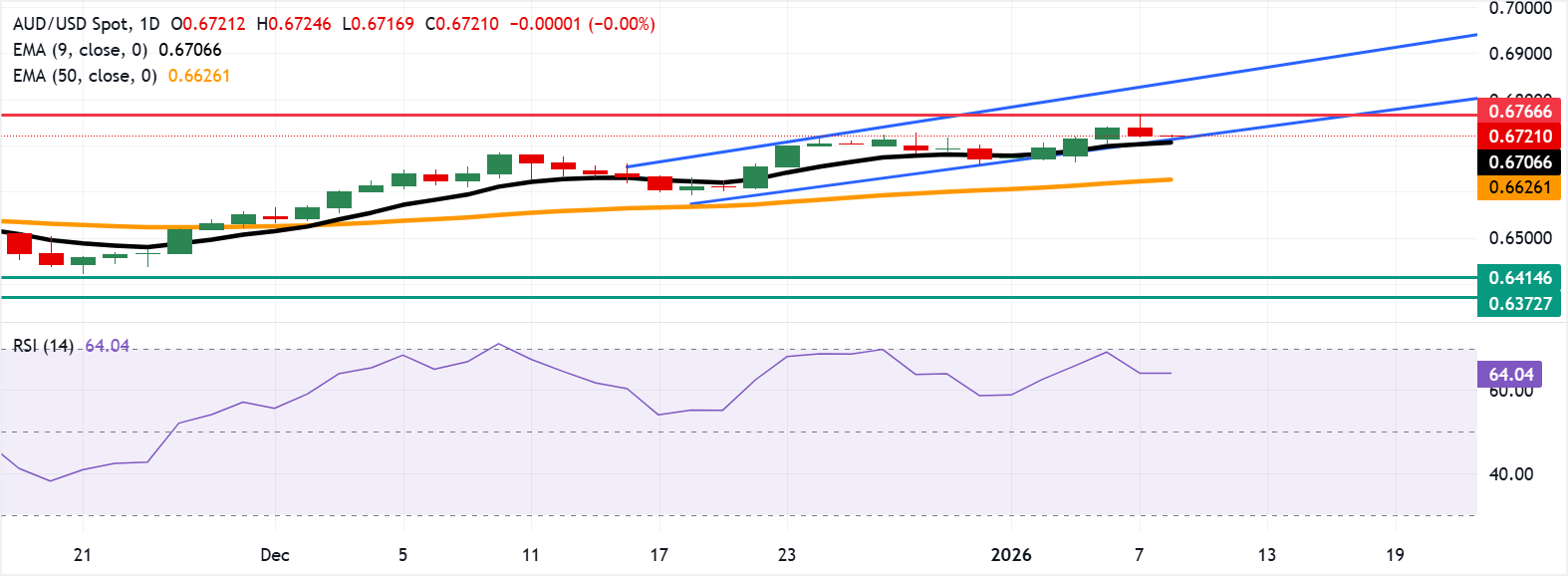
AUD/USD is trading around 0.6720 on Thursday. The technical analysis of the daily chart indicates that the pair remains within the ascending channel pattern, suggesting a persistent bullish bias. However, the 14-day Relative Strength Index (RSI) at 64.42 suggests a bullish momentum.
The AUD/USD pair may target the 0.6766, the highest level since October 2024, followed by the upper boundary of the ascending channel near 0.6840.
The initial support lies at the lower ascending channel boundary around 0.6720, followed by the nine-day Exponential Moving Average (EMA) of 0.6706. A break below the confluence support zone could expose the AUD/USD pair to the area around the 50-day EMA at 0.6626.
Australian Dollar Price Today
The table below shows the percentage change of Australian Dollar (AUD) against listed major currencies today. Australian Dollar was the strongest against the New Zealand Dollar.
| USD | EUR | GBP | JPY | CAD | AUD | NZD | CHF | |
|---|---|---|---|---|---|---|---|---|
| USD | 0.05% | 0.06% | 0.08% | 0.07% | -0.01% | 0.12% | 0.03% | |
| EUR | -0.05% | 0.00% | 0.05% | 0.04% | -0.06% | 0.06% | -0.01% | |
| GBP | -0.06% | -0.01% | 0.02% | 0.01% | -0.07% | 0.05% | -0.02% | |
| JPY | -0.08% | -0.05% | -0.02% | -0.03% | -0.10% | -0.02% | -0.06% | |
| CAD | -0.07% | -0.04% | -0.01% | 0.03% | -0.07% | 0.04% | -0.03% | |
| AUD | 0.01% | 0.06% | 0.07% | 0.10% | 0.07% | 0.12% | 0.06% | |
| NZD | -0.12% | -0.06% | -0.05% | 0.02% | -0.04% | -0.12% | -0.06% | |
| CHF | -0.03% | 0.00% | 0.02% | 0.06% | 0.03% | -0.06% | 0.06% |
The heat map shows percentage changes of major currencies against each other. The base currency is picked from the left column, while the quote currency is picked from the top row. For example, if you pick the Australian Dollar from the left column and move along the horizontal line to the US Dollar, the percentage change displayed in the box will represent AUD (base)/USD (quote).
Australian Dollar FAQs
One of the most significant factors for the Australian Dollar (AUD) is the level of interest rates set by the Reserve Bank of Australia (RBA). Because Australia is a resource-rich country another key driver is the price of its biggest export, Iron Ore. The health of the Chinese economy, its largest trading partner, is a factor, as well as inflation in Australia, its growth rate and Trade Balance. Market sentiment – whether investors are taking on more risky assets (risk-on) or seeking safe-havens (risk-off) – is also a factor, with risk-on positive for AUD.
The Reserve Bank of Australia (RBA) influences the Australian Dollar (AUD) by setting the level of interest rates that Australian banks can lend to each other. This influences the level of interest rates in the economy as a whole. The main goal of the RBA is to maintain a stable inflation rate of 2-3% by adjusting interest rates up or down. Relatively high interest rates compared to other major central banks support the AUD, and the opposite for relatively low. The RBA can also use quantitative easing and tightening to influence credit conditions, with the former AUD-negative and the latter AUD-positive.
China is Australia’s largest trading partner so the health of the Chinese economy is a major influence on the value of the Australian Dollar (AUD). When the Chinese economy is doing well it purchases more raw materials, goods and services from Australia, lifting demand for the AUD, and pushing up its value. The opposite is the case when the Chinese economy is not growing as fast as expected. Positive or negative surprises in Chinese growth data, therefore, often have a direct impact on the Australian Dollar and its pairs.
Iron Ore is Australia’s largest export, accounting for $118 billion a year according to data from 2021, with China as its primary destination. The price of Iron Ore, therefore, can be a driver of the Australian Dollar. Generally, if the price of Iron Ore rises, AUD also goes up, as aggregate demand for the currency increases. The opposite is the case if the price of Iron Ore falls. Higher Iron Ore prices also tend to result in a greater likelihood of a positive Trade Balance for Australia, which is also positive of the AUD.
The Trade Balance, which is the difference between what a country earns from its exports versus what it pays for its imports, is another factor that can influence the value of the Australian Dollar. If Australia produces highly sought after exports, then its currency will gain in value purely from the surplus demand created from foreign buyers seeking to purchase its exports versus what it spends to purchase imports. Therefore, a positive net Trade Balance strengthens the AUD, with the opposite effect if the Trade Balance is negative.
추천 기사


