


USD/INR ticks lower amid caution ahead of US economic data releases
- The Indian Rupee edges higher against the US Dollar as investors turn cautious ahead of the release of US economic data.
- Investors await India’s WPI Inflation data for October, which is expected to show a decline of 0.6%.
- Traders trimmed Fed dovish bets as officials stressed bringing inflation down.
The Indian Rupee (INR) ticks up against the US Dollar (USD) at open on Friday. The USD/INR pair edges lower to near 88.85 as the US Dollar extends its downside. Though the Indian Rupee rises marginally against the US Dollar, the former is expected to trade cautiously ahead of the release of Wholesale Price Index (WPI) Inflation data for October, which will be published at 06:30 GMT.
India’s Ministry of Commerce and Industry is expected to show that inflation at the wholesale level declined by 0.6% on an annualized basis after rising 0.13% in September, a scenario that would prompt expectations of an interest rate cut by the Reserve Bank of India (RBI) in its monetary policy announcement in December.
This week, the speculation of an RBI interest rate cut in the December meeting had already intensified after the release of the Consumer Price Index (CPI) data for October, which showed that inflationary pressures grew at a moderate pace of 0.25% on an annualized basis.
Broadly, the USD/INR pair is upbeat and close to its all-time high of 89.10 as the United States (US) and India have yet to reach a trade deal. To support the Indian Rupee, the RBI has intervened several times since August when US-India trade tensions stemmed. A Reuters report has shown that the RBI might likely sell US Dollars to anchor the Indian Rupee above record low.
Amid an absence of a US-India trade deal, overseas investors have been consistently paring their stake in the Indian stock market. On Thursday, Foreign Institutional Investors (FIIs) turned out to be net sellers for the fourth straight trading day and offloaded shares worth Rs. 383.68 crore.
Daily digest market movers: Fed’s Hammack and Musalem call for caution on further interest rate cuts
- A slight downside move in the USD/INR pair is majorly driven by weakness in the US Dollar. At the press time, the US Dollar Index (DXY), which tracks the Greenback’s value against six major currencies, trades marginally lower to near 99.15. The USD Index is close to its two-week low of 99.00 posted on Thursday.
- The US Dollar has come under pressure as investors expect the US economic data releases, which were halted due to the government shutdown, would exhibit further weakness in the economy.
- "Starting from next week, we’re going to get a lot of economic data from the U.S., and we think it’s going to be pretty bad. I think that the market is now preparing for the coming deluge of poor U.S. economic data," analysts at Commonwealth Bank of Australia said, Reuters reported.
- Signs of an economic slowdown in the US economy would prompt expectations of an interest rate cut by the Federal Reserve (Fed) in the December meeting, which were eased on Thursday as a string of policymakers highlighted upside inflation risks.
- According to the CME FedWatch tool, the probability of the Fed cutting interest rates by 25 basis points (bps) to 3.50%-3.75% in the December meeting has diminished to 50.7% from 63% seen on Thursday.
- St. Louis Fed Bank President Alberto Musalem and Cleveland Fed Bank President Beth Hammack called for a cautious monetary policy approach, while stressing the need to address above-target inflation.
- “Employment side of Fed mandate challenged amid job market softening, but the Fed needs to maintain some amount of policy restriction to cool inflation,” Hammack said in a fireside chat at the Economic Club of Pittsburgh on Thursday.
Technical Analysis: USD/INR holds key 20-day EMA
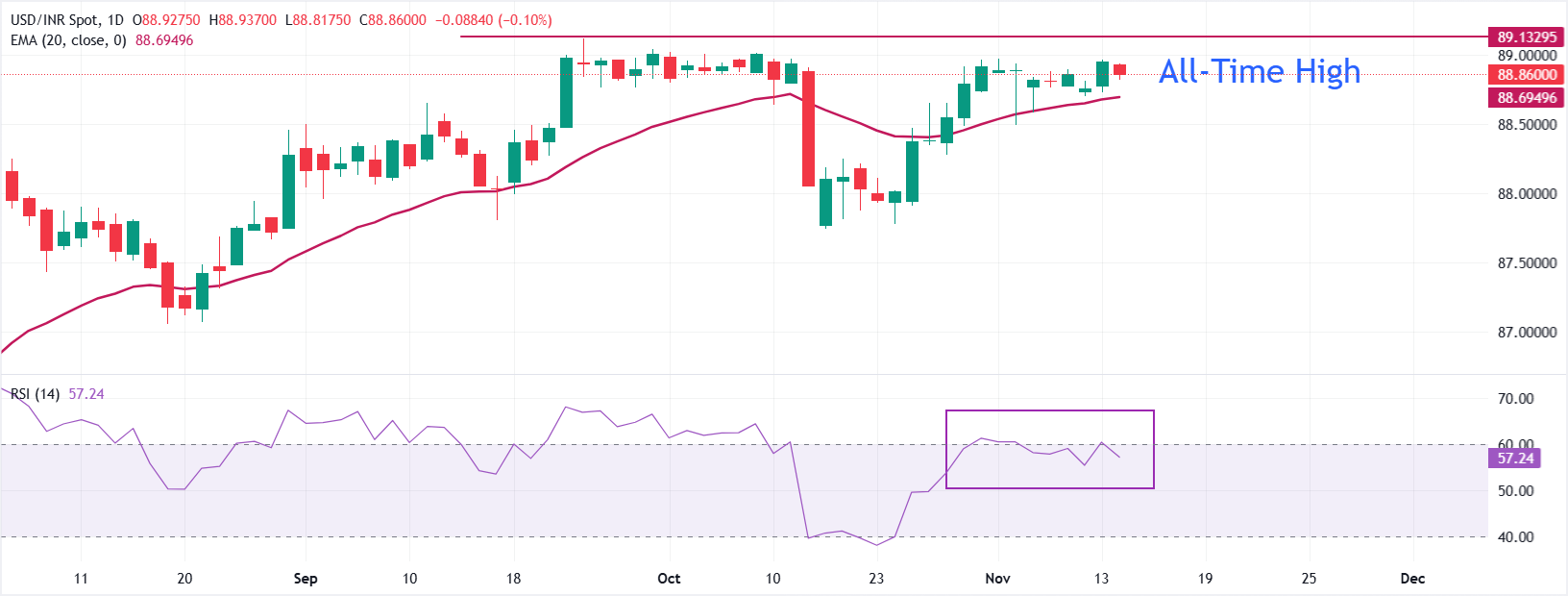
USD/INR falls marginally to near 88.85 at open on Friday. However, the near-term trend of the pair remains bullish as it stays above the 20-day Exponential Moving Average (EMA), which trades around 88.69.
The 14-day Relative Strength Index (RSI) strives to return above 60.00. A fresh bullish momentum would emerge if the RSI (14) manages to do so.
Looking down, the August 21 low of 87.07 will act as key support for the pair. On the upside, the all-time high of 89.12 will be a key barrier.
Indian Rupee FAQs
The Indian Rupee (INR) is one of the most sensitive currencies to external factors. The price of Crude Oil (the country is highly dependent on imported Oil), the value of the US Dollar – most trade is conducted in USD – and the level of foreign investment, are all influential. Direct intervention by the Reserve Bank of India (RBI) in FX markets to keep the exchange rate stable, as well as the level of interest rates set by the RBI, are further major influencing factors on the Rupee.
The Reserve Bank of India (RBI) actively intervenes in forex markets to maintain a stable exchange rate, to help facilitate trade. In addition, the RBI tries to maintain the inflation rate at its 4% target by adjusting interest rates. Higher interest rates usually strengthen the Rupee. This is due to the role of the ‘carry trade’ in which investors borrow in countries with lower interest rates so as to place their money in countries’ offering relatively higher interest rates and profit from the difference.
Macroeconomic factors that influence the value of the Rupee include inflation, interest rates, the economic growth rate (GDP), the balance of trade, and inflows from foreign investment. A higher growth rate can lead to more overseas investment, pushing up demand for the Rupee. A less negative balance of trade will eventually lead to a stronger Rupee. Higher interest rates, especially real rates (interest rates less inflation) are also positive for the Rupee. A risk-on environment can lead to greater inflows of Foreign Direct and Indirect Investment (FDI and FII), which also benefit the Rupee.
Higher inflation, particularly, if it is comparatively higher than India’s peers, is generally negative for the currency as it reflects devaluation through oversupply. Inflation also increases the cost of exports, leading to more Rupees being sold to purchase foreign imports, which is Rupee-negative. At the same time, higher inflation usually leads to the Reserve Bank of India (RBI) raising interest rates and this can be positive for the Rupee, due to increased demand from international investors. The opposite effect is true of lower inflation.
추천 기사


