


The S&P 500 Has Done This Only 3 Times in a Half-Century. History Says This Is What May Happen Next.
Investors have had something to smile about over the past couple of years. The S&P 500 (SNPINDEX: ^GSPC) has climbed in the double digits in each of the past two years, and last year confirmed the positive trend as it sailed into bull market territory. Investors piled into technology stocks as they bet on companies making progress in cutting-edge areas like artificial intelligence and quantum computing. Investor sentiment also was buoyed by prospects of a lower interest rate environment -- a backdrop that generally supports corporate earnings and the consumer's wallet.
This momentum continues today, and that's helped the S&P 500 start the year in a positive way. The benchmark is heading for a gain of more than 2% so far. All of this is great and could spur investors to continue buying stocks and potentially generate wealth over the long term.
Where to invest $1,000 right now? Our analyst team just revealed what they believe are the 10 best stocks to buy right now. Learn More »
But there is one potential element -- and one that isn't so positive -- that investors should consider right now. The S&P 500 has made a rare move in recent times. It's only done this three times in more than a half-century, and every time, the same thing has happened next. Let's take a closer look and decide how we should prepare for what might be ahead.

Image source: Getty Images.
The largest companies driving the economy
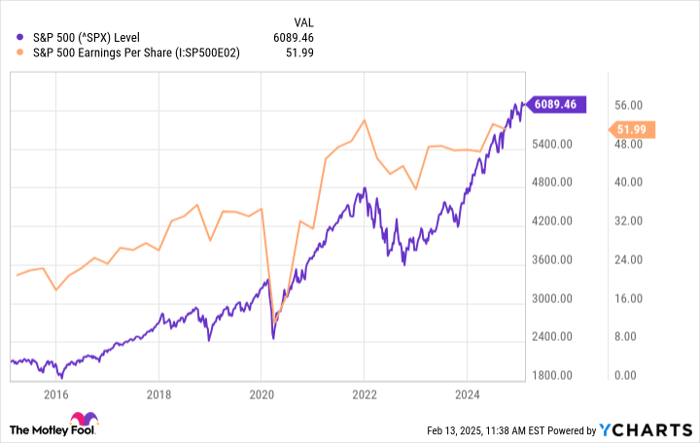
First, though, let's consider why we should be interested in the S&P 500. The benchmark is particularly relevant because it includes the 500 large-cap companies driving today's economy. So, from the earnings performance to the share price performance of its members, the S&P 500 offers us a clear picture of how companies in general are doing -- and how investors are responding. Over the past decade, S&P 500 earnings-per-share and index performance both have been on the rise.
^SPX data by YCharts
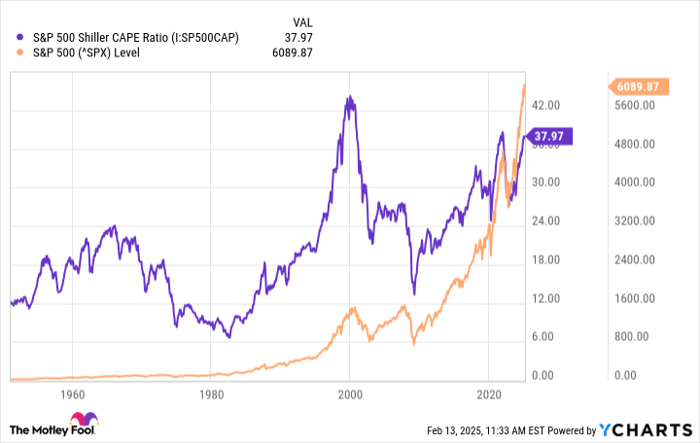
All of that is good, offering us reason to be optimistic about investing. But, as share prices climbed, something else has followed along. And that's valuation. This brings me to the S&P 500's rather rare move. The index, as measured by the Shiller CAPE ratio, recently rose above the level of 35 -- in fact, it's actually surpassed 37. This is only the third time since launching as a 500-member index back in the late 1950s that the benchmark has advanced beyond 35.
The Shiller CAPE ratio is particularly interesting because it looks at share prices along with earnings-per-share over a 10-year period to account for fluctuations in the economy. So, it generally paints a very accurate picture of whether the market is expensive or cheap. And what it tells us today is the S&P 500 is at one of its most expensive moments ever.
What might be next
Now, using history as a guide, let's see what may happen next. In the past, every time the S&P 500 soared past 35, a decline in the index followed.
S&P 500 Shiller CAPE Ratio data by YCharts
This means, if the S&P 500 follows its historical trend, it could be ripe for a correction. So, is it time to worry and stop buying stocks? Not necessarily. It's important to keep a few points in mind. First, though the index will eventually fall -- it's never climbed nonstop without marking a pause here and there -- we don't know exactly when that will happen. Imagine declines come a year from now. If we stop investing right now, we may lose out on a whole year of potential gains.
Second, even if the index as a whole is looking expensive today, many buying opportunities still exist. In fact, at any moment, you can uncover a bargain. So, it's important to consider stocks one by one and seize opportunities when they arise -- even in an "expensive" market.
Finally, indexes go through periods of gains and losses -- it's a normal part of the life of markets -- but if you choose quality companies and invest over the long term, you're very likely to score a win. A look at the S&P 500 over time shows us that even after the darkest periods, the index has gone on to recover and advance. All of this means that if a quality stock is trading for a reasonable price, it may be time to buy -- don't worry about short-term performance, and instead, know that in investing time is on your side.
Should you invest $1,000 in S&P 500 Index right now?
Before you buy stock in S&P 500 Index, consider this:
The Motley Fool Stock Advisor analyst team just identified what they believe are the 10 best stocks for investors to buy now… and S&P 500 Index wasn’t one of them. The 10 stocks that made the cut could produce monster returns in the coming years.
Consider when Nvidia made this list on April 15, 2005... if you invested $1,000 at the time of our recommendation, you’d have $829,128!*
Stock Advisor provides investors with an easy-to-follow blueprint for success, including guidance on building a portfolio, regular updates from analysts, and two new stock picks each month. The Stock Advisor service has more than quadrupled the return of S&P 500 since 2002*.
Learn more »
*Stock Advisor returns as of February 7, 2025
Adria Cimino has no position in any of the stocks mentioned. The Motley Fool has no position in any of the stocks mentioned. The Motley Fool has a disclosure policy.
Recommended Articles


