


LRCX Bounces Off $171.05 Support After a 12.6% Intraday Drop, but $221.10 Still Caps the Stock
TradingKey - Lam Research (NASDAQ: LRCX) fell $11.15, or 5.68%, to $185.01 on Wednesday, November 25, its second straight loss, according to Yahoo Finance data. The day was far rougher than the close suggests: the stock dropped as low as $171.53, down 12.56%, before buyers lifted it 7.86% off the low to finish near the session high of $185.18.
That reversal came at the end of a wild run for the chip-equipment maker, with no company news behind any of it. Lam fell 10.02% on Friday, November 20, jumped 14.45% on Monday, when the whole chip sector rallied after Nvidia's board reinstated Jensen Huang as CEO, then gave back 6.48% on Tuesday. US markets reopen today, Friday, November 27, for a half session from 14:30 to 18:00 GMT.
A High-Beta Bet on AI and Memory Spending
Lam makes the etch and deposition tools that chipmakers use to build memory and logic chips, so its shares move with expectations for how much those customers will spend. That makes it a high-beta stock, one that tends to move further than the market in both directions. On Wednesday, Lam fell 5.68% while Nvidia lost 3.91% and the Nasdaq Composite slipped only 0.62%.
Lam is now about 58% below its 52-week high of $438.50, and the latest swings came as investors questioned the funding of AI data center projects, after October PCE inflation rose 3.8% and traders priced in a possible December Fed rate hike. Lam is also heavily exposed to memory chipmakers' budgets, since memory made up 46% of its systems revenue in the September quarter, the same share as foundry, with logic at 8%.
Notice what did not happen, though. A record quarter and a higher December outlook have not stopped the slide, and Wednesday's 12.56% intraday drop did not hold either. Buyers stepped in close to the $171.05 support level, which suggests the selling is now testing a floor rather than accelerating. The close also stayed above Friday's $183.27, the lowest close of November.
Record Results and a Higher Guide
For the September quarter, Lam reported record revenue of $8.22 billion, up 22% from the June quarter. Non-GAAP EPS, which excludes items such as acquisition-related amortization, rose 21% to $2.20, with a 52.4% gross margin and a 40.2% operating margin, the share of sales left as profit from operations. CEO Tim Archer said Lam "again delivered record revenue and profitability." Cash and cash equivalents also rose to $7.44 billion from $5.58 billion in June, so the balance sheet is not the issue.
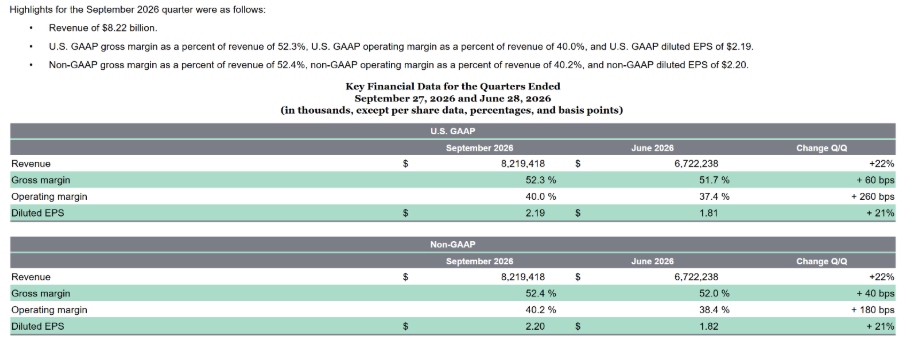
Source: Lam Research Q1 FY27 earnings release, Form 8-K Exhibit 99.1, October 21, 2026 (sec.gov)
For the December quarter, Lam guided revenue to $8.60 billion, plus or minus $400 million, about 4.6% above the September quarter at the midpoint, with EPS of $2.33, plus or minus $0.15. CFO Doug Bettinger said revenue would have been "a little bit higher" without supply constraints, with some shipments moving into the March quarter.

Source: Lam Research Q1 FY27 earnings release, Form 8-K Exhibit 99.1, October 21, 2026 (sec.gov)
China Drop Versus a Bigger 2027
China made up 35% of Lam's September-quarter revenue, up from 26% in the June quarter, but management expects that share to fall significantly in the December quarter, mainly because of lower spending by domestic Chinese customers, though demand from multinational customers in the region should stay reasonably strong. Export controls on chip tools are a constant risk for that business.
Further out, management expects wafer fab equipment spending, the industry's total outlay on chipmaking tools, at around the middle of the $150 billion to $160 billion range for 2026 and more than $200 billion in 2027, led by DRAM memory. At $185.01, Lam trades at about 19.9 times its annualized December-quarter EPS guidance, by my calculation, well below where it traded at its peak.
Lam Research Technical Analysis: Daily Close Below $171.05 Could Open $142.97
Wednesday's long lower wick on the daily chart shows how close the stock came to breaking down. Sellers pushed LRCX as low as $171.53, almost exactly at the $171.05 support, before buyers stepped in. The bigger picture is still bearish. LRCX has been falling inside a downward channel, two parallel lines that have guided prices lower, since its early-October peak. It also trades well below the $221.10 pivot and both moving averages, which track the average price over recent sessions, at $248.45 and $269.07.
RSI, a gauge of buying and selling strength that runs from 0 to 100, has slipped to about 36, below its signal line. The MACD, another momentum indicator, is still negative, which confirms that sellers remain in control.
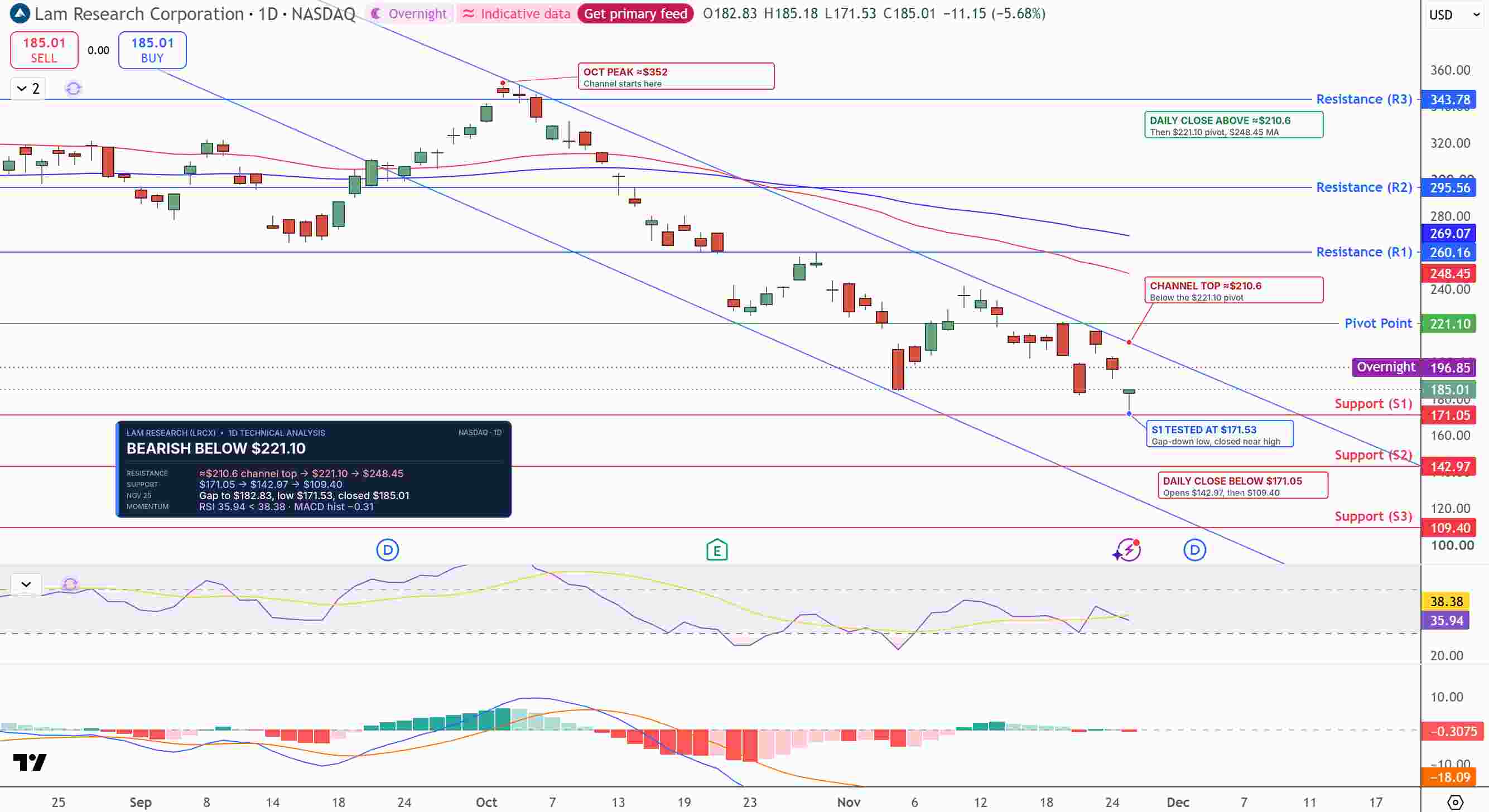
LRCX Price Chart - Source: Tradingview
A daily close below $171.05 could send LRCX toward $142.97, followed by $109.40. For buyers, a daily close back above the falling channel and the $221.10 pivot would be the first real sign of strength.
I'm bearish while LRCX stays below $221.10, with $171.05 as the key floor.
Key Levels
- Last close: $185.01, down 5.68% on Wednesday, November 25 (intraday low: $171.53)
- Support: $171.05, $142.97, $109.40
- Resistance: $221.10, $248.45, $269.07
- RSI: 35.94
- Bullish trigger: Daily close above $221.10
- Bearish trigger: Daily close below $171.05
FAQs
Why is Lam Research stock so volatile?
Lam's shares move with expectations for chip-industry spending on AI and memory, not with company news. It fell 10.02% on November 20, rose 14.45% on November 23, and closed down 5.68% at $185.01 on November 25 after an intraday drop of 12.56%, even though its last quarter set records.
What is the Lam Research stock forecast now?
The bias is bearish while LRCX stays below $221.10. A daily close below $171.05 could send the stock toward $142.97 and $109.40, while a daily close above $221.10 would be the first real sign of strength for buyers.
Bottom Line
Lam's business is growing, with record results and a higher December guide, but the stock is trading on fears about AI spending and China. The level that matters is $171.05. In my view, holding it after Wednesday's sharp rebound from $171.53 would give buyers a base, while a daily close below it would open the way toward $142.97.
Recommended Articles


