


Here's the ETF Portfolio I'm Building for 2027 -- and Why I'm Not Changing It Even if the Market Crashes
Key Points
The S&P 500 and the U.S. economy typically move in the same direction over the long haul.
The Schwab U.S. Dividend Equity ETF screens companies for financial health and dividend stability.
The iShares Semiconductor ETF holds 30 stocks that operate in all aspects of the semiconductor industry.
- Motley Fool Issues Rare "Total Conviction" Buy Alert ›
I've always been a fan of ETFs because they make investing straightforward and check many boxes at once. They don't usually get the same attention as individual stocks because they aren't as flashy, but they can be just as rewarding.
As we get close to 2027, it's a good time to see how ETFs can fit in your portfolio. Personally, there are three I'm loading up on. Two are staples I routinely invest in, and one will be a new addition. We can't predict how the market will move, but in the event of a market crash, they're investments I expect to bounce back and thrive over the long run.
Missed Nvidia in 2009? This Rare Signal Is Flashing Again. In 2009, a "Double Down" signal flashed for a little-known chipmaker called Nvidia. For the first time in years, that same "Total Conviction" signal is flashing for a company 1/100th the size of Nvidia. Continue »

Image source: Getty Images.
Vanguard S&P 500 ETF
I routinely invest in the Vanguard S&P 500 ETF (NYSEMKT:VOO) because it essentially invests in the U.S. economy. The 500 companies in the S&P 500 (SNPINDEX:^GSPC) account for much of U.S. economic activity, so they typically move in the same direction over time. The stock market is notoriously irrational, so sometimes there's a short-term disconnect between the two, but they tend to move hand in hand over the long haul.
If there's an investment I wouldn't think twice about holding through a market crash, it's VOO. The S&P 500 has experienced its fair share of market crashes, surviving and thriving after each one.
Past results don't guarantee future performance, so we don't want to assume it will always happen, but the S&P 500 is built to grow over time. Its composition changes over time as companies rise and fall, but overall, the index rewards winners.
Right now, big tech is leading the way (and that'll be the case for a while), so much of VOO's performance depends on a handful of stocks. This isn't quite ideal from a diversification perspective -- and largely why it's down 4.8% in the past month (as of Nov. 23) -- but it has been working in the index's favor over the past few years.
Schwab U.S. Dividend Equity ETF
You can't control or predict how a stock price will move, but you can count on a reliable dividend. Schwab U.S. Dividend Equity ETF (NYSEMKT:SCHD) provides that. It's known for holding high-quality companies because it requires companies to have at least 10 consecutive years of dividend payments, five consecutive years of dividend increases, and be in good financial health.
If a market crash happens, it's good to have dividends coming in, no doubt, but it's even better when they come from businesses that have stood the test of time and offer strong stability. Take its top holding, Procter & Gamble, for example. P&G isn't a sexy, high-flying tech company, but it sells products that people buy regardless of market or economic conditions. It's also a Dividend King, or a company that has raised its payout for 50 years or more, with 70 consecutive years of dividend increases.
Even with this year's impressive run-up, SCHD maintains an attractive yield. The stock is up 25% this year, so its yield is lower than usual, but at 3.1%, it's still good for a 102-stock ETF.
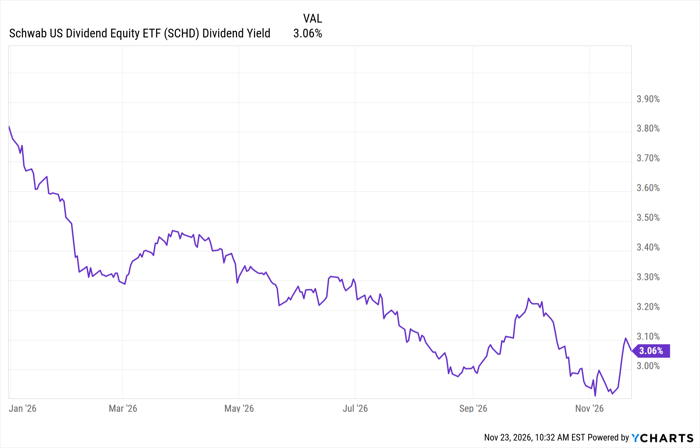
SCHD Dividend Yield data by YCharts
iShares Semiconductor ETF
I don't currently own shares of the iShares Semiconductor ETF (NASDAQ:SOXX), so adding it to the portfolio heading into 2027 is a matter of buying the dip. It has been on a downtrend since its June 22 high.
SOXX holds 30 semiconductor (chip) stocks, ranging from manufacturers to designers to equipment makers. The current AI boom has brought chips to the spotlight because they're crucial for training and developing AI models, but they've been the backbone of the electronics we use for many years.
There's overlap between SOXX and VOO with big tech names like Advanced Micro Devices, Broadcom, Micron Technology, Intel, and Nvidia (SOXX's top five holdings), but they make up a higher concentration in SOXX, allowing you to take advantage of the industry's upside without picking a "winner."
Semiconductor companies are for sure on a high with the current AI boom, but regardless of how it plays out, the need for semiconductors will only keep growing. I like the industry's direction.
Should you buy stock in Vanguard S&P 500 ETF right now?
Before you buy stock in Vanguard S&P 500 ETF, consider this:
The Motley Fool Stock Advisor analyst team just identified what they believe are the 10 best stocks for investors to buy now… and Vanguard S&P 500 ETF wasn’t one of them. The 10 stocks that made the cut could produce monster returns in the coming years.
Consider when Netflix made this list on December 17, 2004... if you invested $1,000 at the time of our recommendation, you’d have $317,482!* Or when Nvidia made this list on April 15, 2005... if you invested $1,000 at the time of our recommendation, you’d have $954,740!*
Now, it’s worth noting Stock Advisor’s total average return is 784% — a market-crushing outperformance compared to 199% for the S&P 500. Don't miss the latest top 10 list, available with Stock Advisor, and join an investing community built by individual investors for individual investors.
See the 10 stocks »
*Stock Advisor returns as of November 25, 2026.
Stefon Walters has positions in Vanguard S&P 500 ETF. The Motley Fool has positions in and recommends Advanced Micro Devices, Broadcom, Intel, Micron Technology, Nvidia, Vanguard S&P 500 ETF, and iShares Trust - iShares Semiconductor ETF. The Motley Fool has a disclosure policy.
Recommended Articles


