


How American Express Turned Berkshire’s $1.3 Billion Bet Into a $576 Million Annual Paycheck
Key Points
American Express shares, worth $45.8 billion, are Berkshire's second biggest holding after Apple.
The card giant’s share buybacks have dramatically increased Berkshire’s ownership stake, bringing in high passive income.
Amex stock’s valuation allows investors to buy a high-quality business at a fair price.
- Motley Fool Issues Rare "Total Conviction" Buy Alert ›
American Express (NYSE:AXP) has long been one of Warren Buffett's favorite companies. It's a storied franchise built on a premium brand that continues to operate at a high level, even 176 years after its founding. The top credit card enterprise is Berkshire Hathaway's (NYSE:BRKA) (NYSE:BRKB) second largest position.
The conglomerate's total cost basis on this financial stock, after it stopped buying in 1998, amounts to $1.3 billion. Based on the 151.6 million shares it owns, representing 22.6% of the entire business, Berkshire's stake is valued at $45.8 billion right now. That capital appreciation is impressive, but it's not the whole story.
Missed Nvidia in 2009? This Rare Signal Is Flashing Again. In 2009, a "Double Down" signal flashed for a little-known chipmaker called Nvidia. For the first time in years, that same "Total Conviction" signal is flashing for a company 1/100th the size of Nvidia. Continue »
American Express currently pays an annual dividend of $3.80. This means $576 million in passive income is sent to Berkshire. That incredible 44% cost-basis yield offers a lesson to the average investor.
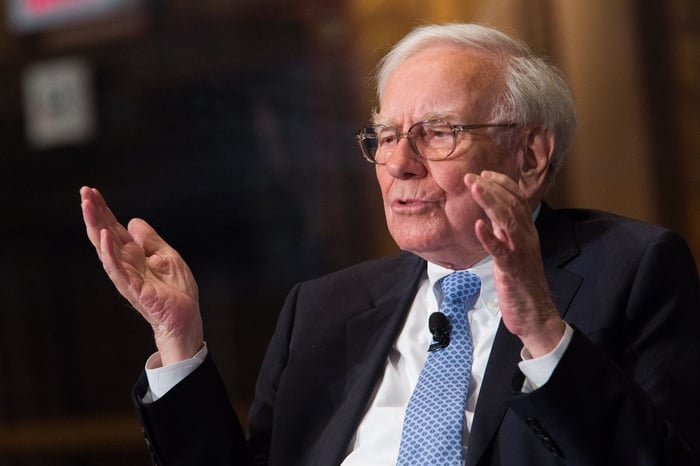
Image source: Getty Images.
A round of golf changed everything
Berkshire's relationship with the card issuer began in 1991. That year, it paid $300 million for a special security called a preferred equity redemption stock. These shares carried an 8.85% dividend but capped Berkshire's upside. And they converted into common stock after three years.
When the conversion arrived in August 1994, Buffett leaned toward selling. Competition from Visa (NYSE:V) and a crowd of other card issuers was intense.
A round of golf with Frank Olson, who was then Hertz's (NASDAQ:HTZ) chief excutive officer and a card-industry expert, changed everything. By the second green, Buffett later wrote in his 1997 shareholder letter, Olson "had convinced me that Amex's corporate card was a terrific franchise." Buffett held on and bought more. His conglomerate owned about 10% of the company by the end of 1995. A small final purchase came in 1998.
The thesis rested on three things. The card business had franchise-like economics. Then-CEO Harvey Golub was outstanding. And Buffett knew the company well, having first invested in it in the mid-1960s after a fraud involving salad oil that caused huge losses for Amex and other companies.
Berkshire Hathaway has never sold a share, and its stake was worth $45.8 billion as of Nov. 20. That makes American Express the conglomerate's second biggest stock holding, behind only Apple (NASDAQ:AAPL).
What's remarkable is that Berkshire's ownership stake has more than doubled since the mid-1990s. American Express' relentless buybacks did the work.
Small yields can grow into big ones
Amex is still a compounding machine. Third-quarter revenue rose 9% year over year to a record $20.1 billion. Adjusted earnings per share climbed 13%. And net card fees increased 16%, a sign that premium customers keep spending.
The company's moat is durable. Management runs a closed-loop network, acting as both the card issuer and the payment processor. It owns the relationship with affluent cardholders and the merchants that want their business.
There are risks. Revenue growth has slowed for two straight quarters. A weaker consumer would hurt spending volumes.
But the valuation is reasonable. The stock trades at a forward price-to-earnings ratio of 15.2. That's cheaper than the S&P 500 index (SNPINDEX:^GSPC). It's a fair price for a company of this quality, especially since the shares have outpaced the market in the past five- and 10-year periods.
Still, the bigger lesson is patience. A new investor today gets a dividend yield of just 1.24%. However, the payout ratio (on a trailing-12-month basis) of 21% leaves room for more raises.
That's what worked for Berkshire Hathaway. In his 2022 shareholder letter, Buffett mentioned that annual dividends from this stake had grown from $41 million to $302 million. Today, that figure is $576 million. At that pace, the conglomerate recoups its entire original investment in less than 2 1/2 years.
When looking at dividend stocks of great businesses that increase their payouts, investors need the discipline to hold for a long time.
Should you buy stock in American Express right now?
Before you buy stock in American Express, consider this:
The Motley Fool Stock Advisor analyst team just identified what they believe are the 10 best stocks for investors to buy now… and American Express wasn’t one of them. The 10 stocks that made the cut could produce monster returns in the coming years.
Consider when Netflix made this list on December 17, 2004... if you invested $1,000 at the time of our recommendation, you’d have $313,329!* Or when Nvidia made this list on April 15, 2005... if you invested $1,000 at the time of our recommendation, you’d have $1,014,158!*
Now, it’s worth noting Stock Advisor’s total average return is 796% — a market-crushing outperformance compared to 200% for the S&P 500. Don't miss the latest top 10 list, available with Stock Advisor, and join an investing community built by individual investors for individual investors.
See the 10 stocks »
*Stock Advisor returns as of November 25, 2026.
American Express is an advertising partner of Motley Fool Money. Neil Patel has no position in any of the stocks mentioned. The Motley Fool has positions in and recommends American Express, Apple, Berkshire Hathaway, and Visa. The Motley Fool has a disclosure policy.
Recommended Articles


