


Rocket Lab Stock Has Collapsed 57% From Highs. Here's Why I'm Not Buying (Yet).
Key Points
Rocket Lab is competing with SpaceX as a private rocket launch company.
It is acquiring the satellite communications provider Iridium and developing a larger rocket.
Shares of the stock are cheaper now, but still expensive on an absolute basis.
- These 10 stocks could mint the next wave of millionaires ›
The summer of the space economy is turning into a pumpkin of a fall. Rocket Lab (NASDAQ: RKLB) -- a space stock that saw its shares soar around the Space Exploration Technologies (SpaceX) initial public offering -- has now seen its shares fall 57% from its highs in just a few months.
Today, it trades at a market cap of $38 billion and is slated to try to close its massive deal for Iridium Communications soon. I remain bullish on the company's business prospects as it tries to become the second space economy prime contractor alongside SpaceX.
Missed Nvidia in 2009? This Rare Signal Is Flashing Again. In 2009, a "Double Down" signal flashed for a little-known chipmaker called Nvidia. For the first time in years, that same "Total Conviction" signal is flashing for a company 1/100th the size of Nvidia. Continue »
However, I am still not buying unless shares reach a lower level this year. Here's why.
Ambitious growth plans
It is difficult to boil down Rocket Lab's ambitions for the space economy into just a few paragraphs. The company already has a solid footing in the rocket launch business with its small Electron rocket. As of the latest quarterly results, 90+ contracts have now been signed for Electron launches, the highest level in the company's history.
Other revenue today comes from the growth of Rocket Lab's space systems segment, which builds systems for third parties and the U.S. government that can be deployed into space. For example, it just won a contract with the Space Force to build multiple geostationary satellites. This is just one of the many contracts being won in this division, which is why the company's total backlog has now grown to $2.3 billion.
Rocket Lab is not resting on its laurels with these existing business lines. It is in the process of acquiring Iridium Communications, a satellite internet provider that will help Rocket Lab more directly compete with SpaceX, for $8 billion in a half-stock, half-cash deal. Lastly, Rocket Lab is working hard on debuting its Neutron rocket, which has been years in development and is much larger than the Electron. It will either debut with its first full test flight later this year or in early 2027.

Image source: Getty Images.
Path to profitability
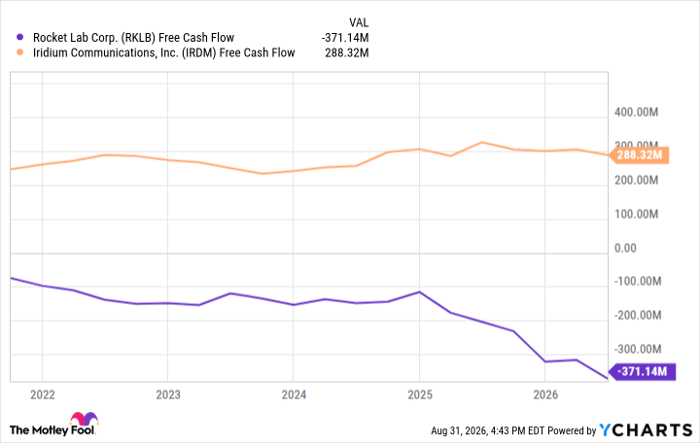
Despite all these investments, Rocket Lab is not profitable, with a negative free cash flow of $371 million over the last 12 months.
There are a few ways it can scale up to profitability. First, the acquisition of Iridium will be an immediate boost, as the company generated $288 million in positive free cash flow over the last 12 months. Second, once the Neutron starts launching for customers, it will go from a science-project money pit to a revenue generator for the business. Third, the continued scaling of the space systems and Electron business will lead to operating leverage.
All of these feats may take a few years to achieve, but Rocket Lab is well on its way.
RKLB Free Cash Flow data by YCharts
Why Rocket Lab is not yet a buy, but should be on your watch list
As a space economy winner, Rocket Lab is most frequently compared to SpaceX. Right now, before the Iridium acquisition closes, Rocket Lab stock has a market cap of $38 billion. SpaceX is approaching $2 trillion. This is a bit of a misleading comparison, because SpaceX is trying to become an artificial intelligence (AI) infrastructure player, which Rocket Lab has never mentioned it wants to do.
A good way to value Rocket Lab stock today is on a price-to-sales (P/S) ratio, which takes out any comparisons to megacap stocks and strictly starts to focus on the fundamentals. On a trailing basis, Rocket Lab trades at a P/S ratio of 48. To be fair, there is a lot of growth coming down the line from the Neutron and this massive backlog, but right now, Rocket Lab trades at a steep revenue multiple. The S&P 500 average is just 3.8, and that is at a record high.
Rocket Lab is a promising business, and I think it will generate billions in revenue in the years ahead. However, I would wait to buy until a much lower price materializes, maybe half of today's level, even though the stock is already down more than 50% from its highs in the last three months.
Don’t miss this second chance at a potentially lucrative opportunity
Ever feel like you missed the boat in buying the most successful stocks? Then you’ll want to hear this.
On rare occasions, our expert team of analysts issues a “Double Down” stock recommendation for companies that they think are about to pop. If you’re worried you’ve already missed your chance to invest, now is the best time to buy before it’s too late. And the numbers speak for themselves:
- Nvidia: if you invested $1,000 when we doubled down in 2009, you’d have $564,667!*
- Apple: if you invested $1,000 when we doubled down in 2008, you’d have $62,021!*
- Netflix: if you invested $1,000 when we doubled down in 2004, you’d have $435,803!*
Right now, we’re issuing “Double Down” alerts for three incredible companies, available when you join Stock Advisor, and there may not be another chance like this anytime soon.
See the 3 stocks »
*Stock Advisor returns as of September 2, 2026.
Brett Schafer has no position in any of the stocks mentioned. The Motley Fool has positions in and recommends Rocket Lab. The Motley Fool has a disclosure policy.
Recommended Articles


