


Dell's Next Earnings Report on September 1 Could Send the Stock Soaring. Here's Why.
Key Points
The stock has performed incredibly well as AI demand has skyrocketed.
There's evidence that demand did not slow in recent months.
There's a good chance Dell will raise its full-year guide.
- 10 stocks we like better than Dell Technologies ›
Dell (NYSE:DELL) is gearing up to report its fiscal 2027 second-quarter earnings results after the market closes on Tuesday, Sept. 1. Management will also hold a live conference call with Wall Street analysts.
A longtime maker of personal computers, Dell has gotten involved in the artificial intelligence trade by selling servers to data centers and other companies implementing AI solutions, serving as the skeletal structure connecting the components that power AI.
Missed Nvidia in 2009? This Rare Signal Is Flashing Again. In 2009, a "Double Down" signal flashed for a little-known chipmaker called Nvidia. For the first time in years, that same "Total Conviction" signal is flashing for a company 1/100th the size of Nvidia. Continue »
This includes central processing units (CPUs), graphics processing units (GPUs), memory, storage, and more.
The stock has had a phenomenal year, up roughly 264%. While trading around a near-term event like earnings is always very difficult to predict, Dell's next earnings report could send the stock soaring. Here's why.

Image source: The Motley Fool.
AI demand shows no signs of slowing
Dell's stock is now largely tied to AI demand, which could obviously make it volatile going forward. Fortunately for the company, there is no evidence that demand for AI is slowing.
This can be seen in multiple earnings reports from earlier this month. Nvidia, the AI chip king, just reported a simply incredible quarter, in which it guided for annual revenue growth of 70% in its fiscal year 2028, well ahead of Wall Street consensus estimates.
Nvidia is at the center of the AI ecosystem, so if its chips are seeing strong demand, then there's a good chance other components within the AI supply chain are as well.
But even looking more directly at Dell, another server maker, Super Micro Computer, also recently reported a strong quarter. In its most recent quarter, Super Micro generated strong gross margins of 17.5%, ahead of estimates.
Furthermore, the company raised its annual revenue guidance to a range of $65 billion to $72 billion, well above consensus estimates of $52.5 billion.
In its fiscal 2027 first-quarter earnings report, Dell guided for full-year AI server revenue of $165 billion to $169 billion, up 47% year over year at the midpoint. Within that number, management guided for $60 billion of AI server revenue, up 144% year over year.
Bank of America analyst Wamsi Mohan believes the company will raise its full-year guidance to a range of $171 billion to $175 billion, including higher AI server revenue of $65 billion.
Keep an eye on guidance and valuation
I will reiterate that it's extraordinarily difficult to trade around near-term events because one can never tell how the market will react. Good news can be priced in and vice versa.
Dell also trades at an expensive valuation compared to the past, even though it is generating strong growth right now.
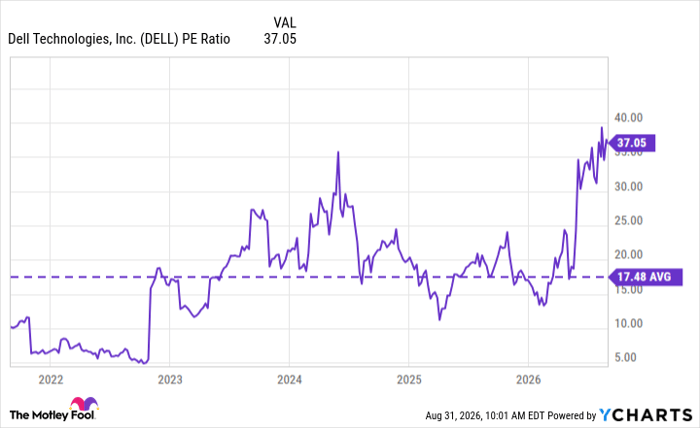
DELL PE Ratio data by YCharts
Whether the stock price moves up or down following earnings will depend on the guidance. But given what we've seen so far this earnings season, I think there's a strong chance Dell will raise its guidance above analysts' expectations.
Dell is still tied to the AI trade, so even the slightest hint of slowing demand could trigger a sell-off, especially after its big run this year.
Analysts and investors will also be trying to understand what the runway looks like beyond this year. But it's tough to time this market, and there's a good chance the AI supercycle will last much longer than investors think.
Should you buy stock in Dell Technologies right now?
Before you buy stock in Dell Technologies, consider this:
The Motley Fool Stock Advisor analyst team just identified what they believe are the 10 best stocks for investors to buy now… and Dell Technologies wasn’t one of them. The 10 stocks that made the cut could produce monster returns in the coming years.
Consider when Netflix made this list on December 17, 2004... if you invested $1,000 at the time of our recommendation, you’d have $440,710!* Or when Nvidia made this list on April 15, 2005... if you invested $1,000 at the time of our recommendation, you’d have $1,335,252!*
Now, it’s worth noting Stock Advisor’s total average return is 978% — a market-crushing outperformance compared to 213% for the S&P 500. Don't miss the latest top 10 list, available with Stock Advisor, and join an investing community built by individual investors for individual investors.
See the 10 stocks »
*Stock Advisor returns as of August 31, 2026.
Bank of America is an advertising partner of Motley Fool Money. Bram Berkowitz has no position in any of the stocks mentioned. The Motley Fool has positions in and recommends Nvidia. The Motley Fool has a disclosure policy.
Recommended Articles


