


Shocking Layoffs (Up to 10%) Could Be Bearish for These 2 Tech Stocks
Key Points
Microsoft just announced widespread early retirement buyouts for the first time in company history.
Meta is laying off 10% of its workforce to counteract the costs of other investments.
These job cuts could be a sign that big tech names are struggling to cover the costs of AI capex.
- 10 stocks we like better than Microsoft ›
Two of the biggest names in artificial intelligence (AI) just announced big job cuts. On Thursday, Microsoft (NASDAQ: MSFT) announced that it's offering early retirement to up to 7% of its U.S. workforce. On the same day, Meta Platforms (NASDAQ: META) said it would be laying off 10% of its employees (about 8,000 jobs) and ending plans to hire for 6,000 new job openings.
The stock market initially reacted harshly to the job cuts. META shares declined about 2.3% on Thursday, while MSFT was down about 4% that day. Both tech stocks recovered some losses on Friday but were still trading below their previous levels.
Will AI create the world's first trillionaire? Our team just released a report on the one little-known company, called an "Indispensable Monopoly" providing the critical technology Nvidia and Intel both need. Continue »
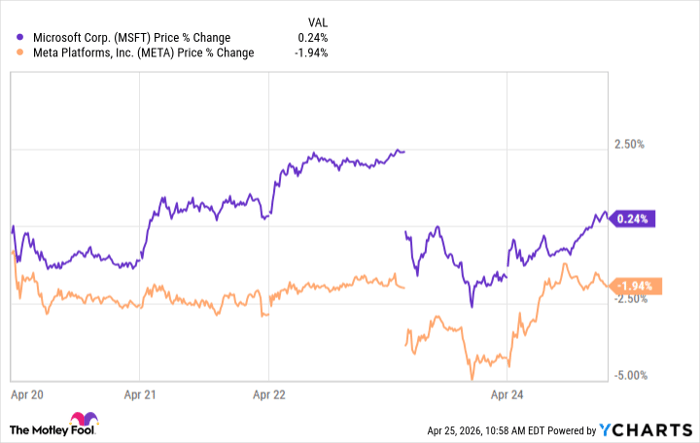
MSFT data by YCharts
Let's take a closer look at what these job cuts might mean for META and MSFT investors.
MSFT and META job cuts: AI revolution or AI washing?
The biggest reason for Meta's and Microsoft's layoffs and job cuts appears to be AI. Both tech companies are investing heavily in AI data centers and other AI capital expenditures. Both are trying to use AI to boost productivity and develop products.
But do these layoffs mean that Meta and Microsoft are successfully using AI to get more productive and profitable? This could be an example of "AI washing," where companies use AI as an excuse to lay off workers -- not because AI is replacing people, but because the companies are betting too heavily on expensive AI capital expenditures (capex) and overhyped AI products.
If Meta and Microsoft are truly boosting productivity with AI, that would be good news for AI stock investors. But companies that are AI washing might see bigger stock price declines in the future.

Image source: Getty Images.
Microsoft: Will AI replace all workers in 2027?
The news about Microsoft's early retirement packages was a surprise. According to Bloomberg, this is the first time the company has ever offered voluntary buyouts of this scale.
Microsoft executives didn't comment publicly on the reason for the buyouts. But CEO Satya Nadella had previously said that AI is handling up to 30% of the company's coding work. And in February, Microsoft AI executive Mustafa Suleyman predicted that within the next 12 to 18 months, AI would be able to replace most white-collar work. If that's true, the company's early retirement buyouts will be a drop in the bucket compared to future mass unemployment for tech workers.
I'm skeptical. I don't believe AI tools like Microsoft Copilot will become good enough to replace all software developers, digital marketers, and other human "knowledge work" professionals anytime soon. It sounds arrogant and aggressive when company executives proclaim that their all-powerful product will put everyone out of a job -- they want us to believe that, because that's what they're selling.
The stock market isn't buying the hype. MSFT is down 12% year to date, and more than 20% in the past six months.
Meta Platforms: Offsetting "other investments"
According to Bloomberg, Meta told its employees that the 10% job reductions were being done as "part of our continued effort to run the company more efficiently" and "offset the other investments we're making." That's a sign that Meta layoffs are directly related to the company's big spending on AI capex.
Meta expects to spend $115 billion to $135 billion in 2026 on capital expenditures, including its Meta Superintelligence Labs AI efforts. But will Meta's AI investments lead to more profit for the company? Or is this another expensive, speculative effort like the metaverse? Meta CEO Mark Zuckerberg used to talk about the metaverse and virtual reality as if it were an inevitable future of the internet that would change everything -- he even changed the name of the company from Facebook.
But heavy spending on the heavily hyped metaverse cost the company $80 billion, and millions of new metaverse users (and advertisers) never materialized. As of March 2026, Meta's metaverse projects have been largely abandoned. In the past few years, the company has gone all-in on AI.
I'm more optimistic about Meta's ability to use AI for profitable purposes. The company seems to be deploying AI in ways that are driving results for its ad business -- by improving ad targeting and boosting engagement among social network users. Meta's AI investments might pay off. But shares are down 10% in the past six months and have underperformed the S&P 500 index for the past year.
It's possible that Meta and Microsoft investors will be big winners from a new revolution in AI-driven productivity. But the companies' recent job cuts don't inspire confidence. Instead of boosting profits and unleashing innovation, Microsoft's and Meta's AI spending could be weighing too heavily on the companies' cash flow. Investors will want to see how AI is driving better bottom-line results for these AI stocks, not just hype -- and soon.
Should you buy stock in Microsoft right now?
Before you buy stock in Microsoft, consider this:
The Motley Fool Stock Advisor analyst team just identified what they believe are the 10 best stocks for investors to buy now… and Microsoft wasn’t one of them. The 10 stocks that made the cut could produce monster returns in the coming years.
Consider when Netflix made this list on December 17, 2004... if you invested $1,000 at the time of our recommendation, you’d have $498,522!* Or when Nvidia made this list on April 15, 2005... if you invested $1,000 at the time of our recommendation, you’d have $1,276,807!*
Now, it’s worth noting Stock Advisor’s total average return is 983% — a market-crushing outperformance compared to 200% for the S&P 500. Don't miss the latest top 10 list, available with Stock Advisor, and join an investing community built by individual investors for individual investors.
See the 10 stocks »
*Stock Advisor returns as of April 27, 2026.
Ben Gran has no position in any of the stocks mentioned. The Motley Fool has positions in and recommends Meta Platforms and Microsoft. The Motley Fool has a disclosure policy.
Recommended Articles


