


Blue Origin's Blue Ring Isn't Blue... or a Ring. But It May Be the Future of Space.
Key Points
Blue Origin has unveiled a bigger, better version of its Blue Ring space tug.
The Jeff Bezos space company appears ready to take on everyone from Firefly to Rocket Lab to Northrop Grumman in a battle for this new space market.
- 10 stocks we like better than Northrop Grumman ›
Hand it to Tory Bruno: When he jumps ship from one company to one of its biggest rivals, he commits.
Less than four months since departing space giant United Launch Alliance (where he served as CEO) to take a position as head of Blue Origin's National Security Group business, Bruno is all-in on one of Blue's most ambitious projects: building the interplanetary space tug that the company calls Blue Ring.
Will AI create the world's first trillionaire? Our team just released a report on the one little-known company, called an "Indispensable Monopoly" providing the critical technology Nvidia and Intel both need. Continue »
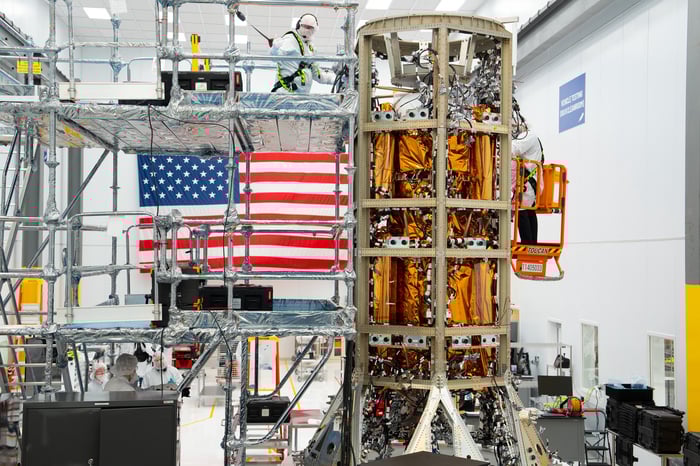
Image source: Blue Origin.
Introducing Blue Ring
On March 28, Bruno posted to X a photo of the new "GEO-Interplanetary Class" version of Blue Ring. Curiously, in the photo, the space tug is neither blue nor ring-shaped. It's actually more of an off-white framework enclosing gold foil-wrapped innards, measuring roughly 6 meters long by 2 meters wide at its base.
Color and shape notwithstanding, what we know about Blue Ring at this point is pretty impressive.
Start with the characterization of the space tug as "GEO-Interplanetary Class." Clearly, Blue Origin intends this vessel to transport and service satellites in the farthest reaches of Earth orbit (geosynchronous, more than 22,000 miles distant from Earth) and even across interplanetary distances as far out as the moon or (perhaps?) even Mars.
Blue Ring appears designed to support and transport more than a dozen separate satellites at a time, boasting 13 "ports" for satellite attachment. This would imply that Blue Ring is a significantly more capable vehicle than Northrop Grumman's (NYSE: NOC) Mission Robotic Vehicle, for example, which is outfitted with three "Mission Extension Pods" that can restore functionality to defunct satellites. Similarly, Blue Ring would be more robust than Rocket Lab's (NASDAQ: RKLB) Photon space tug or Firefly Aerospace's (NASDAQ: FLY) Elytra family of orbital vehicles.
Image source: Getty Images.
What can Blue Ring do for you?
So Jeff Bezos and Blue Origin are targeting the burgeoning market for in-orbit satellite services head-on, flying into a field with several incumbents already -- hoping to outclass them all on its first try. Is this wise?
I think it is. Consider:
At last report, Earth orbit holds more than 12,000 satellites. Granted, most of these are in low Earth orbit, with service lives measured in single-digit years -- probably not worth enough to justify the expense of a dedicated orbital space tug to position, service, or refuel them. Another 600-odd satellites number among the bigger, more expensive GEO-class strata; however, a further 200 or more are in medium or unusual elliptical orbits that may justify the expense of scheduling occasional service visits.
That's a total addressable market of perhaps 800 satellites (and growing). And judging from published estimates of the cost of an orbital service mission -- roughly $65 million per visit -- this implies the total market opportunity floating around up there, just out of reach, could be as large as $52 billion.
And that's not counting the potential for Blue Ring to perform "interplanetary" missions, which presumably would cost far more.
I'd say that's a big enough target to justify Blue Origin aiming to hit it.
What this means for investors
Granted, with Blue Origin still a privately owned company and so inaccessible for most investors to invest in, this may seem a moot point.
It's not.
We may not be able to invest in Blue Origin yet -- it may one day IPO. We can, however, take a cue from the fact that Jeff Bezos is investing in orbital space tugs and invest in other companies that are doing the same thing and that are already public: Northrop Grumman, Rocket Lab, and Firefly.
Of the three, Northrop's tugs are the most advanced. Northrop is also the only one that's already profitable, costing 24 times trailing earnings and paying a dividend yield of 1.3%. If you're looking for a place to start, Northrop Grumman stock seems an obvious choice.
Should you buy stock in Northrop Grumman right now?
Before you buy stock in Northrop Grumman, consider this:
The Motley Fool Stock Advisor analyst team just identified what they believe are the 10 best stocks for investors to buy now… and Northrop Grumman wasn’t one of them. The 10 stocks that made the cut could produce monster returns in the coming years.
Consider when Netflix made this list on December 17, 2004... if you invested $1,000 at the time of our recommendation, you’d have $500,572!* Or when Nvidia made this list on April 15, 2005... if you invested $1,000 at the time of our recommendation, you’d have $1,223,900!*
Now, it’s worth noting Stock Advisor’s total average return is 967% — a market-crushing outperformance compared to 199% for the S&P 500. Don't miss the latest top 10 list, available with Stock Advisor, and join an investing community built by individual investors for individual investors.
See the 10 stocks »
*Stock Advisor returns as of April 25, 2026.
Rich Smith has positions in Rocket Lab. The Motley Fool has positions in and recommends Rocket Lab. The Motley Fool has a disclosure policy.
Recommended Articles


